Autor: Luisa Buitrago

  • How to energize successfully your IoT project?

    How to energize successfully your IoT project?

    The choice of power source is critical to the success of any IoT project.

    In this white paper, Saft explores how choosing the right battery solution must go beyond looking at meeting criteria for technical performance and ensures that the financial requirements of the IoT project will be met.

    Para mayor información visitar el siguiente enlace:    

    https://www.saftbatteries.com/media-resources/knowledge-hub/white-papers/how-energize-successfully-your-iot-project


  • Hydrogen: A renewable energy perspective

    Hydrogen: A renewable energy perspective

    Hydrogen has emerged as an important part of the clean energy mix needed to ensure a sustainable future. Falling costs for hydrogen produced with renewable energy, combined with the urgency of cutting greenhouse-gas emissions, has given clean hydrogen unprecedented political and business momentum.

    This paper from the International Renewable Energy Agency (IRENA) examines the potential of hydrogen fuel for hard-to-decarbonise energy uses, including energy-intensive industries, trucks, aviation, shipping and heating applications. But the decarbonisation impact depends on how hydrogen is produced.

    Para mayor información visitar el siguiente enlace:  

    https://www.irena.org/publications/2019/Sep/Hydrogen-A-renewable-energy-perspective

    https://www.irena.org/-/media/Files/IRENA/Agency/Publication/2019/Sep/IRENA_Hydrogen_2019.pdf


  • Research Summary: SDG7 lagging far behind targets

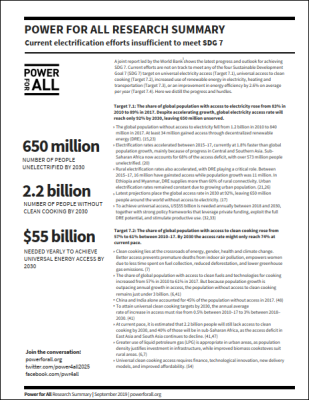
    Research Summary: SDG7 lagging far behind targets

    A report tracking progress toward SDG7 says the status quo will leave nearly 3 billion without electricity or clean cooking by 2030. To achieve universal access, the report added, US$55 billion is needed per year.

    A joint report led by the World Bank shows the latest progress and outlook for achieving SDG 7. Current efforts are not on track to meet any of the four Sustainable Development Goal 7 (SDG 7) target on universal electricity access (Target 7.1), universal access to clean cooking (Target 7.2), increased use of renewable energy in electricity, heating and transportation (Target 7.3), or an improvement in energy efficiency by 2.6% on average per year (Target 7.4). Here we distill the progress and hurdles.

    Para mayor información visitar el siguiente enlace:  

    https://www.powerforall.org/resources/research-summaries/research-summary-sdg7-lagging-far-behind-targets

    https://www.powerforall.org/application/files/3115/6931/5047/SDG_7_tracking_report1.pdf


  • Key World Energy Statistics 2019

    Key World Energy Statistics 2019

    IEA Key World Energy Statistics (KWES) is an introduction to energy statistics, providing top-level numbers across the energy mix, from supply and demand, to prices and research budgets, including outlooks, energy indicators and definitions.

    KWES is part of the IEA’s annual edition of the world’s most comprehensive series of energy databases and data services, which include World Energy Statistics and Balances and the full range of fuel information data services.

    Para mayor información visitar el siguiente enlace:  
    https://webstore.iea.org/key-world-energy-statistics-2019


  • The Ocean as a Solution for Climate Change: 5 Opportunities for Action

    The Ocean as a Solution for Climate Change: 5 Opportunities for Action

    An innovative analysis to quantify the additional contribution that ocean-based mitigation strategies, such as the installation of offshore wind turbines, and protection of mangroves, coral reefs and seagrasses can play in reducing the global emissions gap.

    But also the range of other direct benefits that such strategies can deliver for people and ocean ecosystems. 

    Para mayor información visitar el siguiente enlace:  
    http://www.oceanpanel.org/climate

    http://dev-oceanpanel.pantheonsite.io/sites/default/files/2019-09/19_HLP_Report_Ocean_Solution_Climate_Change_final.pdf


  • BIOFUELS BAROMETER

    BIOFUELS BAROMETER

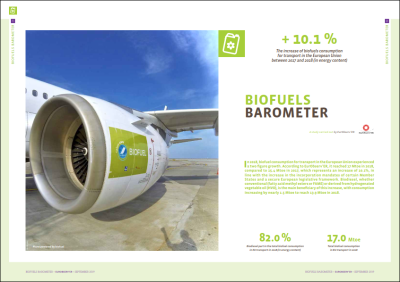
    In 2018, biofuel consumption for transport in the European Union experienced a two figure growth. According to EurObserv’ER, it reached 17 Mtoe in 2018, compared to 15.4 Mtoe in 2017, which represents an increase of 10.1%, in line with the increase in the incorporation mandates of certain Member States and a secure European legislative framework.

    Biodiesel, whether conventional (fatty acid methyl esters or FAME) or derived from hydrogenated vegetable oil (HVO), is the main beneficiary of this increase, with consumption increasing by nearly 1.5 Mtoe to reach 13.9 Mtoe in 2018.

    Para mayor información visitar el siguiente enlace:  
    https://t.co/tTrN8K1KOH?amp=1


  • Delivering Customer Value in Digital times Evolving landscapes in European

    Delivering Customer Value in Digital times Evolving landscapes in European

    The European telecoms sector has evolved significantly over recent years – it is a sector characterised by evolving service, improved trust and enhanced customer relationships. 

    This study, while recognising the complexity of delivering sophisticated telecoms services, provides facts and figures on an often untold story: the
    comprehensive and growing value consumers receive from telecommunications services – realised as a direct result of strong competition between providers, innovation and considerable ongoing investments in networks and services.

    Para mayor información visitar el siguiente enlace:  


    https://t.co/5F6378N0gQ


  • The Mobile Economy Sub-Saharan Africa 2019

    The Mobile Economy Sub-Saharan Africa 2019

    Sub-Saharan Africa will remain the fastest growing region, with a CAGR of 4.6% and an additional 167 million subscribers over the period to 2025. This will take the total subscriber base to just over 600 million, representing around half the population.

    During 2019, 3G will overtake 2G to become the leading mobile technology in the region, with just over 45% of total connections by the end of the year. 3G adoption has doubled over the last two years as a result of network coverage expansion and cheaper devices.

    Para mayor información visitar el siguiente enlace:  


    https://www.gsma.com/r/mobileeconomy/sub-saharan-africa/

    https://www.gsmaintelligence.com/research/?file=36b5ca079193fa82332d09063d3595b5&download


  • The Global Disinformation Order: 2019 Global Inventory of Organised Social Media

    The Global Disinformation Order: 2019 Global Inventory of Organised Social Media

    Over the past three years, we have monitored the global organization of social media manipulation by governments and political parties. Our 2019 report analyses the trends of computational propaganda and the evolving tools, capacities, strategies, and resources.

    1. Evidence of organized social media manipulation campaigns which have taken place in 70 countries, up from 48 countries in 2018 and 28 countries in 2017. In each country, there is at least one political party or government agency using social media to shape public attitudes domestically.
    2. Social media has become co-opted by many authoritarian regimes. In 26 countries, computational propaganda is being used as a tool of information control in three distinct ways: to suppress fundamental human rights, discredit political opponents, and drown out dissenting opinions.

    Para mayor información visitar el siguiente enlace:  

    https://comprop.oii.ox.ac.uk/research/cybertroops2019/

    https://comprop.oii.ox.ac.uk/wp-content/uploads/sites/93/2019/09/CyberTroop-Report19.pdf


  • 2019 Mobile Industry SDG Impact Report

    2019 Mobile Industry SDG Impact Report

    La electrificación del transporte público es fundamental para descarbonizar la movilidad urbana. Aunque el mercado nacional de autobuses eléctricos (e-bus) en la India es incipiente, las proyecciones indican que 4 de cada 10 autobuses vendidos en el país podrían ser eléctricos para 2030. Este estudio de caso proporciona una descripción general de la motivación de la ciudad, el proceso de planificación y las licitaciones y contratos; resume los facilitadores y desafíos clave; cuantifica los beneficios económicos, ambientales y de salud pública; e incluye testimonios y próximos pasos.

    Pune’s public transport agency, Pune Mahanagar Parivahan Mahamandal Limited (PMPML), currently has 220 e-buses operating in its fleet of 2,169 buses — one of the largest municipal e-bus fleets operating in India. Once PMPML commissions the remaining 430 e-buses it has tendered, Pune will be on track to meet the target outlined in the state government’s electric vehicle policy — 25 percent electrification of the public transport bus fleet by 2025 — three years ahead of schedule.

    The ongoing uptake of mobile and mobile-enabled services around the world has seen the mobile industry increase its contribution to all 17 UN Sustainable Development Goals (SDGs) over the last year. The industry has continued to transform the lives of billions around the world. However, progress must be accelerated if the industry is to fully maximise its impact by 2030.

    Since the mobile industry committed to achieving the United Nations Sustainable Development Goals in 2016, the sector has been measuring progress annually. This fourth edition highlights the role mobile technology and connectivity in meeting the targets of the SDGs. It also highlights SDG 13: Climate Action and how mobile technology is providing the backbone to a modern, global economy and a zero-carbon future.

    Para mayor información visitar el siguiente enlace:   


    https://www.gsma.com/betterfuture/2019sdgimpactreport/?utm_source=social&utm_medium=twitter&utm_campaign=sdgimpactreportretargeting

    https://gsmaintelligence.com/research/?file=a60d6541465e86561f37f0f77ebee0f7&download


Busca los documentos, noticias y tendencias más relevantes del sector eléctrico

Buscador de documentos
Buscador de noticias y tendencias

Banco de Información

Descripción del semáforo tecnológico

Los documentos se clasifican en varios colores tipo semáforo tecnológico que indican el nivel de implementación de la tecnología en el país

Tecnología en investigación que no ha sido estudiado o reglamentado por entidades del sector.

La tecnología se aplica de manera focal y se encuentra en estudio por parte de las entidades del sector.

La tecnología se aplica de manera escalable y se encuentran políticas y regulaciones focales establecidas.

La tecnología se aplica a través de servicios  y se encuentran políticas y regulaciones transversales establecidas.

La tecnología se aplica de manera generalizada  y se tiene un despliegue masivo de esta.

Para acceder a todos los documentos publicados y descargarlos ingresa aquí