Autor: Luisa Buitrago

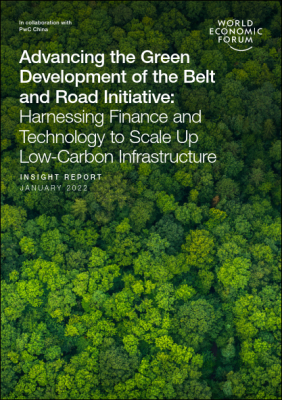
  • Advancing the Green Development of the Belt and Road Initiative: Harnessing Finance and Technology to Scale Up Low-Carbon Infrastructure 

    Advancing the Green Development of the Belt and Road Initiative: Harnessing Finance and Technology to Scale Up Low-Carbon Infrastructure 

    Este informe destaca las tecnologías de baja emisión de carbono, los desarrollos financieros verdes y los entornos propicios, así como el ecosistema más amplio de partes interesadas necesario para el desarrollo verde de la BRI.  

    A massive global infrastructure investment of $66 trillion is needed in emerging economies before 2030. The Belt and Road Initiative (BRI) offers a new development paradigm by investing in green infrastructure, which is necessary to avoid the irreversible carbon lock-in effect on global climate change.  These are illustrated by engaging case studies based on interviews with Green Investment Principles signatories, multilateral development banks and selected organizations that are harnessing cutting-edge business models to achieve decarbonization and the SDGs. The report is a call for knowledge development and further multistakeholder collaboration to build a sustainable future. 


    Para mayor información ingrese a los siguientes enlaces: 
    https://www.weforum.org/reports/advancing-the-green-development-of-the-belt-and-road-initiative-harnessing-finance-and-technology-to-scale-up-low-carbon-infrastructure 

    https://www3.weforum.org/docs/WEF_Advancing_the_Green_Development_of_the_Belt_and_Road_Initiative_2022.pdf  

  • Regulating corporate green claims and greenwashing – policy recommendations

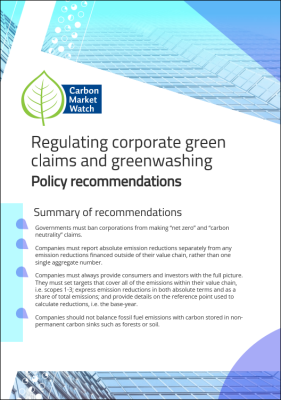
    Regulating corporate green claims and greenwashing – policy recommendations

    Este estudio brinda una serie de recomendaciones sobre políticas ambientales: Los gobiernos deben prohibir a las empresas hacer afirmaciones de «cero neto» y «neutralidad de carbono». Las empresas deben informar de las reducciones de emisiones absolutas por separado de cualquier reducción de emisiones financiada fuera de su cadena de valor, en lugar de una única cifra agregada. 

    Companies must always provide consumers and investors with the full picture. They must set targets that cover all of the emissions within their value chain,  i.e. scopes 1-3; express emission reductions in both absolute terms and as a share of total emissions; and provide details on the reference point used to calculate reductions, i.e. the base-year.Companies should not balance fossil fuel emissions with carbon stored in non-permanent carbon sinks such as forests or soil. 


    Para mayor información ingrese a los siguientes enlaces:
     

    https://carbonmarketwatch.org/publications/regulating-corporate-green-claims/

    https://carbonmarketwatch.org/wp-content/uploads/2022/02/Regulating-corporate-claims-policy-recs.pdf  

  • Debt Management Institutions in Latin America and the Caribbean: A Comparative Analysis

    Debt Management Institutions in Latin America and the Caribbean: A Comparative Analysis

    Este documento presenta el primer esfuerzo sistemático para analizar cómo se organizan estas oficinas y cómo desempeñan las funciones cruciales de la gestión de la deuda: desarrollar y ejecutar la estrategia de gestión de la cartera de pasivos de los Estados y de los nuevos empréstitos. 

     Public debt management is one of the most crucial functions of any government, but we know little about how debt management offices operate. Based on a survey of 24 Latin American and Caribbean countries. The evidence indicates that, although institutional capacity to manage public debt has improved in the region, the experience is uneven among countries. We conclude by highlighting potential areas for improvement. 


    Para mayor información ingrese a los siguientes enlaces: 


     https://publications.iadb.org/en/debt-management-institutions-latin-america-and-caribbean-comparative-analysis 

     https://publications.iadb.org/publications/english/document/Debt-Management-Institutions-in-Latin-America-and-the-Caribbean-A-Comparative-Analysis.pdf  

  • No net zero without SMEs

    No net zero without SMEs

    Este documento analiza la importancia de tener en cuenta a los empresarios y a las PYME en las políticas climáticas y medioambientales. Analiza los factores que impulsan y obstaculizan la iniciativa empresarial ecológica y la ecologización de las PYME, y examina las opciones políticas para apoyar estos objetivos.

    SMEs and entrepreneurs are of critical importance for reaching climate objectives. They have a significant environmental footprint on aggregate, but also make important contributions to reaching net zero through their innovations and greening efforts.  

     
    Para mayor información ingrese a los siguientes enlaces: 

     https://www.oecd-ilibrary.org/energy/no-net-zero-without-smes_bab63915-en  

    https://www.oecd-ilibrary.org/deliver/bab63915-en.pdf?itemId=%2Fcontent%2Fpaper%2Fbab63915-en&mimeType=pdf  

  • BiodiverCities by 2030: Transforming cities’ relationship with nature

    BiodiverCities by 2030: Transforming cities’ relationship with nature

    Este informe ofrece una visión de las ciudades del futuro y los cambios sistémicos necesarios para desarrollar BiodiverCities que sitúen la naturaleza en el centro de la toma de decisiones y de las inversiones en infraestructuras. El informe también expone cómo los líderes urbanos públicos y privados pueden utilizar la naturaleza para reducir el impacto de sus ciudades en la biodiversidad, aumentar su resiliencia climática y obtener importantes beneficios económicos.

     Cities are the engine of the global economy – contributing 80% of the world’s GDP – but their exponential growth in recent decades has come at the expense of nature. The built environment has grown by two-thirds in the first 12 years of the 21st century, leading to the degradation of local ecosystems and the loss of habitats. Urban areas are also responsible for over 75% of global carbon emissions, accelerating climate change which drives further nature loss. 


    Para mayor información ingrese a los siguientes enlaces:
     

     https://www.weforum.org/reports/biodivercities-by-2030-transforming-cities-relationship-with-nature  

    https://www3.weforum.org/docs/WEF_BiodiverCities_by_2030_2022.pdf  

  • Report on Regulatory Frameworks for European Energy Networks 2021 

    Report on Regulatory Frameworks for European Energy Networks 2021 

    Este informe ofrece una visión general de los regímenes reguladores aplicados en 2021 y de la evolución de la eficiencia requerida, y analiza la determinación global de los costes de capital en los Estados miembros de la UE, Gran Bretaña, Irlanda del Norte, Islandia, Noruega y ocho miembros del Consejo Regulador de la Comunidad de la Energía (CRCE).

    A major focus is placed on the calculation of an adequate rate of return (RoR), the determination of the regulatory asset base (RAB) and the depreciation of assets in the different  regulatory regimes. Other important individual parameters and new incentive mechanisms presented in this study should be interpreted in the context of a whole country-specific regulatory regime. Some contents only reflect an ex-ante approach for 2021, while ex post calculations are yet to be performed. This report also serves as a background paper to CEER work on incentives, both in a quantitative as well as in a qualitative way.  


    Para mayor información ingrese al siguiente enlace:
     

     https://www.ceer.eu/documents/104400/-/-/ae4ccaa5-796d-f233-bfa4-37a328e3b2f5  

  • Electrification Considerations for Premise Service Sizing in Residential Applications

    Electrification Considerations for Premise Service Sizing in Residential Applications

    La reciente y acelerada adopción de tecnologías de uso final de la electricidad en los locales residenciales, como los vehículos eléctricos y las bombas de calor para el acondicionamiento de espacios, están dando lugar a preguntas sobre la adecuación del tamaño del servicio eléctrico existente para acomodar la expansión.

    This brief is intended to explain the process by which such determinations are made and to provide general knowledge and guidance for those involved in electrification efforts


    Para mayor información ingrese al siguiente enlace:
     

     https://www.epri.com/research/products/000000003002017638 

  • Electricity Market Report

    Electricity Market Report

    El año 2021 supuso una demanda excepcional para los mercados eléctricos de todo el mundo. El fuerte crecimiento económico, combinado con inviernos más fríos y veranos más cálidos, impulsó la demanda mundial de electricidad en más de un 6%, el mayor aumento desde la recuperación de la crisis financiera en 2010.

    Building on our analysis of these recent events, the January 2022 edition of the IEA Electricity Market Report presents our forecasts for demand, supply and emissions in global electricity markets through 2024. While renewables are set to meet the vast majority of the increase in global electricity demand in the coming years, this trend would only result in a plateauing of emissions from electricity generation. That is insufficient for the power sector to fulfil its critical role as a leading force in the decarbonisation of economies around the world.


    Para mayor información ingrese a los siguientes enlaces:

    https://www.iea.org/reports/electricity-market-report-january-2022?utm_content=bufferf8217&utm_medium=social&utm_source=twitter.com&utm_campaign=buffer&s=09

    https://iea.blob.core.windows.net/assets/d75d928b-9448-4c9b-b13d-6a92145af5a3/ElectricityMarketReport_January2022.pdf

  • Maritime Electrification for Utilities Workshop Report

    Maritime Electrification for Utilities Workshop Report

    El 15 de septiembre de 2021 se celebró el Taller de Electrificación Marítima para Empresas de Servicios Públicos con el fin de reunir a las partes interesadas del sector marítimo y de las empresas de servicios eléctricos para debatir cómo trabajar juntos de forma más eficaz para lograr una mayor reducción de los gases de efecto invernadero (GEI) a través de la electrificación de las actividades marítimas.

    In the coming decades, seaports are likely to see significant increases in electrical energy demand due to three main drivers.

    • electrification and hybridization of ships and cargo-handling equipment, which will require battery recharging
    • vessels connecting to shore power while at the dock (referred to as cold-ironing)
    • local production of alternative fuels, referred to as electrofuels, that can be produced through electrochemical conversion.


    This growth in demand will require maritime and electric utilities to work together in planning for infrastructure, charging times, rate structures, and other needs. The September 15, 2021 workshop invited maritime and electric utility stakeholders to discuss the opportunities for developing stronger partnerships between electric utility and maritime stakeholders.


    Para mayor información ingrese al siguiente enlace:

    https://www.dnv.com/Publications/maritime-electrification-for-utilities-workshop-report-210721


  • Remote Home Energy Assessments

    Remote Home Energy Assessments

    Este informe investiga el potencial de las evaluaciones remotas de energía en el hogar, que ganaron popularidad durante la pandemia, pero que seguirán siendo una herramienta útil en el futuro. Utilizando fuentes de datos de múltiples partes interesadas, nuestra propia encuesta independiente que compara los receptores de las evaluaciones en persona y a distancia, y observaciones directas de las evaluaciones a distancia, examinamos la eficacia de las evaluaciones a distancia y cómo pueden mejorarse. 

    We find that remote assessments are not only necessary to expand the reach of energy efficiency, they are also effective, useful for encouraging energy upgrades, and liked by customers. They are an excellent option for utilities to provide alongside (or in addition to) in-person assessments, especially for certain demographic groups such as young and tech-savvy customers. We conclude with tips (in the report and summarized in a supplementary tips sheet) on how to use behavioral science to increase the likelihood of conversion following a remote assessment. 


    Para mayor información ingrese al siguiente enlace:
     

    https://www.aceee.org/research-report/b2102 

Busca los documentos, noticias y tendencias más relevantes del sector eléctrico

Buscador de documentos
Buscador de noticias y tendencias

Banco de Información

Descripción del semáforo tecnológico

Los documentos se clasifican en varios colores tipo semáforo tecnológico que indican el nivel de implementación de la tecnología en el país

Tecnología en investigación que no ha sido estudiado o reglamentado por entidades del sector.

La tecnología se aplica de manera focal y se encuentra en estudio por parte de las entidades del sector.

La tecnología se aplica de manera escalable y se encuentran políticas y regulaciones focales establecidas.

La tecnología se aplica a través de servicios  y se encuentran políticas y regulaciones transversales establecidas.

La tecnología se aplica de manera generalizada  y se tiene un despliegue masivo de esta.

Para acceder a todos los documentos publicados y descargarlos ingresa aquí