Autor: Luisa Buitrago

  • Flexible Nuclear Energy for Clean Energy Systems

    Flexible Nuclear Energy for Clean Energy Systems

    The Flexible Nuclear Energy for Clean Energy Systems report provides a collection of technical analyses that, in the aggregate, demonstrate the current and potential future roles for nuclear energy in providing flexibility in meeting energy demands. For the purposes of this report, flexibility is defined as:  The ability of nuclear energy generation to economically provide energy services at the time and location they are needed by end-users.

    These energy services can include both electric and nonelectric applications utilizing both traditional and advanced nuclear power plants and integrated systems.

    Para leer más ingrese a:
    https://www.nrel.gov/docs/fy20osti/77088.pdf

  • Mobilising institutional capital for renewable energy

    Mobilising institutional capital for renewable energy

    This report from the International Renewable Energy Agency (IRENA) considers ways to attract institutional investors into the sector on the necessary scale. Its recommendations are aimed at policy makers, public capital providers, capital market regulators and other stakeholders, including major institutional investors that could channel capital into renewables.

    Large-scale institutional investments would effectively inject long-term and relatively “patient” capital into renewables, lowering the overall financing costs for any given project. Renewable energy assets, in turn, can give institutional investors stable, long-term, “bond-like” returns.

    Para leer más ingrese a:

    https://www.irena.org/publications/2020/Nov/Mobilising-institutional-capital-for-renewable-energy

    https://www.irena.org/-/media/Files/IRENA/Agency/Publication/2020/Nov/IRENA_Mobilising_Institutional_Capital_2020.pdf

  • Resource Assessment for Hydrogen Production

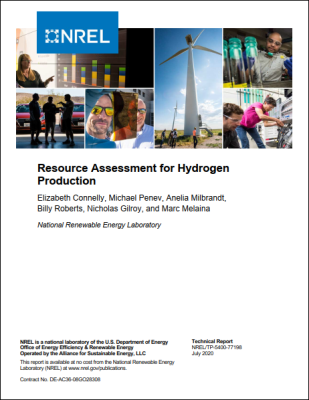
    Resource Assessment for Hydrogen Production

    The technical potential of hydrogen production from fossil, nuclear, and renewable energy resources is presented. Updated maps describe the geographical distribution of hydrogen production potential from renewable energy resources. The results conclude that the technical resource availability of domestic energy resources is sufficient to meet an additional 10 MMT of hydrogen demand in 2040, without placing significant pressure on existing resources.

    While this level of hydrogen demand could result in a significant increase in renewable energy consumption in particular, the technical potential of each resource is estimated to be sufficient to meet the demand.  Future research, to enable the large-scale integration of hydrogen in the U.S. energy and other sectors, will include analyzing the geographic distribution of resources in relation to hydrogen demand for a variety of applications.

    Para leer más ingrese a:

    https://www.nrel.gov/docs/fy20osti/77198.pdf

  • IR.67 DNS and ENUM Guidelines for Service Providers and GRX and IPX Providers v17.0

    IR.67 DNS and ENUM Guidelines for Service Providers and GRX and IPX Providers v17.0

    IR.67 provides guidelines and technical information for those who need to set up and/or maintain DNS servers for inter Service Provider services.

    Para leer más ingrese a:

    https://www.gsma.com/newsroom/resources/httpwww-gsma-comnewsroomwp-contentuploadsir-67-v17-0-pdf/

  • Distributed Energy Resource Cybersecurity Framework Best Practices

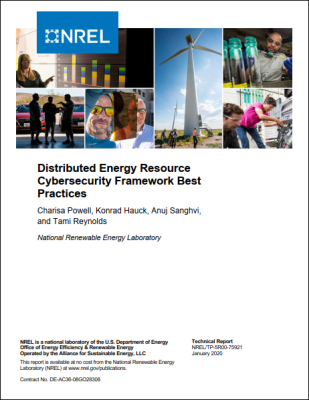
    Distributed Energy Resource Cybersecurity Framework Best Practices

    Integration of various systems and the cyber-physical security concerns they bring. Although frameworks exist for industrial control systems and other energy systems, a simple guided tool that can prioritize recommended actions for controls specific to DERs is lacking. Additionally, the novelty of the field has made it difficult to create a standardized procedure for DERs with cybersecurity in mind.

    In response to this critical need to address cybersecurity risk management, the National Renewable Energy Laboratory (NREL) has developed a framework and accompanying web application known as the Distributed Energy Resources Cybersecurity Framework (DERCF)1 (Powell, 2019). A brief overview of the DERCF can be found in Section 1.2.
    This document provides a guide to cybersecurity best practices identified by technical research and site visits where the framework was used to assess the cybersecurity posture of DER systems.

    Para leer más ingrese a:

    https://www.nrel.gov/docs/fy20osti/75921.pdf

  • Maximizing Distributed Energy Resource Value for All Stakeholders

    Maximizing Distributed Energy Resource Value for All Stakeholders

    As NREL staff explore technical aspects of the integration of distributed energy resources (DERs), we also wonder about the interaction of these technologies with the many stakeholders that are involved with DERs. And in pursuit of integrated and optimized power systems, these stakeholders must continue to discuss and determine whether and how to utilize and value DERs.

    To better understand these aspects of the DER landscape, NREL researchers assembled a diverse group of external stakeholders in May 2019 for a workshop titled Maximizing Distributed Energy Resource Value for All Stakeholders. To ensure a wide range of key perspectives would be present and able to encounter each other in a collaborative setting, we invited power sector representatives, state energy regulators, policymakers, DER aggregators and technology vendors, the green building community, and the research community.

    Para leer más ingrese a:

    https://www.nrel.gov/docs/fy20osti/76926.pdf

  • IEEE Power & Energy Magazine: November/December Issue

    IEEE Power & Energy Magazine: November/December Issue

    The overall theme of this issue is the integration of distributed energy resources (DERs). We have tackled this topic in IEEE Power & Energy Magazine through the years, and this latest issue represents the next progression in this important area affecting our industry.

    We have explored a number of interesting aspects of electrical power associated with the Niagara Falls area through the years in the pages of the “History” column. In this issue, Robert D. Barnett presents a view of the“loads” consumed by customers of the early hydroelectric generation plants near Niagara Falls. The article concentrates on early electrochemical fac-tories and the distribution methods to serve those loads.

    Para leer más ingrese a:

    https://engage.ieee.org/PES-Mag-PDF-Download.html

    https://www.nxtbook.com/fx/save/index.php?book_id=__NXT__5ff4e5401163c575e0b34b53b227ab63&pdf=1

  • Safety in the future

    Safety in the future

    The IEC has published a new white paper, Safety in the future, which examines the topic of safety in the new digital environment. It references current social trends and initiatives, such as the UN Sustainable Development Goals, as well as various real-life examples that are pioneering innovative safety solutions for the future.

    These solutions share the common understanding that the concept of safety will be delivered in an integrated system in which workers, machines and the environment collaborate.

    Para leer más ingrese a:

    https://basecamp.iec.ch/download/iec-white-paper-safety-in-the-future-en/

    https://basecamp.iec.ch/download/iec-white-paper-safety-in-the-future-en/?wpdmdl=2270&ind=1605613446606

  • Partnership against Cybercrime

    Partnership against Cybercrime

    The World Economic Forum created the Partnership against Cybercrime initiative to address the global challenge posed by cybercrime by exploring ways to amplify public-private cooperation against this crime and overcome existing barriers to cooperation.

    The initiative brought together key private- and public-sector stakeholders, including leading law enforcement agencies, international organizations, cybersecurity companies, service and platform providers, global corporations and not-for-profit alliances.
    The group’s approach was not only to understand the challenges, but also to design forward-looking and action-oriented solutions, presented in this report.

    Para leer más ingrese a:

    https://www.weforum.org/reports/partnership-against-cybercrime

    http://www3.weforum.org/docs/WEF_Partnership_against_Cybercrime_report_2020.pdf

  • Utility-Scale Solar Data Update: 2020 Edition

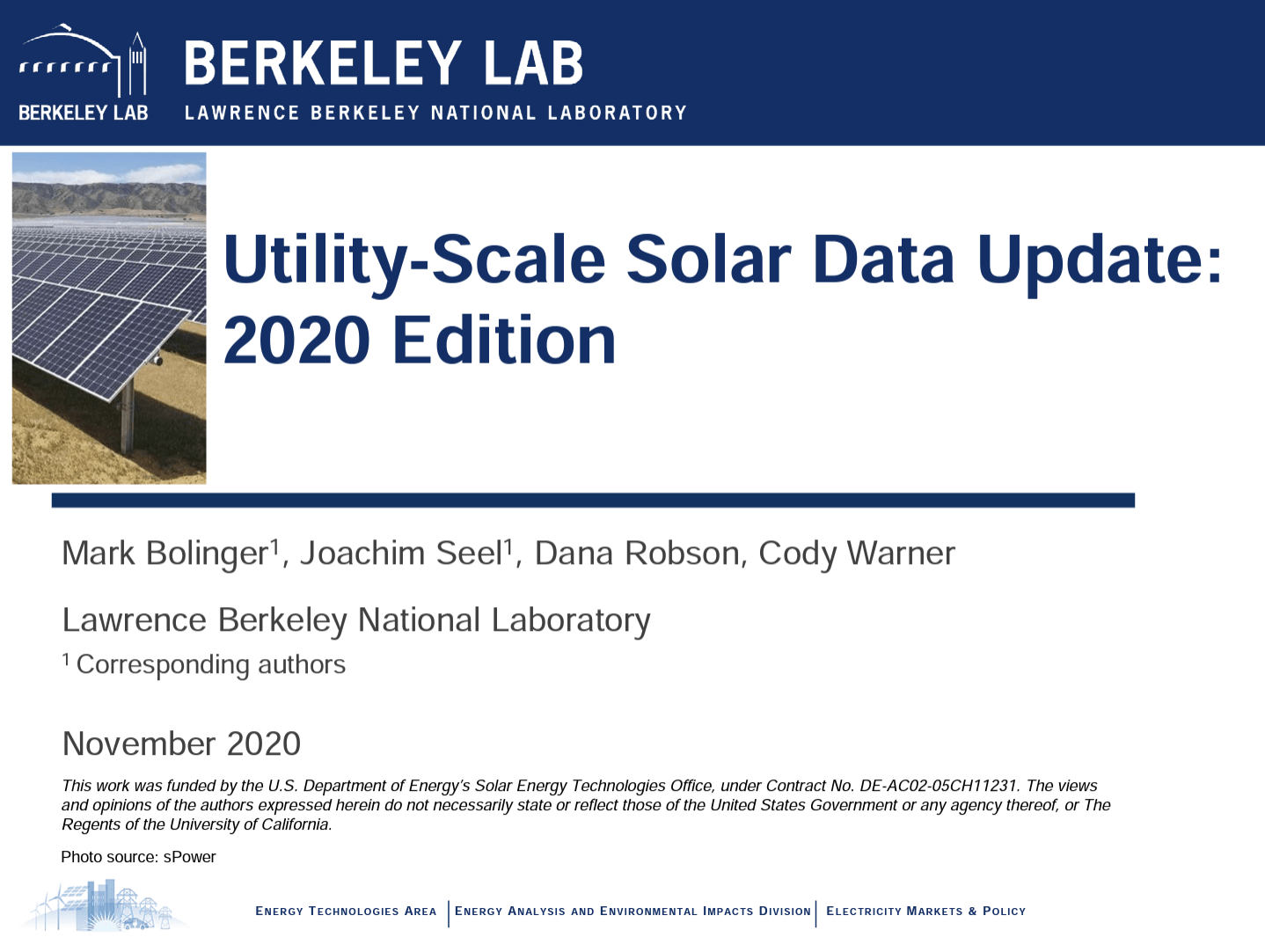
    Utility-Scale Solar Data Update: 2020 Edition

    Berkeley Lab’s 2020 update of utility-scale solar data and trends provides an overview of key trends in the U.S. market, with a focus on 2019. You can find a comprehensive data file and a briefing deck summarizing select insights on the Files tab, below. Highlights of this year’s update include:

        More than 4.5 GWAC of utility-scale solar (i.e., ground-mounted solar projects larger than 5 MWAC) achieved commercial operations in 2019, bringing cumulative capacity to 29 GWAC.  Projects are spread across all 10 regions that we track, though more heavily concentrated in the sunniest regions.
        The median installed cost of projects that came online in 2019 fell to $1.4/WAC ($1.2/WDC), down 20% from 2018 and down by more than 70% from 2010. 77% of projects and 88% of capacity added in 2019 used single-axis tracking.

    Para leer más ingrese a:

    https://emp.lbl.gov/publications/utility-scale-solar-data-update-2020

    https://eta-publications.lbl.gov/sites/default/files/2020_utility-scale_solar_data_update.pdf

Busca los documentos, noticias y tendencias más relevantes del sector eléctrico

Buscador de documentos
Buscador de noticias y tendencias

Banco de Información

Descripción del semáforo tecnológico

Los documentos se clasifican en varios colores tipo semáforo tecnológico que indican el nivel de implementación de la tecnología en el país

Tecnología en investigación que no ha sido estudiado o reglamentado por entidades del sector.

La tecnología se aplica de manera focal y se encuentra en estudio por parte de las entidades del sector.

La tecnología se aplica de manera escalable y se encuentran políticas y regulaciones focales establecidas.

La tecnología se aplica a través de servicios  y se encuentran políticas y regulaciones transversales establecidas.

La tecnología se aplica de manera generalizada  y se tiene un despliegue masivo de esta.

Para acceder a todos los documentos publicados y descargarlos ingresa aquí