Autor: Luisa Buitrago

  • Renewable Energy and Jobs – Annual Review 2020

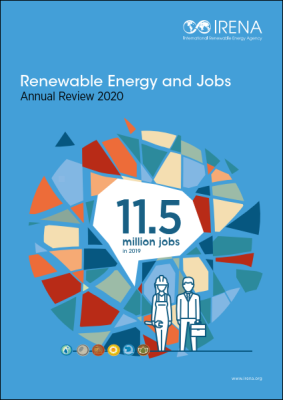
    Renewable Energy and Jobs – Annual Review 2020

    Renewable energy technologies create jobs and up and down the supply chain and can spur broad and sustainable social and economic development. Renewables accounted for an estimated 11.5 million jobs worldwide in 2019, up from 11 million the previous year, according to this seventh edition of the Renewable Energy and Jobs series.
    While few large markets still account for the bulk those jobs, employment in renewables has started spreading more widely, especially through the proliferation of solar photovoltaic (PV) panels. Solar PV accounted for 33% of the world’s renewable energy workforce in 2019. Asia accounted for 63% of total jobs in renewables.

    Off-grid decentralised renewables account for increasing numbers of direct jobs, especially in Africa, as well as propelling employment in agro-processing, health care, communications, local commerce and other productive uses, the report finds. Latin American renewables jobs are concentrated in biofuels and hydropower.
    Employment opportunities are a key consideration in planning for low-carbon economic growth. Many governments have prioritised renewable energy development, firstly to reduce emissions and meet international climate goals, but also in pursuit of broader socio-economic benefits. Renewables could support an improved gender balance in the future energy sector. Women currently hold an estimated 32% of the world’s renewable energy jobs.
    To build the skills base for the transition from fossil fuels to renewables, countries will need more vocational training, stronger curricula, more teacher training and expanded use of information and communications technology for remote learning. The COVID-19 pandemic has underlined the need for renewables to meet social, economic and environmental needs.

    Para leer más ingrese a:

    https://www.irena.org/publications/2020/Sep/Renewable-Energy-and-Jobs-Annual-Review-2020?s=09

    https://www.irena.org/-/media/Files/IRENA/Agency/Publication/2020/Sep/IRENA_RE_Jobs_2020.pdf

  • Sistemas de almacenamiento como infraestructura de transmisión

    Sistemas de almacenamiento como infraestructura de transmisión

    Es un hecho que, durante la última década, las energías renovables (ER) han tenido un increíble despegue, fuera de todo pronóstico. A la fecha, el país cuenta con alrededor de 3.000 MW de capacidad instalada de energía solar fotovoltaica y 2100 MW de eólica (entre proyectos de pequeña y gran escala) en operación. En términos de energía anual, todo apunta a que este año 2020 se superará la meta de abastecer la demanda eléctrica con un 20% de ER, esto es, 5 años antes de la meta establecida.

    Una de las principales estadísticas que da cuenta del acelerado desarrollo que están experimentando en Chile las ER es la cantidad de centrales declaradas en construcción y cómo ha evolucionado esta declaración en los últimos 6 meses. En la Figura 1 se presenta la capacidad total acumulada que se agregaría al sistema durante el periodo 2020-2021 y cómo ésta ha cambiado según las resoluciones exentas publicadas por la Comisión Nacional de Energía (CNE) desde Enero a Junio de 2020.

    Para leer más ingrese a:

    https://www.spec.cl/SPEC-TX-ESS.pdf

  • Shaping the digital transformation in Europe

    Shaping the digital transformation in Europe

    The Commission is publishing a report done by their independent consultant on the macro-economic potential of the digital transformation of the European economy. The paper looks into the challenges that the EU faces, including the COVID-19 implications, and the ways to address them to achieve the aims set out in the strategy on Shaping Europe’s Digital Future.

    The analysis shows that by 2030, the cumulative additional GDP contribution of such digital technologies could amount to €2.2 trillion in the EU (equivalent to the 2019 combined GDP of Spain and the Netherlands). Raising the investment level of private and public actors in digital technologies and skills is essential to see this happen. E-health solutions in Germany and France alone can bring savings of €55 billion, while only 5% of disclosed financing in automated and mobility technology happens in Europe. To achieve this, the analysis shows that Member States and the EU will need to contribute approximately €75 billion per year for ICT investment in the next decade, and €42 billion per year to educate, upskill and reskill the labour force to manage the digital transition.

    Para leer más ingrese a:

    https://ec.europa.eu/digital-single-market/en/news/commission-publishes-analysis-macro-economic-potential-digital-transformation-independent?s=09

    https://ec.europa.eu/newsroom/dae/document.cfm?doc_id=69479

  • Engaging communities to encourage behaviour change Digital Social Market Playbook

    Engaging communities to encourage behaviour change Digital Social Market Playbook

    This guide shows how the lighthouse cities of Milan, Lisbon and London each used the digital social market (DSM) as a citizen engagement tool to encourage positive behaviour change.

    This sums up their experiences so that other cities may employ a similar solution. Watch the Digital Social Market webinar to learn more about the tool.

    Para leer más ingrese a:

    http://www.sharingcities.eu/sharingcities/resources?s=09

    http://nws.eurocities.eu/MediaShell/media/Sharing_Cities_DSM_Playbook_2020.pdf

  • Clasificacion de datos

    Clasificacion de datos

    Este documento técnico busca entregar orientación para el desarrollo de un sistema de clasificación de datos con el fin de garantizar el acceso y la protección de la información generada y procesada por los gobiernos.

    El whitepaper examina los enfoques de clasificación de datos existentes a nivel nacional e internacional, con el fin de ofrecer la clasificación de datos como una herramienta funcional, y los medios para evitar riesgos potenciales como la clasificación de información excesiva o insuficiente.

    Para leer más ingrese a:

    https://www.oas.org/es/sms/cicte/docs/ESP-Clasificacion-de-Datos.pdf

  • Sustainable Energy Management System

    Sustainable Energy Management System

    Sustainable Energy Management Systems allow energy managers to control the way energy assets are operated across the network.

    This playbook summarises how Sharing Cities deployed SEMS in London, Lisbon and Milan. Cities can use this research to design similar integrated systems for their local districts. Watch the SEMS webinar to learn more about how SEMS was implemented in our lighthouse cities

    Para leer más ingrese a:

    http://www.sharingcities.eu/sharingcities/resources?s=09http://nws.eurocities.eu/MediaShell/media/SharingCities_Retrofit_playbook_2020.pdf

    http://www.sharingcities.eu/sharingcities/resources?s=09http://nws.eurocities.eu/MediaShell/media/SharingCities_Retrofit_playbook_2020.pdf

  • The Netherlands 2020 Energy Policy Review

    The Netherlands 2020 Energy Policy Review

    The IEA regularly conducts in-depth peer reviews of the energy policies of its member countries. This process supports energy policy development and encourages the exchange of best practices and experiences to help drive secure and affordable energy transitions.

     The country’s 2019 Climate Agreement defines policies and measures to support the achievement of these emissions reductions and was developed through a collaborative process involving parties from across Dutch society.
    The Netherlands has made notable progress on its transition to a carbon-neutral economy. In this report, the IEA provides a range of energy policy recommendations to help the Netherlands smoothly manage the transition to an efficient and flexible carbon-neutral energy system.

    Para leer más ingrese a:

    https://www.iea.org/reports/the-netherlands-2020

    https://webstore.iea.org/download/direct/4189

  • Bundling Competitive Supply and Distributed Energy Resources

    Bundling Competitive Supply and Distributed Energy Resources

    Texas businesses often pursue one of two distinct energy strategies. One approach focuses on competitive supply, which can offer low and predictable rates. The other encompasses distributed energy resources (DERs), such as backup generators, energy storage, or microgrids, which are technologies that enhance energy reliability and sustainability.

    Your business may have flexible resources that you might not necessarily think of as DERs, An experienced supplier can undertake arrange of strategies to manage electricity supply with DERs; some involve accruing revenue, others offsetting costs. The supplier may also use DERs to target specific aspects of a facility’s utility bill.
    In this paper, NRG describes a more effective way, a cohesive and flexible energy strategy that bundles and coordinates your supply and DERs. Managing these resources together achieves benefits beyond their individual value.

    Para leer más ingrese a:

    https://microgridknowledge.com/white-paper/competitive-supply-distributed-energy-resources/

    https://microgridknowledge.com/wp-content/uploads/2020/09/DERs-in-ERCOT-Whitepaper_NRG.pdf

  • Integrated DER: Orchestrating the Grid’s Last Mile

    Integrated DER: Orchestrating the Grid’s Last Mile

    The global power and utilities industry is changing dramatically, moving from centralized to decentralized decision makers managing distributed energy resources (DER). The diversity embedded in these DER portfolios is a challenge and a great opportunity. These DER assets can support a variety of mutually shared value propositions in the new energy landscape.

    This white paper lays out a roadmap to greater realization of integrated DER (iDER), which describes a more dynamic system of DER than was necessary in the past—a system that coordinates seamlessly with the bulk grid. The vision embedded in iDER represents a platform for ambitious ventures into system orchestration and value creation in the future energy system.

    Para leer más ingrese a:

    https://guidehouseinsights.com/reports/integrated-der-orchestrating-the-grids-last-mile?utm_campaign=GI_US_0921_WP-iDER-20_EMAIL&utm_medium=email&utm_source=Eloqua

    https://guidehouseinsights.com/-/media/project/navigant-research/reportfiles/guidehouse-integrated-der-white-paper.pdf

  • Automotive Lithium ion Battery Recycling in the UK

    Automotive Lithium ion Battery Recycling in the UK

    From 2035 it is proposed that every new passenger car sold in the UK will be non-polluting – in practice, this means that new vehicles sold after 2035 will have a traction battery.

    Electric vehicle traction batteries can range in mass from 50kg to >600kg. Each of these batteries contain a significant amount of rare and strategic metals, that must be imported as the UK has no economically viable deposits.

    Para leer más ingrese a:

    https://t.co/oNkuW5T64F?amp=1&s=09

Busca los documentos, noticias y tendencias más relevantes del sector eléctrico

Buscador de documentos
Buscador de noticias y tendencias

Banco de Información

Descripción del semáforo tecnológico

Los documentos se clasifican en varios colores tipo semáforo tecnológico que indican el nivel de implementación de la tecnología en el país

Tecnología en investigación que no ha sido estudiado o reglamentado por entidades del sector.

La tecnología se aplica de manera focal y se encuentra en estudio por parte de las entidades del sector.

La tecnología se aplica de manera escalable y se encuentran políticas y regulaciones focales establecidas.

La tecnología se aplica a través de servicios  y se encuentran políticas y regulaciones transversales establecidas.

La tecnología se aplica de manera generalizada  y se tiene un despliegue masivo de esta.

Para acceder a todos los documentos publicados y descargarlos ingresa aquí