Autor: Luisa Buitrago

  • Creating Customer-Centric Electricity Regulation

    Creating Customer-Centric Electricity Regulation

    The electric industry is in a transition driven by several factors, including technology and innovation advances, ambitious policy goals, and the proliferation of renewable resources. Customers are also playing a part in the industry change as their preferences evolve, requiring new and different services from energy companies.

    In a report prepared for Edison Electric Institute, Guidehouse provided a survey of alternative regulatory mechanisms that have emerged as tools to respond to evolving customer needs and expectations as technology, policy, and market conditions continue to change.

    Para leer más ingrese a:

    https://guidehouse.com/insights/energy/2020/utilities-shift-to-more-customer-centric-future?s=09
    https://guidehouse.com/-/media/www/site/downloads/energy/2020/ghelectricityregulationforacustomercentricfuture.pdf

  • The economics of explicit demand-side flexibility in distribution grids : the case of mandatory curtailment for a fixed

    The economics of explicit demand-side flexibility in distribution grids : the case of mandatory curtailment for a fixed

    Demand-side flexibility can be incentivised to reduce the need for investment in distribution grids either implicitly or explicitly. Implicit demand-side flexibility is when prosumers react to price signals triggered by network tariffs. Explicit demand-side flexibility is when the DSO can contract flexibility. In this paper, we focus on one contractual arrangement: mandatory curtailment by the DSO for a fixed level of compensation. We develop a long-term bi-level equilibrium model. The upper level (UL) is a regulated DSO deciding on the network investment and/or curtailing consumers for a fixed level of compensation. The lower level (LL) consists of consumers, which can be prosumers or passive consumers. Prosumers can invest in solar PV and battery systems.

    They react to the network tariffs and to the compensation provided by the DSO for curtailing them. The regulated DSO anticipates the reaction of the consumers when investing in the network and when setting the level of curtailment. Network tariffs are set to recover the network costs and the payments made to consumers that have been curtailed. We find that the economics of explicit demand-side flexibility in distribution grids are positive, and they are more positive when tariffs are cost-reflective. This implies that we cannot avoid redesigning tariffs by using explicit demand flexibility. We also find that setting an appropriate level of compensation is difficult in the presence of prosumers and passive consumers. A level of compensation that is high enough for passive consumers will be gamed by prosumers.

    Para leer más ingrese a:

    https://fsr.eui.eu/publications/?handle=1814/67762

    https://cadmus.eui.eu/bitstream/handle/1814/67762/RSCAS%202020_45.pdf?sequence=1

  • Citizen science and citizen engagement

    Citizen science and citizen engagement

    Inclusiveness on all levels underpins SwafS. We need science education for all, gender equality in our organisations, ethics and integrity embedded in research, communication we can trust, open science and ultimately place citizens at the core to ensure excellent Research and Innovation to tackle the challenges of today for a better future.

    Europe can only thrive by matching the immense potential of science with the values, needs, and aspirations of society. Horizon Europe must strengthen efforts to tap into the vast potential citizens have to offer and ensure effective cooperation between science and society. This document reports on the Horizon 2020 Science with and for Society (SwafS), citizen science and citizen engagement project portfolio results.

    Para leer más ingrese a:

    https://op.europa.eu/en/publication-detail/-/publication/c30ddc24-cbc6-11ea-adf7-01aa75ed71a1/language-en?s=09

  • COVID-19: Flexibility and The Grid—Improving Available Flexibility for Abnormal Grid Operating Conditions

    COVID-19: Flexibility and The Grid—Improving Available Flexibility for Abnormal Grid Operating Conditions

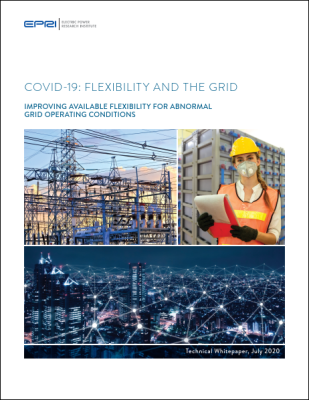
    While the full extent of operational lessons from the COVID-19 pandemic have yet to be experienced, some learnings are already noteworthy. In particular:   Despite substantial drops in demand and amid an ongoing growth in the installed capacity of variable renewables, most operational conditions do not pose an extraordinary challenge to normal, reliable grid operation.

          In certain locations and subregions, during low de- mand conditions, the potential for over-supply or low net-demand related operational risks may emerge in some periods.
        To prepare for those outlier conditions, grid operators should have certainty and  clarity about  procedures to control distributed energy and ‘contractually pro- tected’ resources in emergency conditions. If possible, this should be codified in grid connection codes or operations security standards.
        Consideration should be given to opportunities to secure access to additional flexibility for prolonged, abnormal operating conditions when market, contrac- tual, or scheduling processes are not suspended.
        Generation availability may be affected in the near- to mid-term by reduced maintenance programs or by financial issues owing to lower running hours for mar- ginal generation. These factors may warrant a cautious approach to future resource adequacy assessments.

    Para leer más ingrese a:

    https://www.epri.com/research/programs/067417/results/3002019550?utm_campaign=EPRI%20Direct&utm_medium=email&_hsmi=91772872&_hsenc=p2ANqtz-92QnNyGfpA3Fzxg1Z-a4FBFVctjXNN7DOczB2OLNJLvybbK2VcIcGFIGPg3LeVigBWygksXIrTlaeP6ZrDZfU8wB9E4VMEdPadpC-IF0gNuE8xcfE&utm_content=91772560&utm_source=hs_email

  • Enabling Air Traffic Management (ATM) data services : main takeaways from the second virtual workshop

    Enabling Air Traffic Management (ATM) data services : main takeaways from the second virtual workshop

    Over the past two years (2018-2019) European aviation has been confronted with serious capacity challenges and high levels of delay. Subsequently, the Covid-19 pandemic has revealed that the European airspace system lacks resilience and the ability to absorb demand shocks, be these in the form of increases or drops in air traffic. The provision of Air Traffic Management (ATM) data services holds the potential to boost the system’s resilience while enabling the development of virtual centers.

    Virtual centers, in turn, can make it possible to shift capacities in times of crisis of the kind we are facing today, where, for instance, a significant reduction of the capacity in one center may be needed. Building upon the first workshop on Enabling ATM Data Services, this second workshop aimed to share the latest progress made on the European Commission’s study as well as to provide an opportunity for an open discussion with key stakeholders. This brief summarises the presented results and captures the main reactions received to the study.

    Para leer más ingrese a:

    https://fsr.eui.eu/publications/?handle=1814/67775

    https://cadmus.eui.eu/bitstream/handle/1814/67775/PB_2020_33_FSR.pdf?sequence=1

  • Getting our act together on the EU interoperability acts

    Getting our act together on the EU interoperability acts

    In this policy brief, we argue that the acts should be ambitious in addressing the multiple dimensions of interoperability and that we can draw inspiration from existing experience with interoperability in the electricity and the healthcare sectors. We also provide governance recommendations. First, different multi-dimensional interoperability frameworks exist. While they agree that full interoperability can only be achieved if all dimensions are addressed, they do not agree on either the number of dimensions or on labelling them. We do not propose an additional framework but identify commonalities across the frameworks that need to be addressed to achieve full interoperability of energy services within the Union. Second, experience shows that different use cases can inspire different solutions.

    We focus on the North American Green Button initiative for utility customer data and ENTSO-E’s experience in supporting network code requirements for the exchange of market and network data. Moreover, experience with interoperability in healthcare is very advanced and can serve as an inspiration for energy, especially regarding interoperability testing and governance. Third, governance is a key issue in achieving interoperability. The existing governance mainly covers stakeholder dialogue and European standardisation. We provide ideas on how to use the EU interoperability acts to step up these efforts. In addition, we think governance should be extended to include formalisation of best practices, implementation monitoring and reporting, and interoperability testing. This governance could be taken on by a new EU entity.

    Para leer más ingrese a:

    https://fsr.eui.eu/publications/?handle=1814/67774

    https://cadmus.eui.eu/bitstream/handle/1814/67774/PB_2020_30_FSR.pdf?sequence=1

  • Q4 2019/Q1 2020 Solar Industry Update

    Q4 2019/Q1 2020 Solar Industry Update

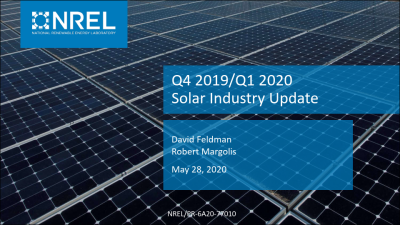
    Each quarter, the National Renewable Energy Laboratory (NREL) conducts the Quarterly Solar Industry Update, a presentation of technical trends within the solar industry, to the solar office staff.

    Each presentation focuses on global and U.S. supply and demand, module and system price, investment trends and business models, and updates on U.S. government programs supporting the solar industry.

    Para leer más ingrese a:

    https://www.energy.gov/eere/solar/quarterly-solar-industry-update

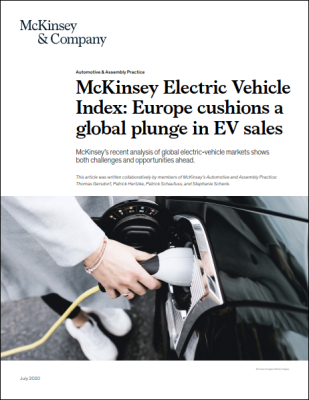
  • McKinsey Electric Vehicle Index: Europe cushions a global plunge in EV sales

    McKinsey Electric Vehicle Index: Europe cushions a global plunge in EV sales

    McKinsey’s proprietary Electric Vehicle Index (EVI) assesses the dynamics of the e-mobility market in 15 key countries worldwide (for more information on the metrics evaluated, see sidebar “What is the Electric Vehicle Index?”).

    EVI results for 2019 and the first quarter of 2020 provide important insights about market growth, regional demand patterns, market share for major electric-vehicle (EV) manufacturers, and supply-chain trends.

    Para leer más ingrese a:

    https://www.mckinsey.com/industries/automotive-and-assembly/our-insights/mckinsey-electric-vehicle-index-europe-cushions-a-global-plunge-in-ev-sales?cid=other-soc-twi-mip-mck-oth—&sid=3509879432&linkId=94483019&s=09

  • Consumer Guide to Electric Vehicles, April 2020 (Spanish Translation)

    Consumer Guide to Electric Vehicles, April 2020 (Spanish Translation)

    Electric vehicles (EVs) are fun to drive, safe, comfortable, and convenient to refuel. They also cost less to operate per mile and produce no tailpipe emissions. Electric cars are available in almost every vehicle class, from subcompact to SUV. Today’s electric cars do everything a gas car can do—and more. Drivers love the high performance, the silent, instant acceleration, and the additional technology and safety features associated with electric vehicles.

    A growing network of public charging sites nationwide lets more consumers consider purchasing an electric car, though most EV drivers tend to charge at home—because it’s convenient, and it usually saves money. By replacing gasoline with domestic electricity, EVs cut fossil-fuel use and emissions, which benefits public health. Electrifying all forms of transport could reduce greenhouse gas emissions in 2050 by 57% versus 2015 levels. About 46 EV models are available new today and 127 models, including pickup trucks, are expected by 2023.

    Para leer más ingrese a:

    https://www.epri.com/research/products/3002009442

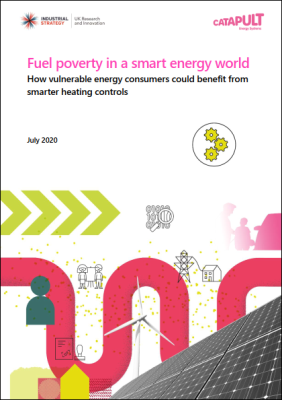
  • Fuel poverty in a smart energy world

    Fuel poverty in a smart energy world

    Smart heating controls, while not yet commonplace, are growing in popularity in UK homes. While many households currently put up with a below par heating experiences because they find traditional heating controls confusing and hard to use, smart heating can give households room-by-room control of comfort and cost.

    This research fills that gap – conducted for the Energy Revolution Integration Service to inform Smart Local Energy System innovation projects. It explores how vulnerable households use smart heating controls and how they could benefit from future smart energy services (e.g. room-by-room control and advanced information about the cost of different ways of heating their home).

    Para leer más ingrese a:

    https://es.catapult.org.uk/reports/fuel-poverty-in-a-smart-energy-world/

Busca los documentos, noticias y tendencias más relevantes del sector eléctrico

Buscador de documentos
Buscador de noticias y tendencias

Banco de Información

Descripción del semáforo tecnológico

Los documentos se clasifican en varios colores tipo semáforo tecnológico que indican el nivel de implementación de la tecnología en el país

Tecnología en investigación que no ha sido estudiado o reglamentado por entidades del sector.

La tecnología se aplica de manera focal y se encuentra en estudio por parte de las entidades del sector.

La tecnología se aplica de manera escalable y se encuentran políticas y regulaciones focales establecidas.

La tecnología se aplica a través de servicios  y se encuentran políticas y regulaciones transversales establecidas.

La tecnología se aplica de manera generalizada  y se tiene un despliegue masivo de esta.

Para acceder a todos los documentos publicados y descargarlos ingresa aquí