Autor: DIFUSIÓN COLOMBIA INTELIGENTE

  • Powering progress with data

    Powering progress with data

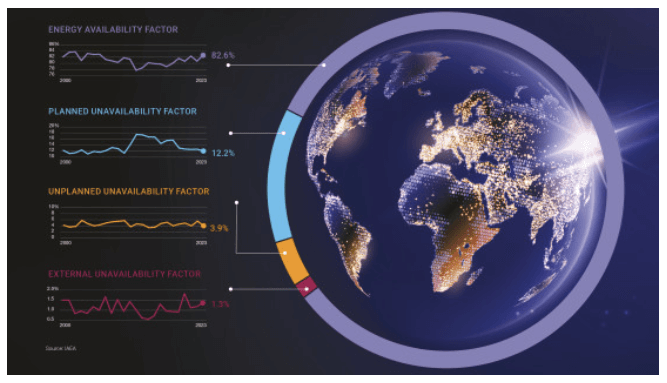
    For 55 years, the IAEA’s Power Reactor Information System (PRIS) has been collecting, managing and disseminating official data and statistics on nuclear power reactors to ensure information transparency, reliability and accessibility for member countries and industry stakeholders. Its standardized and continuous data collection direct from official sources in 38 countries makes PRIS an invaluable tool for nuclear operating and decommissioning countries, as well as nuclear newcomers and international and non-governmental organizations.


    PRIS data are used to support a variety of critical operational tasks as well as periodic reviews vital for safe, secure and reliable operation. For example, Teollisuuden Voima Oyj (TVO), an operator in Finland, uses PRIS reports to evaluate its reactors’ power history and operating experience, and prepares reports based on the findings to help optimize reactor efficiency.


    The country nuclear power profiles (CNPPs), created in 1998 and completely revised in 2023, complement PRIS by providing comprehensive overviews of a country’s nuclear power infrastructure, policies and long-term development strategies.

    Para leer más ingrese a:

    https://www.iaea.org/bulletin/powering-progress-with-data

  • POWER HUNGRY: AI and our energy future

    POWER HUNGRY: AI and our energy future

    It’s well documented that AI is a power-hungry technology. But there has been far less reporting on the extent of that hunger, how much its appetite is set to grow in the coming years, where that power will come from, and who will pay for it. For the past six months, MIT Technology Review’s team of reporters and editors have worked to answer those questions. The result is an unprecedented look at the state of AI’s energy and resource usage, where it is now, where it is headed in the years to come, and why we have to get it right.


    At the centerpiece of this package is an entirely novel line of reporting into the demands of inference—the way human beings interact with AI when we make text queries or ask AI to come up with new images or create videos. Experts say inference is set to eclipse the already massive amount of energy required to train new AI models. We were so startled by what we learned reporting this story that we also put together a brief on everything you need to know about estimating AI’s energy and emissions burden.

    Para leer más ingrese a:

    https://www.technologyreview.com/supertopic/ai-energy-package/

  • Tras críticas por ciberataques, Gobierno de Peña da a conocer ‘Estrategia Nacional de Ciberseguridad

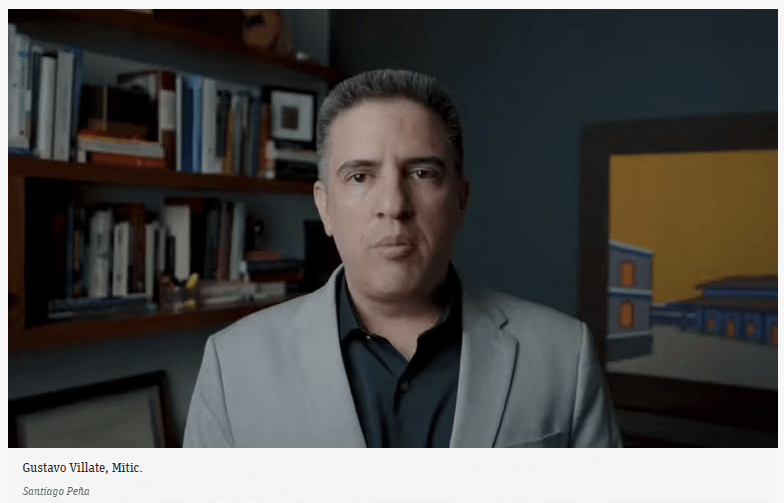
    Tras críticas por ciberataques, Gobierno de Peña da a conocer ‘Estrategia Nacional de Ciberseguridad

    • Mediante el Decreto Número 3.900 y firmado por el vicepresidente de la República, Pedro Alliana, quien ejerce la Presidencia de la República, se aprobó la “Estrategia Nacional de Ciberseguridad”.
    • El documento fue elaborado por el Ministerio de Tecnologías de la Información y Comunicación (Mitic), en coordinación con el Comité Interamericano contra el Terrorismo (CICTE) de la Organización de los Estados Americanos (OEA).
    • La estrategia busca establecer políticas públicas que garanticen la seguridad en el ciberespacio y proteger la infraestructura crítica del país frente a amenazas digitales.

    Para leer más ingrese a:

    https://www.abc.com.py/politica/2025/05/23/tras-ciberataques-gobierno-de-pena-da-a-conocer-estrategia-nacional-de-ciberseguridad/
  • CATL presenta una batería que promete alimentar una casa durante seis años y hasta 150 coches eléctricos con tan solo una carga

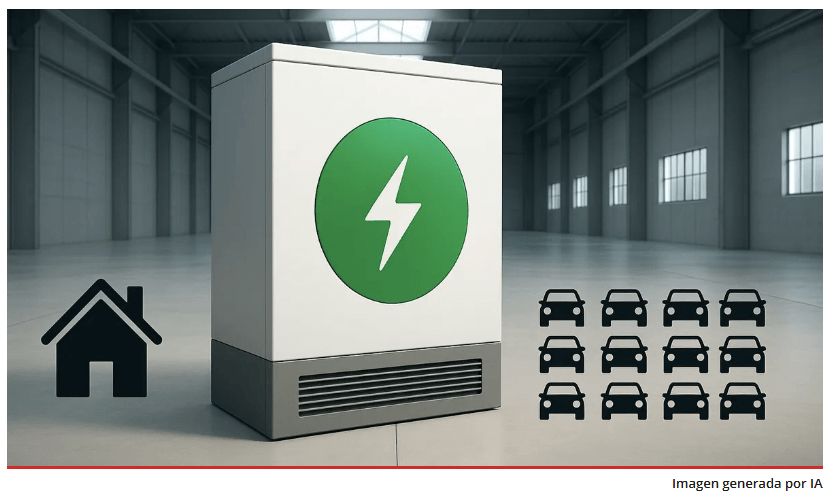
    CATL presenta una batería que promete alimentar una casa durante seis años y hasta 150 coches eléctricos con tan solo una carga

    Después del apagón que afectó a miles de hogares en España, el interés por las energías renovables y los sistemas de almacenamiento energético ha crecido de forma drástica. Según datos recientes, la demanda de baterías y placas solares se ha disparado un 450%.
    En este contexto, el gigante chino CATL ha presentado una batería de almacenamiento que podría cambiarlo todo, la CATL TENER Stack. Una solución diseñada para alimentar una vivienda durante seis años o recargar hasta 150 coches eléctricos con una sola carga.
    Esta batería pertenece a la categoría BESS (Battery Energy Storage Systems), que engloba las tecnologías que permiten almacenar la energía generada por fuentes renovables como el sol o el viento. Puede alcanzar los 9 MWh, lo que representa un aumento del 50% en densidad energética frente a los sistemas actuales de contenedores estándar.

    Para leer más ingrese a:

    https://computerhoy.20minutos.es/tecnologia/catl-presenta-bateria-promete-alimentar-casa-durante-seis-anos-150-coches-electricos-sola-carga-capaz-1461091
  • How to solve a bottleneck for CO2 capture and conversion

    How to solve a bottleneck for CO2 capture and conversion

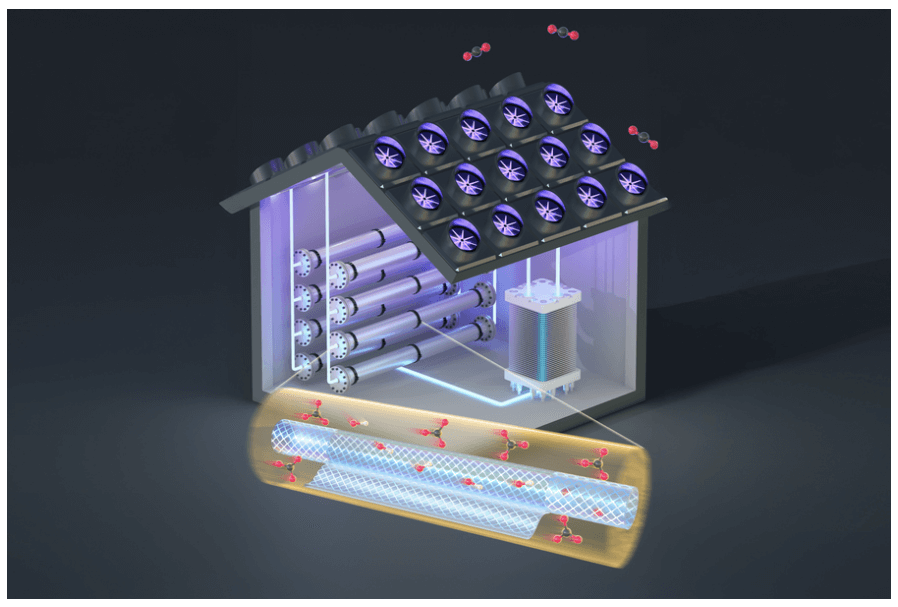
    Removing carbon dioxide from the atmosphere efficiently is often seen as a crucial need for combatting climate change, but systems for removing carbon dioxide suffer from a tradeoff. Chemical compounds that efficiently remove CO₂ from the air do not easily release it once captured, and compounds that release CO₂ efficiently are not very efficient at capturing it. Optimizing one part of the cycle tends to make the other part worse.

    Now, using nanoscale filtering membranes, researchers at MIT have added a simple intermediate step that facilitates both parts of the cycle. The new approach could improve the efficiency of electrochemical carbon dioxide capture and release by six times and cut costs by at least 20 percent, they say.

    The new findings are reported today in the journal ACS Energy Letters, in a paper by MIT doctoral students Simon Rufer, Tal Joseph, and Zara Aamer, and professor of mechanical engineering Kripa Varanasi.

    Para leer más ingrese a:

    https://news.mit.edu/2025/solving-bottleneck-co2-capture-and-conversion-0520
  • Wisconsin Municipality Using Waste Gas to Power Microturbines at Sewer Plant

    Wisconsin Municipality Using Waste Gas to Power Microturbines at Sewer Plant

    Gas-fired microgrids are increasingly powering mission critical water and sewer operations in towns and cities throughout the U.S.

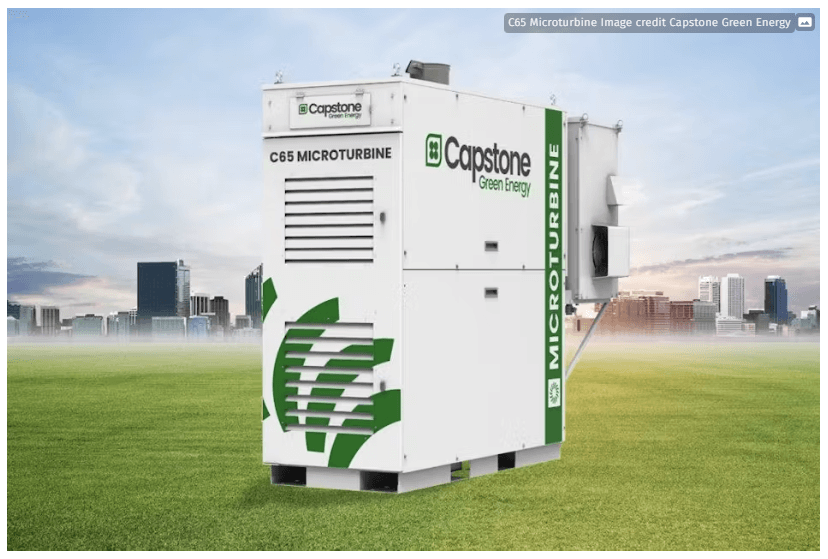
    The city of Janesville, Wisconsin, is powering its wastewater treatment operations with on-site power featuring new biofuel-fired microturbines from Capstone Green Energy.

    Capstone distributor Vergent Power is handling the order from the city of Janesville. The municipality has purchased two additional C65 microturbines, one C200S microturbine, and a Vergent controller.

    While two C65 microturbines from the original 2010 installation are operational, the follow-on project includes the commissioning of a C200 microturbine in November 2024, as well as the recent commissioning of two C65 microturbines in April 2025. The orders will increase the facility’s total on-site generation capacity to 460 kW.

    Para leer más ingrese a:

    https://www.microgridknowledge.com/chp-combined-heat-and-power/news/55291380/wisconson-municipality-using-waste-gas-to-power-microturbines-at-sewer-plant
  • Director General in Ecuador to Support Nuclear Power Plans, the Galapagos and More

    Director General in Ecuador to Support Nuclear Power Plans, the Galapagos and More

    Rafael Mariano Grossi met with President Daniel Noboa and Foreign Minister Gabriela Sommerfeld, as well as the Minister of Energy Ines Manzano and important institutions in the country during his visit.

    A key focus of the visit was sustainable, low-carbon energy, as Ecuador is well on the road to including nuclear power in its energy mix. Mr Grossi signed two new agreements with Minister Manzano to continue supporting this journey through the IAEA Milestones Approach, a phased process to assist countries considering or planning their first nuclear power plant. 

    The Director General also met Andres Rebolledo from Latin American Energy Organization OLADE which is headquartered in Quito. “The growing interest in nuclear energy across Latin America and the Caribbean means our growing cooperation with OLADE is increasingly important,” said Mr Grossi.

    Para leer más ingrese a:

    https://www.iaea.org/newscenter/news/director-general-in-ecuador-to-support-nuclear-power-plans-the-galapagos-and-more
  • Monthly Electricity Statistics

    Monthly Electricity Statistics

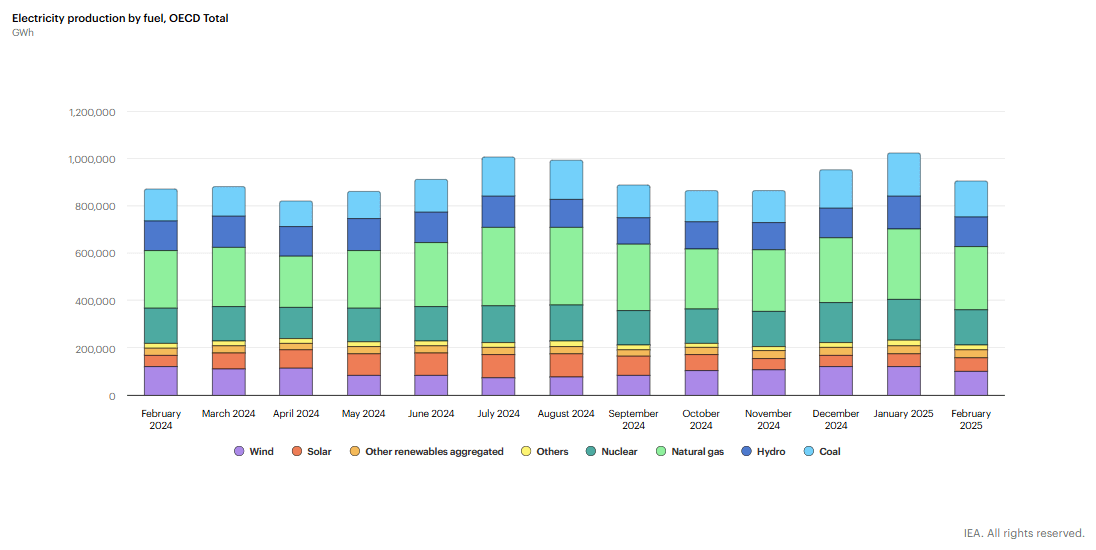
    In February 2025, total net electricity generation in the OECD reached 904.8 TWh, an increase of 4.0% compared to February 2024. Of this total, 434.4 TWh (48.0%) was produced from fossil fuels, 316.0 TWh (34.9%) from renewable sources and 150.7 TWh (16.7%) from nuclear power.

    Electricity generation from fossil fuels increased by 10.2% year-on-year1 in the OECD in February 2025. Generation from natural gas rose by 8.8% y-o-y (+21.3 TWh), and generation from coal increased by 14.0% y-o-y. The shares of natural gas, coal and oil as a percentage of total electricity generation were 29.2%, 17.0% and 1.2%, respectively. The increase in coal-fired electricity generation was driven by the OECD Americas (+36.6% y-o-y, +19.1 TWh) and OECD Europe (+17.6% y-o-y, +5.8 TWh), whereas generation decreased in OECD Asia Oceania (-12.3% y-o-y, -6.1 TWh). Notable increases were observed in the United States (+40.9% y-o-y, +18.9 TWh) and in Germany (+34.1% y-o-y, +3.1 TWh).

    Electricity generation from renewable sources decreased by 2.1% year-on-year (-6.7 TWh) in the OECD in February 2025. While the output from solar generation continues to increase (+24.5% y-o-y, +11.9 TWh), that growth did not offset the decrease observed in wind generation (-17.0% y-o-y, -20.1 TWh). This trend was mainly driven by OECD Europe, where electricity generation from wind dropped by 29.4% y-o-y (or -19.4 TWh), driven by Germany (-7.3 TWh), France (-2.0 TWh) and Poland (-1.3 TWh). On the other hand, hydropower generation in the OECD remained stable (+0.3% y-o-y), amounting to 125.4 TWh.

    Para leer más ingrese a:

    https://www.iea.org/data-and-statistics/data-tools/monthly-electricity-statistics
  • What we know – and don’t – about the April 2025 Iberian Peninsula Power Blackout

    What we know – and don’t – about the April 2025 Iberian Peninsula Power Blackout

    What happened with the power grid in Spain, Portugal, and parts of France on April 28, 2025?
    During the early afternoon of Monday, April 28, 2025, the power grid in Spain experienced a cascading event and lost about 60% of its power generation. The sudden 15 gigawatt loss in electricity generation impacted grid frequencies and stability across the integrated Iberian Peninsula grid, leading to a nearly daylong blackout across Spain, Portugal, and parts of southern France. By late Monday evening, Redes Energéticas Nacionais (REN), Portugal’s national electricity and natural gas transmission system operator, had restored 85 of 89 substations in Portugal. Red Eléctrica de España (REE, “Red Eléctrica”), Spain’s national electricity transmission system operator, had restored nearly all demand in Spain by Tuesday morning.

    Para leer más ingrese a:

    https://sepapower.org/knowledge/april-2025-iberian-blackout/
  • España investiga potenciales vulnerabilidades de ciberseguridad en pequeñas centrales eléctricas como causa del ‘gran apagón’

    España investiga potenciales vulnerabilidades de ciberseguridad en pequeñas centrales eléctricas como causa del ‘gran apagón’

    El Ejecutivo español aún no ha determinado las causas concretas del apagón que dejó al país todo el día sin luz el pasado 28 de febrero. Descubrirlo, como anunció Pedro Sánchez el pasado 7 de mayo en una comparecencia en el Congreso “llevará algo de tiempo”, pues los datos que hay que analizar, procedentes de cientos de instalaciones (desde centros de control a las plantas de generación de electricidad) ascienden a unos 756 millones, “los valores que generaron las 4.200 plantas del sistema entre las 12:15 y las 12:35 de aquel día”.

    El diario Financial Times publicaba ayer que el Gobierno español está exigiendo información a los pequeños generadores de electricidad sobre el estado de sus ciberdefensas, como parte del proceso de investigación abierto para determinar si estos fueron un eslabón débil explotado por actores maliciosos con el objetivo de tumbar la red eléctrica del país. “Altos funcionarios del Gobierno están ‘preocupados’ por la solidez de las ciberdefensas de las pequeñas y medianas instalaciones eléctricas, en particular los parques solares y eólicos”, según una persona familiarizada con el asunto citada en la información publicada por el rotativo. De hecho, el Ejecutivo no descarta todavía que la causa del incidente sea, finalmente, un ciberataque. “A día de hoy, no descartamos ninguna posibilidad. Todo sigue sobre la mesa”, según declaraciones al citado diario de fuentes del Ministerio para la Transición Ecológica y Reto Demográfico.

    Para leer más ingrese a:

    https://www.computerworld.es/article/3983801/espana-investiga-potenciales-vulnerabilidades-de-ciberseguridad-en-pequenas-centrales-electricas-como-causa-del-gran-apagon.html

Busca los documentos, noticias y tendencias más relevantes del sector eléctrico

Buscador de documentos
Buscador de noticias y tendencias

Banco de Información

Descripción del semáforo tecnológico

Los documentos se clasifican en varios colores tipo semáforo tecnológico que indican el nivel de implementación de la tecnología en el país

Tecnología en investigación que no ha sido estudiado o reglamentado por entidades del sector.

La tecnología se aplica de manera focal y se encuentra en estudio por parte de las entidades del sector.

La tecnología se aplica de manera escalable y se encuentran políticas y regulaciones focales establecidas.

La tecnología se aplica a través de servicios  y se encuentran políticas y regulaciones transversales establecidas.

La tecnología se aplica de manera generalizada  y se tiene un despliegue masivo de esta.

Para acceder a todos los documentos publicados y descargarlos ingresa aquí