Autor: DIFUSIÓN COLOMBIA INTELIGENTE

  • Will AI help reduce electricity usage? Most Americans seem to think so 

    Will AI help reduce electricity usage? Most Americans seem to think so 

    Sixty-one percent of Americans believe that AI systems will prove valuable for their household electricity usage, according to the latest survey from the Smart Energy Consumer Collaborative (SECC), a nonprofit organization that studies Americans’ energy-related behaviors, interests and values. 

    Among Americans who have experience with AI systems, such as ChatGPT and Midjourney, this figure rises to 76%. 

    The “Computing Consumer Interest in AI” survey – the latest installment in SECC’s Smart Energy Snapshot Series, which debuted in 2023 – was fielded to a nationally representative sample of 1,530 respondents in late June, SECC said. As AI increasingly becomes part of the energy landscape, the survey sought to understand how consumers feel about this emerging technology and what their expectations are for its potential applications. 

    Americans expressed relatively high interest in potential AI services from their electricity providers, with proactive notifications about power outages/scheduled maintenance topping the list at 69%. Fifty-seven percent are interested in personalized recommendations for reducing their electricity usage, while about half expressed interest in personalized suggestions for reducing their carbon footprints and for the optimization of their usage via the control of smart home devices. 

    However, Americans also have concerns around AI. First, the new Snapshot Survey showed that many consumers question the accuracy of AI systems; only 12% believe that AI systems are very accurate, while an additional 47% think that they are somewhat accurate. For consumers who don’t have prior experience with AI systems, only 6% believe AI systems to be very accurate, and one-third think they are somewhat accurate. 

    Para leer más ingrese a:

    https://www.power-grid.com/smart-grid/will-ai-help-reduce-electricity-usage-most-americans-seem-to-think-so/

  • Halliburton hit by cyberattack, certain systems impacted 

    Halliburton hit by cyberattack, certain systems impacted 

    Halliburton determined it was hit by a cyberattack Wednesday after an unauthorized third party gained access to some of its systems, the company said Friday in a regulatory filing. 

    Halliburton has launched an investigation after an unauthorized actor gained access to some of its systems in a hacking incident discovered Wednesday, according to 8-K filing with the Securities and Exchange Commission.  

    The Houston-based company, one of the world’s leading energy services providers, said it proactively shut off certain systems and notified law enforcement after learning of the intrusion.  

    Halliburton is working with outside advisors to investigate the incident, restore its internal systems and determine any material business impact.  

    The company said it is communicating with customers and other stakeholders. 

    Halliburton is one of the largest diversified energy services companies in the world, with more than 48,000 employees and annual revenue of $23 billion.  

    Para leer más ingrese a:

    https://www.cybersecuritydive.com/news/halliburton-cyberattack/725065/

  • Australian government approves renewables link to Singapore with up to 42GWh energy storage 

    Australian government approves renewables link to Singapore with up to 42GWh energy storage 

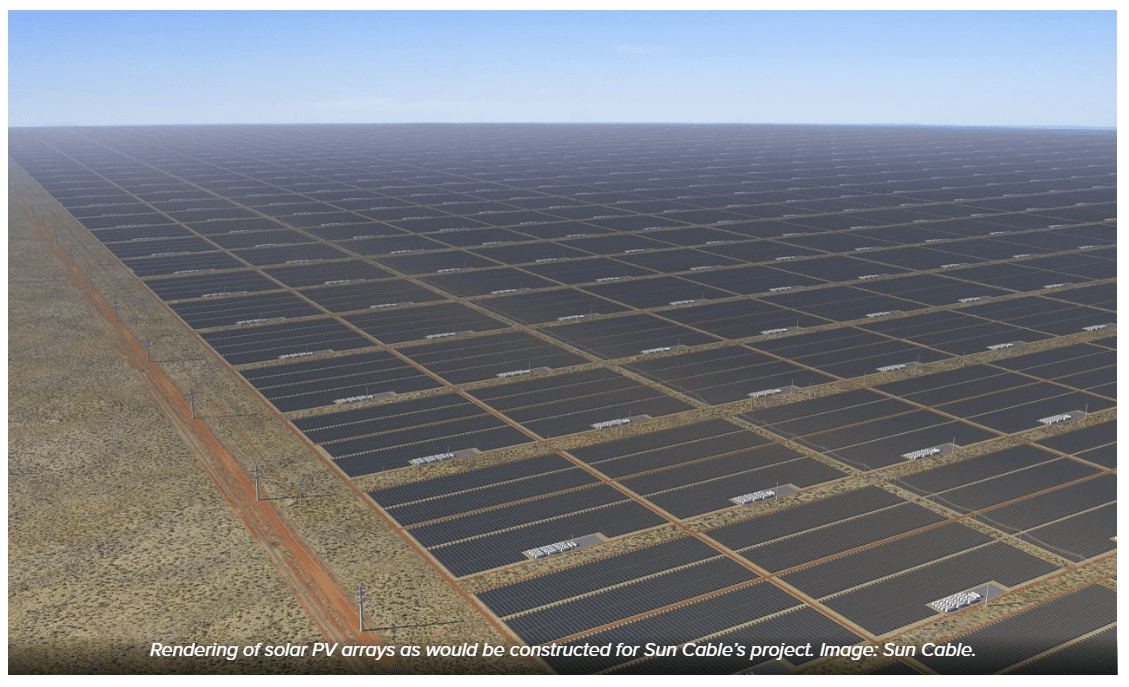
    In a statement made yesterday (20 August), Sun Cable said the project has been assessed and approved by Tanya Plibersek, the Commonwealth’s minister for the Environment and Water, under the Environment Protection and Biodiversity Conservation Act (EPBC). This approval follows the previous one secured from the Northern Territory government and NT Environment Protection Authority for the interconnector last month. 

    Para leer más ingrese a:

    Australian government approves renewables link to Singapore with up to 42GWh energy storage

  • Carrots, sticks or both: State efforts to combat anti-renewables NIMBYs 

    Carrots, sticks or both: State efforts to combat anti-renewables NIMBYs 

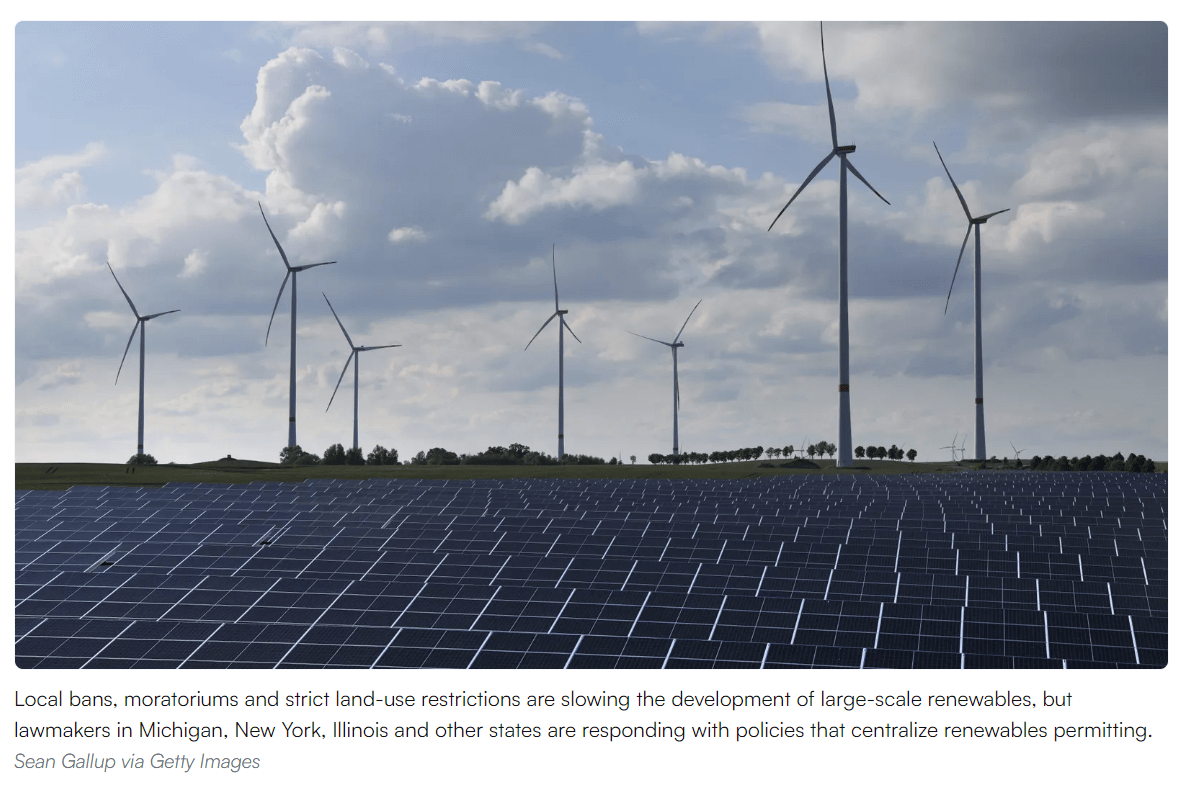
    Utility-scale renewables development has ground to a halt in at least 15% of U.S. counties due to a combination of bans, moratoriums, and overly strict zoning and land-use restrictions, according to a February analysis by USA Today. 

    Lawmakers in Michigan, New York, Illinois and other states with 100% carbon-free electricity goals are pushing back with policies that centralize renewables permitting at the state level, provide financial incentives for more permissive local ordinances, or both. Though initiatives like Michigan’s Renewables Ready Communities Award program are too new to have had an observable impact, the early success of two New York programs is heartening for advocates of community-oriented approaches that include tangible financial benefits for municipalities and utility customers. 

    “There is no question that these packages help [developers] gain public support,” said Dan Spitzer, who co-leads New York-based law firm Hodgson Russ’s cleantech and renewable energy practice. 

    Such efforts could accelerate onshore wind and solar development, keeping state and federal governments on track to reach their clean electricity goals in the short term. But experts worry that the backlash to state policies perceived as unfair by host communities could entrench local opposition to utility-scale renewables, spur litigation and ultimately slow the energy transition. The most effective state policies, they say, incentivize constructive local participation in siting and permitting processes and nudge developers to treat host communities fairly while limiting opportunities for opponents to delay or kill mutually beneficial projects. 

    Para leer más ingrese a:

    https://www.utilitydive.com/news/states-renewable-energy-permitting-siting-incentives-wind-solar/724815/

  • For 3 Outage-Prone Tribes, 3 Nested Microgrids Spanning 26 Miles 

    For 3 Outage-Prone Tribes, 3 Nested Microgrids Spanning 26 Miles 

    Before Arne Jacobson began leading an effort to plan nested microgrids serving three tribal communities in Northern California, the director of the Schatz Energy Research Center understood very well the economic, social and environmental benefits of microgrids in outage-plagued regions.  

    Schatz had served as the technical lead for the behind-the-meter Blue Lake Rancheria microgrid, which is located on tribal land and has become a poster child for the benefits microgrids can bring to communities. 

    The Blue Lake Rancheria model of inviting in community 

    In December 2022, an earthquake struck the Humboldt County region and knocked out power. Blue Lake Rancheria, which had installed its microgrid in 2016, became “an island of electrical activity,” said Jacobson. It provided critical – and potentially lifesaving – support for local residents. 

    When the earthquake struck, Blue Lake reserved the ground floor of its hotel for people who needed to charge medical devices such as oxygen machines and insulin pumps. Community members lined up to get gas at Blue Lake’s gas station, purchase ice and use the available Wi-Fi. 

    In fact, Blue Lake’s decision to open its doors during emergencies to people who needed to charge medial devices has been credited with saving four lives during outages, said Heidi Moore-Guynup, director of tribal and government affairs for Blue Lake Rancheria. 

    Blue Lake, a designated emergency management refuge site, has agreements with the county and the Coast Guard allowing the agencies to create command centers on its property, and it often serves as the staging area for wildland firefighting, said Moore-Guynup. 

    Para leer más ingrese a:

    https://www.microgridknowledge.com/reliability-resilience/article/55132376/for-3-outage-prone-tribes-3-nested-microgrids-spanning-26-miles

  • AI, manufacturing spur SMR interest, but project complexity weighs on deals: NuScale 

    AI, manufacturing spur SMR interest, but project complexity weighs on deals: NuScale 

    • The July enactment of the Advanced Nuclear for Clean Energy, or ADVANCE, Act and the U.S. Department of Energy’s June announcement of up to $900 million in funding for early small modular reactor deployments are positive developments for NuScale’s business, CEO John Hopkins said on the company’s earnings call. These developments came amid increased interest from hyperscale data center operators and manufacturers seeking reliable, emissions-free electricity, Hopkins said. 
    • But project complexity and risk aversion among potential offtakers have dogged NuScale’s efforts to close revenue-generating customer agreements, Hopkins said during the call’s Q&A session. 
    • Actions taken by NuScale to reduce operating costs and improve efficiency, including an approximate 28% reduction in its workforce earlier this year, helped the company trim operating losses in Q2 2024, the company said Thursday. NuScale reported an operating loss of $41.9 million in the quarter ended June 30, down from an operating loss of $56.1 million in Q2 2023. 

    Para leer más ingrese a:

    https://www.utilitydive.com/news/ai-manufacturing-data-center-smr-advance-nuclear-nuscale/723962/

  • With sustainable cement, startup aims to eliminate gigatons of CO₂ 

    With sustainable cement, startup aims to eliminate gigatons of CO₂ 

    While today’s cement is made through extremely high temperatures in a kiln, ancient Romans didn’t have that option. Still, anyone who’s been to Rome recently will tell you that ancient cement seems to have held up just fine. 


    The startup Sublime Systems thinks the Romans were onto something. The MIT spinout has created a drop-in replacement for today’s most commonly used cement, known as portland cement, that uses electrochemistry to skip the ultrahigh temperatures of conventional production — and the immense carbon dioxide emissions that go with it. 


    “Romans couldn’t go to those obscene temperatures, but they’ve proven their cement is hard and durable, and we now have 2,000 years of innovation to get that cement to meet the criteria we expect out of modern cement,” explains Sublime co-founder and CEO Leah Ellis, who developed the approach as a postdoc in the lab of Sublime co-founder and MIT Professor Yet-Ming Chiang. 


    Sublime’s approach has potential to make a major dent in global greenhouse gas emissions. The International Energy Agency estimates that cement is responsible for about 7 percent of human-driven carbon dioxide emissions worldwide. Sublime’s process eliminates emissions by foregoing the high temperatures and the use of limestone, which is nearly 50 percent CO₂ by weight, in favor of a novel electrochemical process. 


    “Cement enabled civilization as we know it today, but now it needs to be reinvented,” says Chiang, who is MIT’s Kyocera Professor of Ceramics. “Cement creates about 4 gigatons of emissions a year, and by 2050 that’s projected to become 6 gigatons a year. I think of what we’re doing as technically a very feasible way of decreasing those 4 gigatons of cement emissions as soon as possible.” 

    Para leer más ingrese a:

    https://news.mit.edu/2024/sustainable-cement-startup-sublime-eliminates-co2-gigatons-0809

  • California Net Metering Change Contributed to SunPower’s Bankruptcy, Solar and Storage Association says 

    California Net Metering Change Contributed to SunPower’s Bankruptcy, Solar and Storage Association says 

    A solar installer and contributor to microgrid development in the U.S. has declared Chapter 11 bankruptcy, and some sector experts partially blame California’s state net metering policies, which are seen to favor utilities. 

    SunPower filed a petition seeking Chapter 11 reorganization and bankruptcy protection earlier this month. The company also cut a deal with Complete Solaria to sell certain assets such as the Blue Raven Solar and New Homes businesses to the latter as a stalking horse buyer. 

    In bankruptcy lexicon, a stalking horse buyer is an entity which bids for assets of a bankrupt firm in advance of an auction of those assets. 

    «For nearly 40 years, SunPower has made solar energy more accessible to Americans, driven by our mission to change the way our world is powered. We are confident that Complete Solaria’s CEO, T.J. Rodgers, will carry forward our vision to shape the future of residential solar as a pioneer in this space,» said Tom Werner, Executive Chairman at SunPower, in a company statement. 

    «In light of the challenges SunPower has faced, the proposed transaction offers a significant opportunity for key parts of our business to continue our legacy under new ownership. We are working to secure long-term solutions for the remaining areas of our business, while maintaining our focus on supporting our valued employees, customers, dealers, builders, and partners,» Werner added.  

    SunPower has been a major player within the microgrid sector for years. Recently, the company was project leader on a “Connected Communities” initiative involving residential microgrids.  The Connected Communities partners include Schneider Electric, utility Southern California Edison and the energy research group at the University of California-Irvine. 

    Para leer más ingrese a:

    https://www.microgridknowledge.com/policy/economics/article/55133537/california-net-metering-change-contributed-to-sunpowers-bankruptcy-solar-and-storage-association-says

  • Building an engineering culture and resilient technology 

    Building an engineering culture and resilient technology 

    The pace of change in technology has created many opportunities—and raised as many challenges. Overcoming the challenges to grasp the opportunities requires tools and processes that nurture an engineering culture, build stable foundations for resilient technology operations, and manage complex cloud costs. Driving this shift requires modern technology leaders to expand from their traditional role as “guardians of IT” to become closer partners with the business. So says David Pedreira, CTO of Santander Argentina, in this interview with McKinsey’s Jorge Machado, where he reflects on his long experience leading technology organizations and the key actions that have allowed him to transform the technology function. What follows is an edited version of their conversation. 

    Jorge Machado: How did you go about building up an engineering culture? What was the biggest change in terms of how you managed technology as a result? 

    David Pedreira: To build an engineering culture, you need to bring together people who like to challenge traditional processes—we went from requiring 15 signoffs for a road map to getting it approved in one meeting and adopting agile resource management—and who understand what is required to enable a better developer experience, such as using APIs to create services. I’ve also prioritized technology leaders who like to manage people over experienced managers with less technical experience; it’s critical to have deep experience in technology first.  

    Second, I’ve invested in tools, particularly an integrated developer portal. The right tool enforces process standardization and helps with communications. When you try to organize engineering in a portal, you learn that all your engineering processes need to be easy. To help your developers build, you need to go from what has traditionally been a confusing series of requests and hurdles to a much simpler self-service model, where approved code and services are ready to go and easy to integrate. A developer portal also handles all the aspects of an application’s life cycle, from the code to managing incidents in production. 

    Para leer más ingrese a:

    https://www.mckinsey.com/capabilities/mckinsey-digital/our-insights/building-an-engineering-culture-and-resilient-technology

  • New framework empowers pavement life-cycle decision-making while reducing data collection burden 

    New framework empowers pavement life-cycle decision-making while reducing data collection burden 

    Roads are the backbone of our society and economy, taking people and goods across distances long and short. They are a staple of the built environment, taking up nearly 2.8 million lane-miles (or 4.6 million lane-kilometers) of the United States’ surface area. 


    These same roads have a considerable life-cycle environmental impact, having been associated with over 75 megatons of greenhouse gases (GHG) each year over the past three decades in the United States. That is equivalent to the emissions of a gasoline-powered passenger vehicle traveling over 190 billion miles, or circling the Earth more than 7.5 million times, each year.  


    By 2050, it is estimated that pavement sector emissions will decrease by 14% due to improvements like cement clinker replacement, but it is possible to extract a 65% reduction through measures like investing in materials and maintenance practices to make road networks stiffer and smoother, meaning they require less energy to drive on. As a practical example, consider that in 2022, vehicles in the United States collectively drove 3.2 trillion miles. If the average surface roughness of all pavements were improved by 1%, there would be 190 million tons of CO2 saved each year. 


    One of the challenges to achieving greater GHG reductions is data scarcity, making it difficult for decision makers to evaluate the environmental impact of roads across their whole life cycle, comprising the emissions associated with the production of raw materials to construction, use, maintenance and repair, and finally demolition or decommissioning. Data scarcity and the complexity of calculation would make analyzing the life cycle environmental impacts of pavements prohibitively expensive, preventing informed decisions on what materials to use and how to maintain them. Today’s world is one of rapid change, with shifting weather and traffic patterns presenting new challenges for roads.  

    Para leer más ingrese a:

    https://news.mit.edu/2024/mit-cshub-tool-empowers-pavement-life-cycle-decision-making-0809

Busca los documentos, noticias y tendencias más relevantes del sector eléctrico

Buscador de documentos
Buscador de noticias y tendencias

Banco de Información

Descripción del semáforo tecnológico

Los documentos se clasifican en varios colores tipo semáforo tecnológico que indican el nivel de implementación de la tecnología en el país

Tecnología en investigación que no ha sido estudiado o reglamentado por entidades del sector.

La tecnología se aplica de manera focal y se encuentra en estudio por parte de las entidades del sector.

La tecnología se aplica de manera escalable y se encuentran políticas y regulaciones focales establecidas.

La tecnología se aplica a través de servicios  y se encuentran políticas y regulaciones transversales establecidas.

La tecnología se aplica de manera generalizada  y se tiene un despliegue masivo de esta.

Para acceder a todos los documentos publicados y descargarlos ingresa aquí