Autor: DIFUSIÓN COLOMBIA INTELIGENTE

  • DOE issues road map for speeding, improving grid interconnections to unlock 2.6-TW backlog

    DOE issues road map for speeding, improving grid interconnections to unlock 2.6-TW backlog

    • The U.S. Department of Energy on Wednesday issued a road map aimed at improving processes that will allow generators to connect to the grid more quickly and efficiently.

    • In steps that go beyond the Federal Energy Regulatory Commission’s recent interconnection reform rule, the Transmission Interconnection Roadmap calls for considering market-based options to ration interconnection access and separate the interconnection process from making network upgrades.

    • “This is a landmark document, most notably because it offers the strongest institutional endorsement yet for reducing reliance on the interconnection process to identify and fund deep network upgrades, and to consider options for delinking interconnection processes from network upgrade planning altogether,” said Tyler Norris, a doctoral student at Duke University and former vice president of development at Cypress Creek Renewables. 

    Para leer más ingrese a:

    https://www.utilitydive.com/news/doe-transmission-interconnection-roadmap-grid-ferc/713562/

  • Conflicts of interest – The cost of investing in the energy transition in a high interest-rate eraConflicts of interest

    Conflicts of interest – The cost of investing in the energy transition in a high interest-rate eraConflicts of interest

    The ‘zero era’ for interest rates has come to an end. In the past two years, rates have risen sharply as central banks have scrambled to fight inflationary pressures. Governments, companies and households face markedly higher market rates and bond yields, which could yet rise further. The increase in the cost of capital has profound implications for the energy and natural resources industries, particularly the cost and pace of the transition to low-carbon technologies.

    The monetary environment over the next couple of decades is likely to remain much tighter than it was in the period from 2009 to 2022. In major economies, nominal and real interest rates could be as much as two percentage points higher, on average, than in the ‘zero era’. Companies, investors and policymakers should brace themselves: tougher financial conditions could persist for some time to come.

    The higher cost of borrowing affects the energy and natural resources sectors unevenly. Highly capital intensive and often reliant on subsidies, low-carbon energy and nascent green technologies are most exposed. Debt accounts for a higher share of the capital structure for low-carbon energy sectors, too. The impact of higher interest rates grows as the capital expenditure (capex) share of total expenditure increases.

    Para leer más ingrese a:

    https://www.woodmac.com/horizons/energy-transition-investing-in-a-high-interest-rate-era/

  • Scoring for the Future with a Common Definition: A Taxonomy for Microgrids

    Scoring for the Future with a Common Definition: A Taxonomy for Microgrids

    • The New York State Energy Research and Development Authority announced Friday that the state won’t be going forward with the three projects it provisionally awarded in its third offshore wind solicitation due to “material modifications” to the projects, including GE Vernova’s pivot away from an 18-MW turbine model.
    • The solicitation has concluded with no final awards being made, NYSERDA said. The three projects canceled are the 1,404-MW Attentive Energy One, the 1,314-MW Community Offshore Wind and the 1,314-MW Excelsior Wind — a total of 4 GW of capacity.
    • “Going forward, we expect to center our offshore wind business around a workhorse product, the Haliade-X 15.5 MW-250,” GE Vernova said in a February SEC filing. 

    Para leer más ingrese a:

    https://www.utilitydive.com/news/new-york-offshore-wind-projects-cancelled-turbine/713833/

  • New York nixes 3 offshore wind projects, notes GE Vernova move to abandon 18-MW turbine

    New York nixes 3 offshore wind projects, notes GE Vernova move to abandon 18-MW turbine

    • The New York State Energy Research and Development Authority announced Friday that the state won’t be going forward with the three projects it provisionally awarded in its third offshore wind solicitation due to “material modifications” to the projects, including GE Vernova’s pivot away from an 18-MW turbine model.
    • The solicitation has concluded with no final awards being made, NYSERDA said. The three projects canceled are the 1,404-MW Attentive Energy One, the 1,314-MW Community Offshore Wind and the 1,314-MW Excelsior Wind — a total of 4 GW of capacity.
    • “Going forward, we expect to center our offshore wind business around a workhorse product, the Haliade-X 15.5 MW-250,” GE Vernova said in a February SEC filing. 

    Para leer más ingrese a:

    https://www.utilitydive.com/news/new-york-offshore-wind-projects-cancelled-turbine/713833/

  • Performance and Prospects of the EU Green Deal

    Performance and Prospects of the EU Green Deal

    The EU Parliamentary Elections, which will be held from 6-9 June 2024 across the European Union, will shape and indeed constrain the next Commission’s room for manoeuvre, particularly  when it comes to decision-making regarding environmental and climate change policy. This is why, in the April 2024 edition of the Topic of the Month, we take a closer look at the Commission’s European Green Deal (EGD) flagship project. In this post, we trace its origins and implementation to date, while future instalments focus on some of the Green Deal’s most recent policy initiatives and examine the challenges that lie ahead.

    This project was already at the heart of the speech that Ursula von der Leyen gave to the European Parliament in July 2019 when she emerged as candidate for the Commission presidency. In her speech, von der Leyen identified planetary health as the ‘most pressing challenge […] the greatest responsibility and opportunity of our times’. It was also a project that suited the political moment: this occurred against the background of United States’ withdrawal from the Paris Agreement (announced by then-President Trump in June 2017 and formally initiated in November 2019), as well as increasing domestic pressure to act more decisively on climate change through movements such as the Fridays for Future protests. Von der Leyen promised bolder EU action on climate change and environmental issues to obtain the support for her candidacy from the European Parliament. This included a pledge to strengthen the EU’s climate target for 2030.

    Para leer más ingrese a:

    https://fsr.eui.eu/performance-and-prospects-of-the-eu-green-deal/

  • How Power-Hungry Data Centers and Large Industries Are Turning to Microgrids–On and Off-Grid

    How Power-Hungry Data Centers and Large Industries Are Turning to Microgrids–On and Off-Grid

    Owners of data centers and other facilities with large loads are increasingly talking to microgrid providers about building off-grid microgrids to ensure they have electricity when utilities are power-strapped or when utilities can’t provide interconnection in a timely manner.

    But it’s likely these microgrids will become connected to the grid. When utilities have enough capacity and when interconnection challenges ease up, the industries could convert them to grid-connected systems that provide grid services. This would involve integrating controls and intelligence into the systems.

    That’s the message from Elham Akhavan, senior microgrid research analyst at Wood Mackenzie, which provides industry research.

    Akhavan will speak about microgrid trends at Microgrid 2024, which takes place April 22-24 in Baltimore, Maryland.

    Para leer más ingrese a:

    https://www.microgridknowledge.com/data-center-microgrids/article/55019485/how-power-hungry-data-centers-and-large-industries-are-turning-to-microgrids-on-and-off-grid

  • Solar PPA prices stable for now but expected to rise absent interest rate cut: LevelTen

    Solar PPA prices stable for now but expected to rise absent interest rate cut: LevelTen

    • Solar power purchase agreement prices stabilized over the past quarter, after several months of rising costs, according to data from the energy marketplace at LevelTen Energy.

    • The average cost for North American solar PPAs fell 1.4% during the first quarter of 2024, while wind PPA prices rose 2.4%, according to LevelTen Energy. Wind PPAs are up 20.3% year over year, while solar PPAs have increased 4.9% since early 2023.

    • LevelTen Energy does not expect solar PPA prices to continue declining this year. High interest rates have adversely impacted the market and the Federal Reserve’s decision to postpone rate cuts this year will likely put upward pressure on PPA prices, said Samuel Mumford, an analyst at LevelTen Energy.

    Para leer más ingrese a:

    https://www.utilitydive.com/news/solar-wind-energy-ppa-power-purchase-agreement-prices-stable-interest-rate-inflation/713800/

  • The United States of Grid Modernization

    The United States of Grid Modernization

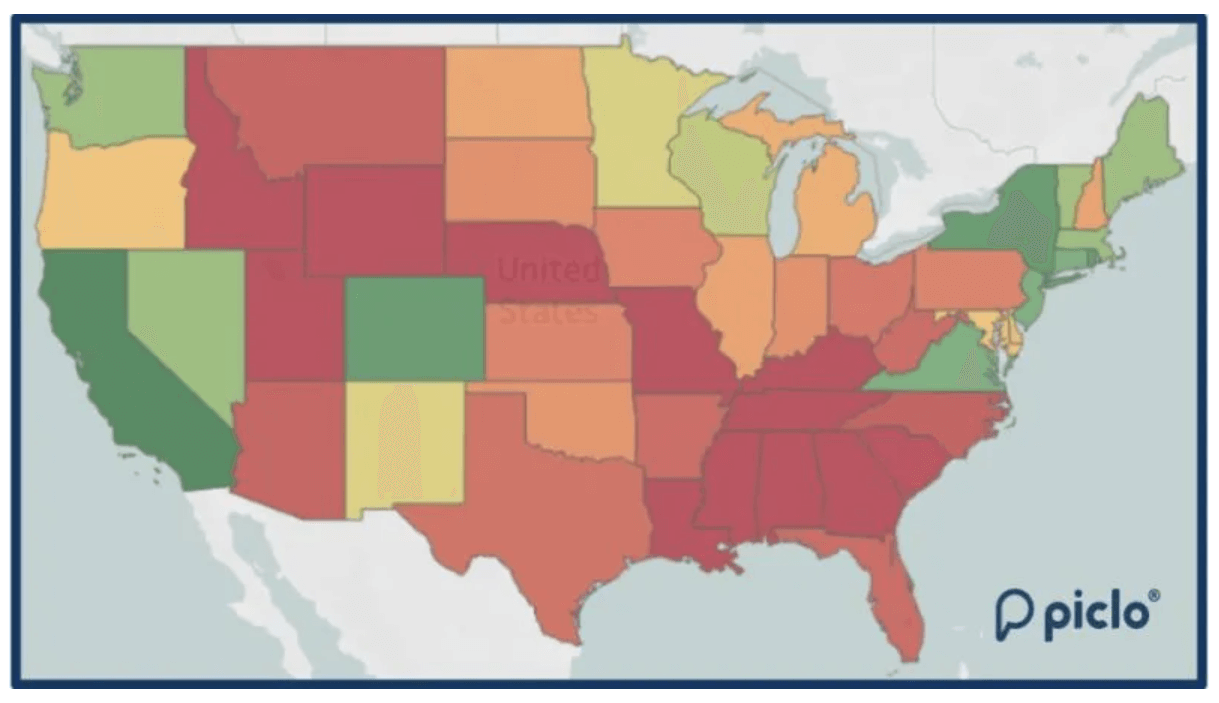
    Initiatives such as the Infrastructure Investment and Jobs Act (IIJA), the Inflation Reduction Act (IRA), and the CHIPS and Science Act have ignited new discussions about the future of energy. The federal government may have helped ignite the fire, but, the conversations shaping our energy future are happening at the state level. Many states are exploring how to cultivate new clean methods of energy generation, storage, and flexibility, and critically examining how we foster a more modern grid that leads the charge into the future (pun intended).

    In much of the country, the grid is over a century old, and designed for a one-way energy system that is no longer relevant. Without comprehensive grid modernization, the US cannot meet the growing demand for renewable Distributed Energy Resources (DERs) needed to meet the federal government’s goal of achieving 100% carbon pollution-free electricity by 2035. The Department of Energy estimates that the electric grid must more than double by 2035 to achieve the federal government’s goal of 100% clean energy – and a study from the National Renewable Energy Laboratory suggests grid capacity may need to triple. The findings are staggering, considering the cost, siting challenges, and construction time required for such a prolific grid buildout. The magnitude of the challenge highlights the urgency of grid modernization and expansion of clean energy production capacity.

    Para leer más ingrese a:

    The United States of Grid Modernization

  • Does New York’s ‘rooftop solar gap’ leave low-income residents behind?

    Does New York’s ‘rooftop solar gap’ leave low-income residents behind?

    Although New York has the largest of several state tax credit incentives for homeowners installing rooftop solar, the state’s “rooftop solar gap” is large, leaving many low-income residents unable to take full advantage of incentives, according to a new report from think tank Win Climate.

    New York’s State Solar Tax Credit has paid for 25% of a rooftop solar installation, or $5,000 – whichever is less. The Residential Solar Tax Credit Reform Act (S3596/ A6739) made the tax credit fully refundable, with the intention of allowing low-income homeowners and residents to benefit, and increased the tax credit amount to $10,000.

    The report, Closing NY’s Rooftop Solar Gap, aimed to analyze how many New York residents have utilized the State Solar Tax Credit, and how the Residential Solar Tax Credit Reform Act could impact the cost of solar for low-income residents. The “rooftop solar gap” is the difference in rooftop solar installation rates between households making more and less than $50,000 per year.

    Per the report, New York homeowners with an annual income of more than $50,000 are 2.5 times more likely to have rooftop solar than those making below $50,000, as those making below $50,000 often don’t pay enough income tax to fully claim the credit. Households making less than $50,000 annually make up 24% of owner-occupied houses in New York, but have only received 5% of residential tax credit subsidies.

    Para leer más ingrese a:

    Does New York’s ‘rooftop solar gap’ leave low-income residents behind?

  • Virtual power plant adoption could save California ratepayers $550M annually: Brattle report

    Virtual power plant adoption could save California ratepayers $550M annually: Brattle report

    • California could avoid $755 million in traditional power system costs and save electricity consumers $550 million annually by deploying about 7.7 GW of virtual power plant capacity by 2035, or five times its current VPP capacity, the Brattle Group said in a report released Thursday.
    • The report analyzed the cumulative potential of five VPP technologies, including smart thermostats, behind-the-meter batteries, managed electric vehicle charging, automated demand response for commercial and industrial users and grid-interactive water heating, while excluding high-potential technologies, such as bidirectional EV charging, that Brattle says still face technical or commercial barriers to widespread adoption. 
    • Yet despite its high penetration of distributed energy resources and innovative pilot programs like Pacific Gas & Electric’s 30-MW load-shaping pilot with Sunrun, California’s VPP rollout “is just not yet happening at the scale you would expect,” Brattle Group Principal and report co-author Ryan Hledik told Utility Dive in an interview.

    Para leer más ingrese a:

    https://www.utilitydive.com/news/virtual-power-plant-adoption-could-save-california-ratepayers-550m-annuall/713185/

Busca los documentos, noticias y tendencias más relevantes del sector eléctrico

Buscador de documentos
Buscador de noticias y tendencias

Banco de Información

Descripción del semáforo tecnológico

Los documentos se clasifican en varios colores tipo semáforo tecnológico que indican el nivel de implementación de la tecnología en el país

Tecnología en investigación que no ha sido estudiado o reglamentado por entidades del sector.

La tecnología se aplica de manera focal y se encuentra en estudio por parte de las entidades del sector.

La tecnología se aplica de manera escalable y se encuentran políticas y regulaciones focales establecidas.

La tecnología se aplica a través de servicios  y se encuentran políticas y regulaciones transversales establecidas.

La tecnología se aplica de manera generalizada  y se tiene un despliegue masivo de esta.

Para acceder a todos los documentos publicados y descargarlos ingresa aquí