Autor: Luisa Buitrago

  • Behind-the-Meter Solar Accounting in Renewable Portfolio Standards

    Behind-the-Meter Solar Accounting in Renewable Portfolio Standards

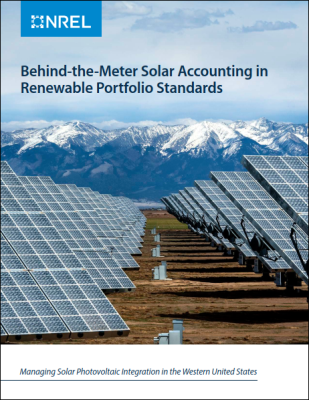
    How does the accounting of behind-the-meter solar photovoltaics (BTM PV) in a state’s renewable portfolio standard (RPS) influence the amount of renewable generation in a region? We show here that the answer depends on two key design elements of a state’s RPS: (1) whether renewable energy certificates (RECs) from BTM PV can be used for compliance and (2) whether load served by generation from BTM PV counts as load covered by the RPS.

    If load served by BTM PV generation counts toward load and the RECs cannot be used for compliance, generation from BTM PV increases the total renewable generation in the state on a 1:1 basis; however, no state currently implements an RPS in that form. In contrast, under a common RPS design in which BTM PV RECs can be used for compliance and load served by BTM PV generation is not covered by the RPS, the presence of BTM PV and transfer of RECs for compliance can actually decrease the total amount of renewable generation required in the region, relative to a situation in which there is no BTM PV.

    Para leer más ingrese a:

    https://www.osti.gov/biblio/1737535-behind-meter-solar-accounting-renewable-portfolio-standards

  • Research Roadmap on Grid-Forming Inverters

    Research Roadmap on Grid-Forming Inverters

    This research roadmap is intended to fill the knowledge gap by providing a system view of grid-forming inverter-based resource controls and their impact on grid stability, which we believe is central to meeting some of the challenges to operating the future North American electric power system. This includes the roles and requirements of grid-forming inverter-based resources—including solar photovoltaics, wind generators, and energy storage.

    For this roadmap, we focus on a specific family of grid-forming inverter control approaches that do not rely on an external voltage source (i.e., no phase-locked loop) and that can share load without explicit communications. Although the roadmap is focused narrowly on system challenges for grid-forming controls and power system stability, including interactions with protection, we hope it serves as a foundational element for future system-of-systems roadmapping needed in a broader grid modernization effort with increasing deployments of inverter-based resources.

    Para leer más ingrese a:

    https://www.osti.gov/biblio/1721727-research-roadmap-grid-forming-inverters

  • The 50 States of Electric Vehicles: States Evaluating Charging Infrastructure Needs and Ownership Models in Q2 2020

    The 50 States of Electric Vehicles: States Evaluating Charging Infrastructure Needs and Ownership Models in Q2 2020

    The report finds that 43 states and the District of Columbia took actions related to electric vehicles and charging infrastructure during Q2 2020 (see figure below), with the greatest number of actions relating to rebate programs, charging station deployment, studies, electric vehicle registration fees, and grant programs.

    The report discusses three trends in electric vehicle actions taken in Q2 2020: (1) states investigating the appropriate roles for utilities and private entities in charging infrastructure deployment, (2) states studying and planning for electric vehicle infrastructure needs, and (3) states and utilities offering electric vehicle or charging station incentives for low-income customers.

    Para leer más ingrese a:

    The 50 States of Electric Vehicles: States Evaluating Charging Infrastructure Needs and Ownership Models in Q2 2020

  • Financing Microgrids in the Federal Sector

    Financing Microgrids in the Federal Sector

    Recent high-impact events such as hurricanes and wildfires highlight the need for energy system resilience. One potential impact of these events is the loss of utility grid power to federal sites, negatively affecting the ability to carry out their missions.

    This paper explores procurement options and agreements that may be useful to federal agencies interested in implementing microgrids at their sites. Microgrid complexities, implementation considerations, and suggestions to get started are also discussed. This information will be most useful to agencies when they are exploring electric energy system resilience options and/or considering different procurement options to meet their needs.

    Para leer más ingrese a:

    https://www.osti.gov/biblio/1660176-financing-microgrids-federal-sector

  • Reinventing grid management for a new age

    Reinventing grid management for a new age

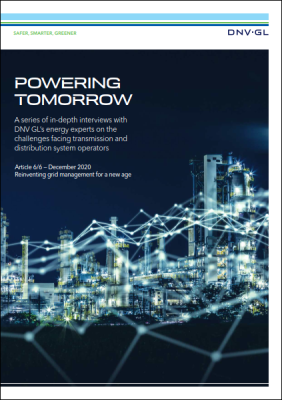
    This six-part series will explore the role TSOs and DSOs play in the energy transition; how to make networks smarter; the impact of electrification on network operations; the impact of the offshore wind revolution on power networks; and the levels of maturity in renewables integration.

    In the sixth interview of our Powering Tomorrow series, climate, energy and environment journalist Sonja van Renssen, spoke to our experts about:
     Rethinking grid stability
     The technologies that grid operators can adopt to manage increasingly complex networks
    The role of power electronics
     Advanced asset management and finding the optimal balance between risk, performance and cost

    Para leer más ingrese a:

    https://brandcentral.dnvgl.com/download/DownloadGateway.dll?utm_campaign=EN_ADV_GLOBAL_20Q1_AUTO_TR%26D_PoweringTomorrow_Download&utm_medium=email&utm_source=Eloqua&h=BE1B38BB718539CC0AB58A5FF2EA7A839347E15F4C606C93D71B660AFA43F9090C985C732D413EE43201B240E2BF8D5B&elqTrackId=6dc5fba3485c4c3188d460c45ecd7375&elq=a5243f0c4d9b44b1bdba144c051604c0&elqaid=15487&elqat=1&elqCampaignId=&elqcst=272&elqcsid=2177

  • A Guide to Energy Master Planning of High-Performance Districts and Communities

    A Guide to Energy Master Planning of High-Performance Districts and Communities

    This document serves as a framework for districts, campuses, and communities, illustrating an iterative process of building support for, planning, and implementing high-performance districts by engaging stakeholders, setting aggressive energy goals, completing technical and financial planning, and implementing a high-performance energy master plan.

    The information in this guide is based on a 3-year U.S. Department of Energy Zero Energy District Accelerator and a range of real-world examples of emerging high-performance districts. It is particularly useful for architects, planners, engineers, local government agencies, and real estate developers in the early phases of planning a district with high-performance or other deep energy goals.

    Para leer más ingrese a:

    https://www.osti.gov/biblio/1734654-guide-energy-master-planning-high-performance-districts-communities

  • Emissions Gap Report 2020 UNEP, UNEP DTU Partnership

    Emissions Gap Report 2020 UNEP, UNEP DTU Partnership

    The report finds that, despite a brief dip in carbon dioxide emissions caused by the COVID-19 pandemic, the world is still heading for a temperature rise in excess of 3°C this century – far beyond the Paris Agreement goals of limiting global warming to well below 2°C and pursuing 1.5°C.

    However, a low-carbon pandemic recovery could cut 25 per cent off the greenhouse emissions expected in 2030, based on policies in place before COVID-19. Such a recovery would far outstrip savings foreseen with the implementation of unconditional Nationally Determined Contributions under the Paris Agreement, and put the world close to the 2°C pathway. The report also analyses low-carbon recovery measures so far, summarizes the scale of new net-zero emissions pledges by nations and looks at the potential of the lifestyle, aviation and shipping sectors to bridge the gap.

    Para leer más ingrese a:

    https://www.unep.org/emissions-gap-report-2020

  • Emissions Gap Report 2020

    Emissions Gap Report 2020

    Every year, the Emissions Gap Report signals the difference between where greenhouse emissions are predicted to be in 2030 and where they should be to avoid the worst impacts of climate change.
    The 2020 report finds that a brief dip in carbon dioxide emissions caused by the COVID-19 pandemic will make no significant difference to long-term climate change.

    The world is still heading for a catastrophic temperature rise in excess of 3°C this century – far beyond the Paris Agreement goals of limiting global warming to well below 2°C and pursuing 1.5°C.
    But hope lies in a green recovery from the COVID-19 pandemic, which could help put the world close to the pathway to 2°C, and growing commitments to net-zero emissions by 2050 – although more work would be required to reach the 1.5°C goal.

    Para leer más ingrese a:

    https://www.unep.org/interactive/emissions-gap-report/2020/?s=09

    https://www.unep.org/emissions-gap-report-2020

  • The State Energy Efficiency Scorecard

    The State Energy Efficiency Scorecard

    The 2020 State Energy Efficiency Scorecard analyzes the energy efficiency efforts of all 50 U.S. states and Washington, DC. It tracks their policies and programs to reduce energy use, such as adopting or advancing energy-saving targets, vehicle rules, or appliance standards. It is the most comprehensive national measuring stick for energy efficiency—reviewing states on 32 metrics—and provides a roadmap for future improvements.

    This year’s Scorecard finds that states, many of which have set ambitious climate goals since 2018, had to abruptly shift their focus to mitigate the health and economic impacts of the deadly global pandemic. But some states were still able to make progress.

    Para leer más ingrese a:

    https://www.aceee.org/state-policy/scorecard?s=09

  • Modern Customer Engagement Journey Report

    Modern Customer Engagement Journey Report

    A unique research project that illustrates consumers’ attitudes and values related to energy, smart home technology, their electricity providers and more during the COVID-19 pandemic.

    This research was developed from more than 30 on-camera interviews recorded from June 15 to July 2 in the United States and Canada. These interviews focused on understanding the reasons behind consumers’ energy-related behaviors and their views on their electricity providers, renewable energy and other important issues.

    Para leer más ingrese a:

    Modern Customer Engagement Journey Report

Busca los documentos, noticias y tendencias más relevantes del sector eléctrico

Buscador de documentos
Buscador de noticias y tendencias

Banco de Información

Descripción del semáforo tecnológico

Los documentos se clasifican en varios colores tipo semáforo tecnológico que indican el nivel de implementación de la tecnología en el país

Tecnología en investigación que no ha sido estudiado o reglamentado por entidades del sector.

La tecnología se aplica de manera focal y se encuentra en estudio por parte de las entidades del sector.

La tecnología se aplica de manera escalable y se encuentran políticas y regulaciones focales establecidas.

La tecnología se aplica a través de servicios  y se encuentran políticas y regulaciones transversales establecidas.

La tecnología se aplica de manera generalizada  y se tiene un despliegue masivo de esta.

Para acceder a todos los documentos publicados y descargarlos ingresa aquí