Autor: Luisa Buitrago

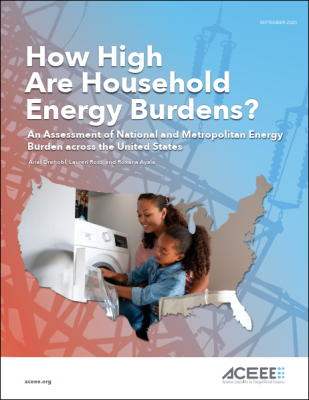
  • How High Are Household Energy Burdens? An Assessment of National and Metropolitan Energy Burdens

    How High Are Household Energy Burdens? An Assessment of National and Metropolitan Energy Burdens

    This report examines residential energy affordability at the national and regional levels as well as in 25 of the largest metropolitan areas in the United States. We analyze how household energy burdens—the percentage of household income spent on energy bills—vary across specific groups based on factors such as income, housing type and age, tenure, race and ethnicity, and occupant age.

    Findings demonstrate that high energy burdens are a persistent national challenge We also find that nationally, regionally, and across all metro areas, low-income, Black, Hispanic, Native American, and older adult households had disproportionally higher energy burdens than the average household. We conclude by highlighting weatherization as a long-term strategy that can mitigate high energy burdens, and we explore policy-related strategies to accelerate, improve, and better target low-income housing retrofits, energy efficiency and weatherization.

    Para leer más ingrese a:

    https://www.aceee.org/research-report/u2006

  • Climate Assembly UK’s report, The Path to Net Zero

    Climate Assembly UK’s report, The Path to Net Zero

    Climate Assembly UK’s report, The Path to Net Zero, shows how a representative sample of the population believe the UK should meet its net zero emissions commitment with detailed recommendations across ten areas including: how we travel; what we eat and how we use the land; what we buy; heat and energy use in the home; how we generate our electricity; and greenhouse gas removals.
    The report begins with forewords from the commissioning select committee Chairs and the assembly’s Expert Leads that place the assembly and its report in context.

    These forewords are followed by an opening statement from the assembly members that highlights the key themes emerging from their recommendations.
    The Executive Summary provides an overview of the key considerations and conditions agreed by Assembly members as well as the balance of support for each recommendation.
    Chapter 1 then provides detail of the assembly’s process and membership.
    Chapters 2 – 11 outline in depth the assembly’s recommendations and the rationale behind th

    Para leer más ingrese a:

    https://www.climateassembly.uk/report/?s=09

    https://www.climateassembly.uk/report/read/final-report.pdf

  • Renewable power pathways: Modelling the integration of wind and solar in India by 2030

    Renewable power pathways: Modelling the integration of wind and solar in India by 2030

    The power system must balance demand and supply at every location in the grid and at all times. In doing so, the power system already handles substantial variability, both on the demand side
    and the supply side. Demand changes over the course of the day; generating units experience technical faults; hydro output varies with the seasons, supply interruptions are witnessed due to
    sub-transmission and distribution outages, and so on.

    However, the introduction of the growing shares of variable renewable energies (VRE) such as wind and solar creates additional challenges for the power system. The power system needs to adapt to these new sources of variability, both in terms of short-term operations and longer-term system planning and investments.

    Para leer más ingrese a:

    https://www.energy-transitions.org/publications/renewable-power-pathways/

    https://www.energy-transitions.org/wp-content/uploads/2020/09/Renewable-Power-Pathways-Report.pdf

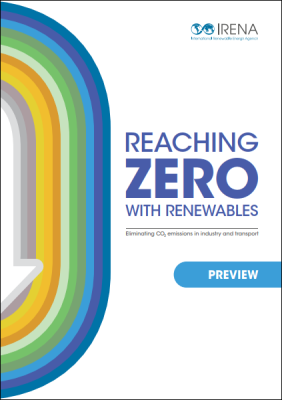
  • Reaching Zero with Renewables

    Reaching Zero with Renewables

    To avoid catastrophic climate change, the world needs to reach zero carbon dioxide (CO2) emissions in all all sectors of the economy by the 2050s. Effective energy decarbonisation presents a major challenge, especially in key industry and transport sectors.
    The International Renewable Energy Agency (IRENA) has produced a comprehensive study of deep decarbonisation options, focused on reaching zero into time to fulfil the Paris Agreement and hold the line on rising global temperatures.

    Several sectors stand out as especially hard to decarbonise. Four of the most energy-intensive industries (iron and steel, chemicals and petrochemicals, cement and lime, and aluminium) and three key transport sectors (road freight, aviation, and shipping) could together account for 38% of energy and process emissions and 29% of final energy use by 2050 without major policy changes now, the report finds.
    Reaching zero with renewables considers how these sectors could achieve zero emissions by 2060 and assesses the use of renewables and related technologies to achieve this. Decarbonisation options for each sector span efficiency improvements, electrification, direct heat, and fuel production using renewables, along with CO2 removal measures.
    Without such measures, energy and process emissions could amount to 11.4 gigatonnes from industry and 8.6 gigatonnes from transport at mid-century, the report indicates. Along with sector-specific actions, cross-cutting actions are needed at higher levels.

    Para leer más ingrese a:

    https://www.irena.org/publications/2020/Sep/Reaching-Zero-with-Renewables?s=09

    https://www.irena.org/-/media/Files/IRENA/Agency/Publication/2020/Sep/IRENA_Reaching_Zero_with_Renewables_Preview_2020.pdf

  • Energy Storage in Ukraine – Upcoming Regulatory Changes and New Opportunities

    Energy Storage in Ukraine – Upcoming Regulatory Changes and New Opportunities

    Ukraine is the biggest country in Europe by area, with a population of forty-two million people, and has one of the oldest, most centralised, most inflexible energy systems in Europe. Despite these challenges, Ukraine can decarbonise its energy system by embarking on an ambitious green energy transition agenda.
    The Ukrainian government, supported by key industry players such as the local TSO, is eager to take on this important challenge: the country has signed the Paris Agreement; it has decided to support the European Green Deal; and it aims to have 80% of RES in the energy mix by 2050.

    The ultimate goal is to transition to a carbon-neutral economy by 2070. Especially in the first months of 2020, the Ukrainian Government has increased its commitment to a greener energy system. Despite the COVID-19 pandemic, moreover, the Government does not plan to change its strategy. With the contribution of energy storage, Ukraine can achieve a greener, decarbonised, decentralised energy system.
    EASE, the European Association for Storage of Energy, and UESA, the Ukrainian Energy Storage Association, welcome these initiatives. The associations and their members, coming from Industry, research centres, and universities, aim to support Ukrainian stakeholders in this transition.

    Para leer más ingrese a:

    https://ease-storage.eu/publication/energy-storage-in-ukraine-upcoming-regulatory-changes-and-new-opportunities/

    https://ease-storage.eu/wp-content/uploads/2020/06/EASE-UESA-Workshop-on-Energy-Storage-Developments-in-Ukraine.pdf

  • Future Customer

    Future Customer

    How has COVID-19 shifted your shopping mindset? Are you more mindful of the brands you shop at? Our Future Customer special report, published in The Times, looks at how COVID-19 has prompted extreme changes in consumer demands and spending patterns, the potential TikTok marketing holds, and what’s next for bricks and mortar retail.

    It explores the rise of secondhand fashion and the impact it is having on prices, sustainability, and retail business models. It examines why beauty brand companies need to show honesty and accountability if they are truly passionate about change and activism. The featured infographic looks at how COVID-19 might be building customers into more mindful shoppers.

    Para leer más ingrese a:

    https://www.raconteur.net/future-customer-2020

  • Digital Transformation

    Digital Transformation

    97 per cent of business decision-makers say that COVID-19 pandemic has sped up digital transformation at their company, so what are the top digital priorities for businesses? Our Digital Transformation special report, published in The Times, looks at how coronavirus has accelerated transformation in business but also in education, the potential damage of cloud’s carbon footprint, and the key elements for a successful digital evolution.

    It explores the recent uptick in online activity impact on the environment and what cloud providers are about potential damage. The featured infographic examines how the pandemic has accelerated digital transformation and which technologies are in demand as a result.

    Para leer más ingrese a:

    https://www.raconteur.net/digital-transformation-2020-sep

  • Segundo reporte de Economía Circular

    Segundo reporte de Economía Circular

    El DANE presenta el Segundo reporte de Economía Circular para ilustrar, con la información disponible sobre la materia, el nivel de circularidad de la economía del país.

    Para tal fin, se presentan los indicadores clasificados en cuatro componentes: i) extracción de activos ambientales; ii) producción de bienes y servicios; iii) consumo y uso; y, iv) cierre y optimización en los ciclos de vida de los materiales y productos; así como un capítulo adicional que presenta 6 diagramas de Sankey que representan los flujos de la Cuenta Satélite Ambiental – CSA.

    Para leer más ingrese a:

    https://www.dane.gov.co/index.php/estadisticas-por-tema/ambientales/economia-circular?s=09

    https://www.dane.gov.co/files/investigaciones/boletines/economia-circular/economia-circular-2-reporte.pdf

  • 7 Priorities to Help the Global Economy Recover

    7 Priorities to Help the Global Economy Recover

    The COVID-19 crisis has brought the world economy to a standstill, provoking an abrupt fall in GDP and in international trade. In this unprecedented crisis, the first priority is to protect populations and urgently reinforce healthcare systems. As countries start to emerge from emergency, efforts are progressively turning to economic recovery.

    The Energy Transitions Commission has defined some key priorities to help the global economy recover while building a healthier, more resilient, net-zero-emissions economy. Governments have the choice, the power and the responsibility to build it faster with companies around the world.

    Para leer más ingrese a:

    https://www.energy-transitions.org/publications/7-priorities-to-help-the-global-economy-recover/

    https://www.energy-transitions.org/wp-content/uploads/2020/07/COVID-Recovery-Response-1.pdf

  • Delivering on America’s Pledge Achieving Climate Progress in 2020

    Delivering on America’s Pledge Achieving Climate Progress in 2020

    This report focuses on the 2030 impact of the global COVID-19 pandemic and subsequent economic recession. The report analyzes the long-term impacts of 2020 changes on the ability of states, cities, businesses, and others to drive the ambitious emissions reductions modeled in the December 2019 report Accelerating America’s Pledge.

    Even in the face of enormous challenges posed by the pandemic and slashed budgets; states, cities, businesses, universities, and others have steadily demonstrated commitments to strong climate and clean energy action and policy. The report also identifies how economic recovery and stimulus packages provide a critical opportunity to maintain momentum and further spur needed climate action.

    Para leer más ingrese a:

    https://www.americaspledgeonclimate.com/report-delivering-on-americas-pledge/

    https://assets.bbhub.io/dotorg/sites/28/2020/09/Delivering-on-Americas-Pledge.pdf

Busca los documentos, noticias y tendencias más relevantes del sector eléctrico

Buscador de documentos
Buscador de noticias y tendencias

Banco de Información

Descripción del semáforo tecnológico

Los documentos se clasifican en varios colores tipo semáforo tecnológico que indican el nivel de implementación de la tecnología en el país

Tecnología en investigación que no ha sido estudiado o reglamentado por entidades del sector.

La tecnología se aplica de manera focal y se encuentra en estudio por parte de las entidades del sector.

La tecnología se aplica de manera escalable y se encuentran políticas y regulaciones focales establecidas.

La tecnología se aplica a través de servicios  y se encuentran políticas y regulaciones transversales establecidas.

La tecnología se aplica de manera generalizada  y se tiene un despliegue masivo de esta.

Para acceder a todos los documentos publicados y descargarlos ingresa aquí