Autor: Luisa Buitrago

  • Development and Evaluation of Distributed Energy Resource Device Models: Electric Vehicles, Electric Water

    Development and Evaluation of Distributed Energy Resource Device Models: Electric Vehicles, Electric Water

    This report focuses on the experimental results obtained to develop and verify simulations of three specific EV models.

    This section summarizes elements of the mathematical model and shows the necessity data collected from the EVs while charging and discharging (driving). In the course of the study, we found it necessary to make some modifications to the model to deal with observed transient behavior. Section 1.2 details the model assumptions and equations, Section 1.3 provides details of the EVs tested, Section 1.4 outlines the test procedures developed for the projects, and Section 1.5 presents the experimental results obtained for the three different EVs tested and how these results compare to the models running the same test profiles.

    Para leer más ingrese a:
    https://www.nrel.gov/docs/fy20osti/75323.pdf

  • Model of Operation and Maintenance Costs for Photovoltaic Systems

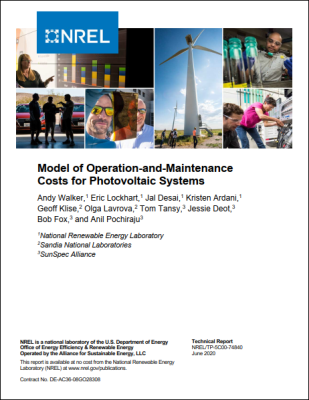
    Model of Operation and Maintenance Costs for Photovoltaic Systems

    This report presents a method for calculating costs associated with the operation and maintenance (O&M) of photovoltaic (PV) systems. The report compiles details regarding the cost and frequency of multiple O&M services to estimate annual O&M costs ($/year) for each year of an analysis period, the net present value ($) of life cycle costs accumulated over the analysis period, and the reserve account amount ($) that might be required to fund unexpected repairs. The reserve account includes parts inventory and is important for providing a source of funds to make repairs quickly and avoid lost production.

    This  method allows a detailed selection of services to perform based on system size, market served (e.g., residential, commercial, or utility), type and configuration of system components (e.g., micro-, string, or central inverter), and site and environmental conditions (e.g., pollen, bird populations) which is an improvement over simple per unit valuations of O&M costs ($/kW/year). This model also distinguishes costs that vary from year to year and increase at different rates over time as modeled by heuristic failure distributions (e.g., Weibull or Lognormal distribution) based on actuarial data for many of the services.

    Para leer más ingrese a:

    https://www.nrel.gov/docs/fy20osti/74840.pdf

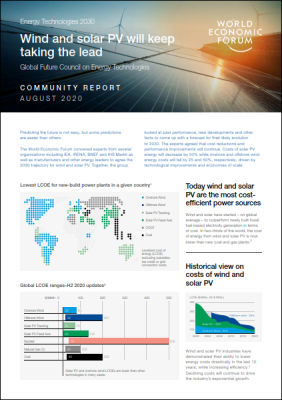
  • Wind and solar PV will keep taking the lead Global Future Council on Energy Technologies

    Wind and solar PV will keep taking the lead Global Future Council on Energy Technologies

    Predicting the future is not easy, but some predictions  are easier than others. The World Economic Forum convened experts from several organizations including IEA, IRENA, BNEF and IHS Markit as
    well as manufacturers and other energy leaders to agree the 2030 trajectory for wind and solar PV.

    Together, the group looked at past performance, new developments and other facts to come up with a forecast for their likely evolution to 2030. The experts agreed that cost reductions and performance improvements will continue. Costs of solar PV energy will decrease by 50% while onshore and offshore wind energy costs will fall by 25 and 50%, respectively, driven by technological improvements and economies of scale.

    Para leer más ingrese a:

    http://www3.weforum.org/docs/WEF_Wind_and_Solar_2030.pdf

  • Cybersecurity and Distributed Energy Resources

    Cybersecurity and Distributed Energy Resources

    This fact sheet addresses cybersecurity for distributed energy resources (DERs) and identifies best practices in cybersecurity governance, technical management of cyber-physical systems, and physical security.

    Para leer más ingrese a:

    https://www.nrel.gov/docs/fy20osti/76307.pdf

  • BENCHMARKING AFRICA’S MINIGRIDS

    BENCHMARKING AFRICA’S MINIGRIDS

    The Africa Minigrid Developers Association (AMDA) is proud to publish the first edition of our annual Benchmarking Africa’s Minigrids report, which for the first time measures industry performance through a comprehensive dataset across 12 countries and 28 companies, encompassing market leaders and newcomers.

    The report confirms the essential role of minigrids in ensuring delivery of affordable, clean and reliable electricity to all Africans, and spotlighted both barriers to accelerated growth and ways to overcome them.

    Para leer más ingrese a:

    http://africamda.org/index.php/news-2/thought-leadership/

    https://drive.google.com/file/d/1yX6z8cXlaGsS4j6UHNAQj0QwrVNi8cJ4/view?usp=sharing

  • PIMs for Progress Using Performance Incentive Mechanisms to Accelerate Progress on Energy Policy Goals

    PIMs for Progress Using Performance Incentive Mechanisms to Accelerate Progress on Energy Policy Goals

    Performance incentive mechanisms (PIMs) are receiving increased attention for their ability to better align utility incentives with new social and environmental policy goals. By transitioning to business models where an increasing share of revenues relies on efforts to build a clean, reliable, and affordable energy economy, utilities have the opportunity to better meet evolving customer, policy, and technological demands.

    PIMs can motivate utilities with financial rewards and penalties to deploy and utilize distributed energy resources (DERs), improve resilience, better engage customers, and deliver greenhouse gas (GHG) emissions reductions. However, the ability of PIMs to change the way the utility does business depends on their development, design, and implementation.
    RMI’s new report, PIMs for Progress, reviews a selection of historical PIM examples and provides a simple taxonomy of the results to identify important lessons for future PIM development. By exploring why some PIM proposals are rejected by regulators and others are accepted, as well as what happens to PIMs after acceptance, we can learn how these regulatory tools can best be leveraged in a shifting electricity landscape.

    Para leer más ingrese a:

    PIMs for Progress

  • Reimagining Grid Resilience A Framework For Addressing Catastrophic Threats to the US Electricity Grid

    Reimagining Grid Resilience A Framework For Addressing Catastrophic Threats to the US Electricity Grid

    Since its origins at the beginning of the last century, the electricity system has been a critical driver of US economic growth. Reliable and resilient delivery of electricity to homes and businesses is a foundation of national prosperity, and grid outages have grave consequences.

    The current grid is characterized by a one-way flow of services and value that convert primary energy to value-added services. This system, with its linear dependencies and easily disrupted individual components, is inherently fragile. Disruptions within any component of the grid can cause outages for customers.

    Para leer más ingrese a:

    https://rmi.org/insight/reimagining-grid-resilience/

    https://rmi.org/wp-content/uploads/2020/07/reimagining_grid_resilience.pdf

  • Energy Efficient Real Estate Listings: A Controlled Experiment

    Energy Efficient Real Estate Listings: A Controlled Experiment

    Can a real estate website that lists energy efficiency information increase traffic to energy efficient homes? This report describes a controlled study in which simulated real estate search results are used to disguise a discrete choice experiment. Using a large national sample of American home buyers (N = 1,538), we show that efficiency information can influence both simulated home purchase decision-making and willingness to pay for efficiency.

    We demonstrate that some strategies for presenting efficiency information are more effective than others. Specifically, voluntary labeling programs, in which only the most efficient homes receive labels, are less effective than programs where all homes are labelled. This report has important implications for cities, realtors, listing websites, and others wanting to make efficiency information more accessible.

    Para leer más ingrese a:

    https://www.aceee.org/research-report/b2002

  • ACE IOT Solutions Threat Profile

    ACE IOT Solutions Threat Profile

    Cybersecurity researchers from the Pacific Northwest National Laboratory (PNNL) have recently published a Threat Profile of ACE IoT Solutions’ commercial deployment of the Eclipse VOLTTRON platform.

    The Threat Profile, published by PNNL’s Secure Software Central (SSC) Team, provides ACE IoT and our customers with a clear understanding of potential threats against ACE IoT’s Cloud Platform and an independent assessment of ACE IoT’s approaches to mitigating security threats.

    Para leer más ingrese a:

    https://aceiotsolutions.com/journal/2020/pnnl-publishes-cybersecurity-threat-profile-of-ace-iots-eclipse-volttron-deployment.html?s=09

    https://volttron.org/sites/default/files/publications/ACE%20IoT%20Threat%20Profile%20v1.0.pdf

  • The Future of Bring Your Own Thermostat® white paper

    The Future of Bring Your Own Thermostat® white paper

    In this paper, originally authored as part of the Peak Load Management Association’s «Practitioner Perspectives» series, EnergyHub experts explain the rapid growth of BYOT demand response programs over the last several years and give you a glimpse at how BYOT will evolve in the next decade.

    EnergyHub designed, developed, and popularized the BYOT model with leading utilities and thought leaders 2012. Today, no company manages more BYOT programs than EnergyHub, with more than 30 utilities using EnergyHub’s Mercury DERMS platform to manage their demand response program.

    Para leer más ingrese a:

    https://www.energyhub.com/bring-your-own-thermostat-future?s=09

    https://cdn2.hubspot.net/hubfs/415845/White%20papers/Future%20of%20BYOT/future%20of%20byot%20energyhub.pdf

Busca los documentos, noticias y tendencias más relevantes del sector eléctrico

Buscador de documentos
Buscador de noticias y tendencias

Banco de Información

Descripción del semáforo tecnológico

Los documentos se clasifican en varios colores tipo semáforo tecnológico que indican el nivel de implementación de la tecnología en el país

Tecnología en investigación que no ha sido estudiado o reglamentado por entidades del sector.

La tecnología se aplica de manera focal y se encuentra en estudio por parte de las entidades del sector.

La tecnología se aplica de manera escalable y se encuentran políticas y regulaciones focales establecidas.

La tecnología se aplica a través de servicios  y se encuentran políticas y regulaciones transversales establecidas.

La tecnología se aplica de manera generalizada  y se tiene un despliegue masivo de esta.

Para acceder a todos los documentos publicados y descargarlos ingresa aquí