
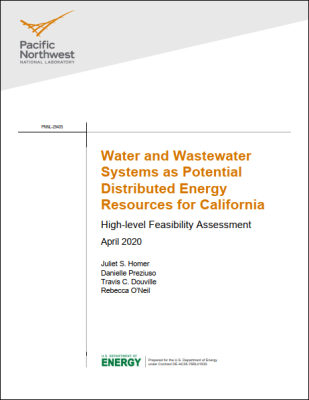
Water systems in California are a major electricity user, and electricity costs represent a significant portion of water utilities’ operating costs. Water and wastewater utilities have the capacity to shift demand in response to grid needs or price signals, and can generate power through biogas, hydropower, or onsite renewable energy systems like solar panels and wind turbines. This report points to some of the most promising opportunity areas for water and wastewater utilities to participate as distributed energy resources (DERs) while also carefully laying out practical considerations.
As the grid in California has shifted to high penetrations of solar, the resulting steep net load ramps and periods of solar overgeneration create opportunities for water and wastewater utilities that did not previously exist. Water utilities can be compensated for participating in demand response offerings either directly through the California Independent System Operator (CAISO), as in the new bi-directional proxy demand response product that compensates participants for both increasing and decreasing energy usage, or through load serving entities (such as utilities, community choice aggregators, or direct access providers). For water utilities, advanced energy optimization software and excess hydraulic storage capacity in some systems, allow for enhanced opportunities to participate in demand response programs.
Para leer más ingrese a:
https://www.pnnl.gov/main/publications/external/technical_reports/PNNL-29405.pdf
Compartir artículo
Para información general sobre la organización: difusion@colombiainteligente.org | Dirección: Edf. TecnoParque Cr 46#56-11 Piso 13 | Medellín – Colombia
Teléfono: +57-4-4441211 Ext. 171 | FAX: +57-4-4440460

Los documentos se clasifican en varios colores tipo semáforo tecnológico que indican el nivel de implementación de la tecnología en el país
Tecnología en investigación que no ha sido estudiado o reglamentado por entidades del sector.
La tecnología se aplica de manera focal y se encuentra en estudio por parte de las entidades del sector.
La tecnología se aplica de manera escalable y se encuentran políticas y regulaciones focales establecidas.
La tecnología se aplica a través de servicios y se encuentran políticas y regulaciones transversales establecidas.
La tecnología se aplica de manera generalizada y se tiene un despliegue masivo de esta.
Para acceder a todos los documentos publicados y descargarlos ingresa aquí