
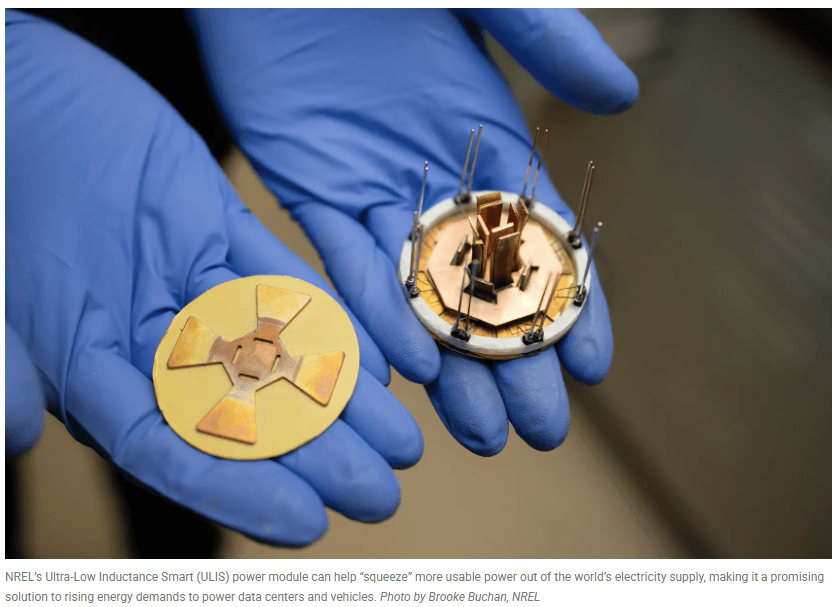
Global energy demands are surging, pushed by energy-intensive data centers powering artificial intelligence and increased manufacturing. How will the world meet these rising energy needs?
One answer is to get more use out of the energy we already produce and at a lower cost. In pursuit of this goal, NREL researchers have created a silicon-carbide-based power module—a physical housing for the power electronics that control the flow of electricity between systems—with never-before-seen efficiency, power density, and low-cost manufacturability.
The breakthrough, called NREL’s Ultra-Low Inductance Smart power module, is nicknamed ULIS. Powered by silicon carbide semiconductors, ULIS is capable of achieving five times greater energy density than predecessor designs in a smaller package, making it possible for manufacturers to build and power more efficient, compact, and lighter technologies. The 1200-volt, 400-amp power module is suitable for use in data centers, power grids, microreactors, and even heavy-duty vehicles such as next-generation aircraft and military vehicles.
Most importantly, ULIS boasts parasitic inductance—resistance to changes in electrical current, which is the primary hurdle to any electrical conversion—seven to nine times lower than any current state-of-the-art silicon carbide power module. Its ultrafast, ultraefficient switching of electrical current into usable forms allows ULIS to “squeeze” more usable power out of the electricity supply. This makes it a compelling solution to the world’s energy demand problem.
“We consider ULIS to be a true breakthrough,” said Faisal Khan, NREL’s chief power electronics researcher and the principal investigator for the project. “It’s a future-proofed, ultrafast power module that will make the next generation of power converters more affordable, efficient, and compact.”
Para leer más ingrese a:
Compartir artículo
Para información general sobre la organización: difusion@colombiainteligente.org | Dirección: Edf. TecnoParque Cr 46#56-11 Piso 13 | Medellín – Colombia
Teléfono: +57-4-4441211 Ext. 171 | FAX: +57-4-4440460

Los documentos se clasifican en varios colores tipo semáforo tecnológico que indican el nivel de implementación de la tecnología en el país
Tecnología en investigación que no ha sido estudiado o reglamentado por entidades del sector.
La tecnología se aplica de manera focal y se encuentra en estudio por parte de las entidades del sector.
La tecnología se aplica de manera escalable y se encuentran políticas y regulaciones focales establecidas.
La tecnología se aplica a través de servicios y se encuentran políticas y regulaciones transversales establecidas.
La tecnología se aplica de manera generalizada y se tiene un despliegue masivo de esta.
Para acceder a todos los documentos publicados y descargarlos ingresa aquí