Autor: DIFUSIÓN COLOMBIA INTELIGENTE

  • How the government shutdown is (and isn’t) impacting housing funds for cities

    How the government shutdown is (and isn’t) impacting housing funds for cities

    As the federal government shutdown enters its second week, here are three ways it is impacting housing funding for local governments.

    Previously approved funding for programs such as Community Development Block Grants, Home Investment Partnerships and Homeless Assistance Grants remain available for drawdown, according to a Sept. 29 shutdown contingency plan published by the Department of Housing and Urban Development.

    Grants that don’t require HUD staff can be withdrawn as usual, according to the plan. For funds requiring further action or review, furloughed staff will be recalled “intermittently to review and approve or deny disbursement requests as necessary to avoid an imminent threat to the safety of human life or property.”

    HUD will also continue to make payments under previously obligated Section 8 housing contracts.

    Para leer más ingrese a:

    https://www.smartcitiesdive.com/news/government-shutdown-housing-funds-impact/802357/

  • The government’s own data rebuts Trump’s claims about wind and solar prices

    The government’s own data rebuts Trump’s claims about wind and solar prices

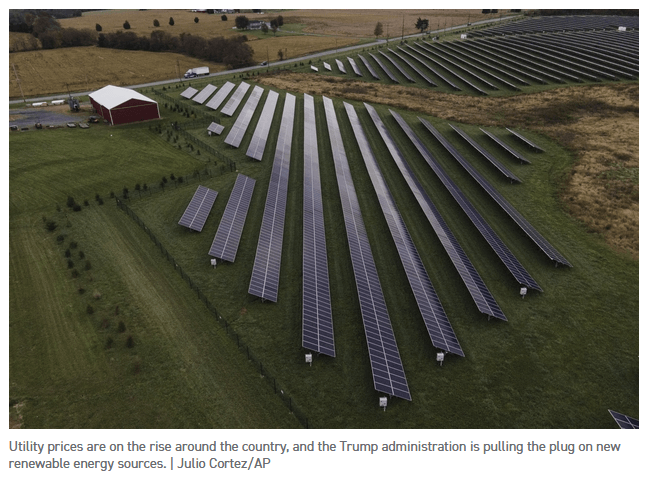
    States that embrace renewable energy are far more likely to save money for electricity consumers than those relying on fossil fuels or nuclear power, a POLITICO analysis of federal and industry data shows — findings that undermine one of the Trump administration’s main justifications for its aggressive rollback of federal clean energy policies.


    POLITICO’s analysis of U.S. Energy Information Administration power price data contradicts arguments by President Donald Trump and his appointees that a heavy dependence on wind and solar power drives up electricity prices. Trump repeated that claim in his speech late last month to the United Nations, describing wind as the “most expensive energy ever conceived” and contending that “all green is all bankrupt.”


    “We’re getting rid of the falsely named renewables,” said Trump, whose agencies have wiped out tens of billions of dollars in Biden-era clean energy and climate spending while pushing for more production of oil, natural gas and coal. “By the way, they’re a joke. They don’t work. They’re too expensive.”

    Para leer más ingrese a:

    https://www.politico.com/news/2025/10/07/green-electricity-costs-cheap-trump-00594123

  • AI Data Centers Are Sending Power Bills Soaring

    AI Data Centers Are Sending Power Bills Soaring

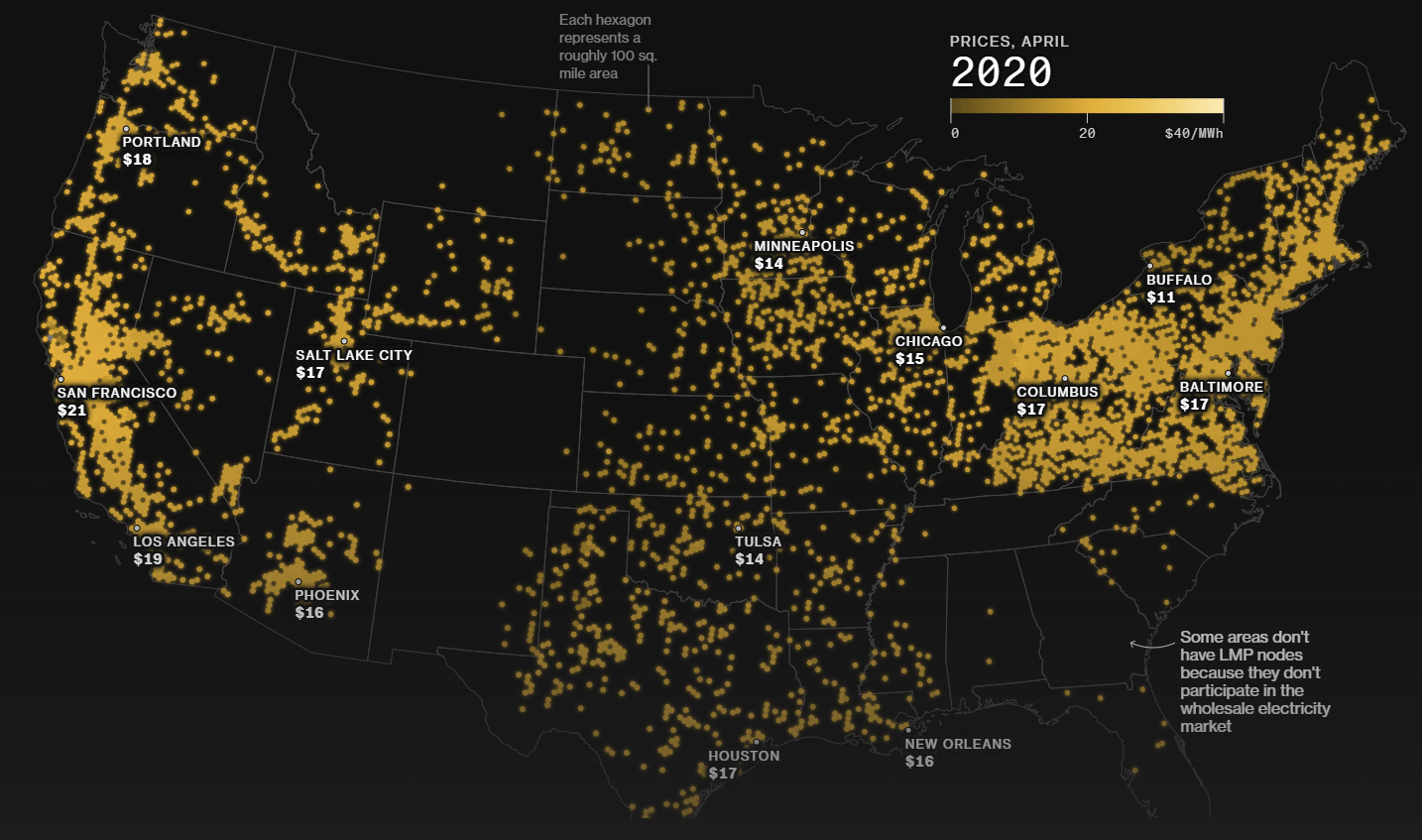
    El artículo examina cómo el auge de la inteligencia artificial ha impulsado la proliferación de centros de datos a gran escala, lo que a su vez está elevando los precios mayoristas de la electricidad en muchas zonas de Estados Unidos. En algunos nodos del sistema eléctrico, los costos han subido hasta un 267 % respecto a hace cinco años, especialmente en regiones cercanas a grandes infraestructuras de datos. Esta escalada repercute en las tarifas residenciales y comerciales, trasladando los costos del crecimiento tecnológico hacia el consumidor común.


    El análisis realizado por Bloomberg, apoyado en datos de miles de nodos eléctricos y ubicaciones de centros de datos, revela que más del 70 % de los incrementos de precio ocurren en nodos ubicados a menos de 50 millas de actividad significativa de centros de datos. Además, el artículo señala cómo compañías tecnológicas, reguladores y entidades de la red eléctrica están debatiendo cómo distribuir los costos de infraestructura adicional y garantizar que los grandes usuarios asuman una parte justa de la carga.

    Para leer más ingrese a:

    https://chatgpt.com/c/68ebc166-1288-8332-8077-8401de594648

  • Finance for just and inclusive energy transitions

    Finance for just and inclusive energy transitions

    As the world prepares for World Energy Congress 2026 in Riyadh, the spotlight must turn to  financing the future – how funds can be mobilised, directed, and transformed to support multiple, diverse energy pathways and approaches in varied geographies worldwide, while ensuring that no one is left behind.  

    Why climate finance is the missing link 

    Despite clear targets and a surge in technologies, the financing required to achieve a lower carbon, equitable future remains insufficient, especially in emerging and developing economies. The cost of capital for such projects is often prohibitively high, and the risks associated with new technologies or markets can deter private investment. Without targeted financial flows and appropriate derisking, even well intended policies and projects risk deepening existing inequalities and leaving behind the very communities most vulnerable to climate change and energy poverty. 

    Principles of just and inclusive finance 

    A just and inclusive energy future requires that finance be sufficient, accessible, affordable, and aligned with social and economic priorities. This means: 

    • Mainstreaming the needs of diverse populations in the design and implementation of inclusive finance instruments. 
    • Blending public and private finance to de-risk investments and catalyse large-scale capital flows. This can be particularly important in developing countries. 
    • Prioritising underserved regions and communities, ensuring high-quality project development, equitable access to funding and opportunities for participation. 

    Para leer más ingrese a:

    https://worldenergycongress.org/news-list/finance-inclusive-energy-transitions

  • The Surprising Value of the Energy You Don’t Use

    The Surprising Value of the Energy You Don’t Use

    Going from gas pump to tire, less than a quarter of the energy in every gallon is converted into motion — most goes missing as heat, friction, and exhaust — and less than one percent ends up moving the driver. In your kitchen, only a third or so of that blue-flame heat penetrates the kettle — the remainder vents away. And in data centers humming to serve up videos and answer questions, just a third of the electricity is powering the calculations — another two thirds goes to heating their power supplies, spinning their fans, and chilling their waste heat. Counting all the losses end-to-end, only about 0.01 percent of the power-plant fuel ends up delivering customer value.

    Energy waste is everywhere, largely invisible, and shockingly valuable. Taken together, these losses across the world’s energy supply systems add up to $4.5 trillion every year — or nearly 5 percent of global GDP. Converting delivered energy into useful services – such as hot showers and cold beer — wastes at least 80 percent of what’s left.

    In many cases, affordable — indeed, often profitable — solutions are available to cut the waste, improve efficiency, and save money. That’s why prioritizing energy efficiency is an essential part of the solution to ease the transition to clean energy. Because renewables waste less energy generating and transmitting energy, wind and solar power can double or even triple the efficiency of electricity production. And pairing clean energy supplies with conventionally improved end-uses —  such as variable-speed electric motors or electric heat pumps — can then double efficiency again.

    Para leer más ingrese a:

    The Surprising Value of the Energy You Don’t Use

  • Stronger incentives in grid development to go beyond business as usual

    Stronger incentives in grid development to go beyond business as usual

    Business as usual is hardly a solution in unusual times. In the case of electricity networks, business as usual means that an increase in the demand for grid capacity is satisfied by building new lines or deploying larger transformers. However, electricity networks are not experiencing usual times: over the coming years, the European electricity system is expected to support the integration of a significant amount of additional renewable energy sources and the electrification of a large share of final energy uses. In this context, following traditional approaches to network development and operation is likely to be a recipe for delay and cost escalation. Fortunately, developments in technology, in particular in digital and power electronic solutions that allow better monitoring and control of electric cables and substations,[1] offer the opportunity to satisfy the increasing needs of electricity grid users with less investment in (new) physical assets and reduced lead times.[2]


    However, technological innovation is not enough if we want to go beyond business as usual. Transmission and distribution system operators, like any economic actor, choose the best technology depending on the incentives they face.[3] In their case, incentives are mostly determined by the regulatory framework they are subject to as part of their franchise. In the European Union, the details of such a framework are defined at the Member State level by national regulatory authorities (for an exhaustive overview, look at the annual report by CEER). While any generalisation should be taken with caution, it is normally possible to say that most of the allowed revenues of electricity system operators are driven by the recovery of the expenses associated with investments in physical assets, including the remuneration of invested capital. If you combine this fact with the typical system operators’ duty of ensuring the continuous and secure supply of electricity, something that can be more comfortably achieved with ‘oversized’ networks, it is apparent that going beyond business as usual in electricity network development and operation might be difficult.

    Para leer más ingrese a:

    https://fsr.eui.eu/stronger-incentives-in-grid-development-to-go-beyond-business-as-usual/

  • Why cybersecurity’s future depends on people, not just technology

    Why cybersecurity’s future depends on people, not just technology

    For years, the story of cybersecurity has been told in the language of machines. Firewalls, antivirus software, intrusion detection systems and now quantum computing and artificial intelligence — each new tool promised to outpace the next wave of attackers.

    But for all of this innovation, breaches still happen every day аnd most of them are not caused by cutting-edge exploits, but by people. In 2024, for example, 95% of data breaches were tied to human error.

    Sophisticated defences often break down because workers don’t have the cybersecurity training to use them correctly. And so, if digital resilience is the target, investment in people needs to match investment in teсhnology.

    The manner in which we train people to work in the cyber world has remained the same over many years, even as technological change has left the traditional curricula behind. Degrees will continue to be significant but they cannot be the only way to implement cybersecurity training.


    Credentialing must be faster and more adaptive. Short courses developed in collaboration with industry, governments аnd universities can provide students and mid-career workers with skills that are up-to-date. Generative tools created using artificial intelligence (AI) can help courses stay current, of course, but they should always be used in collaboration with human educators and security professionals. Without that partnership, the training will always lag behind the threat.


    Just as important, training cannot stop at the IT department. Every employee from those on a factory floor to the CEO, needs еnough cyber awareness to spot suspicious activity and reaсt responsibly. The goal is not to turn everyone into a cybersecurity expert, but to close the gap between specialists and the rest of the organization.

    Para leer más ingrese a:

    https://www.weforum.org/stories/2025/10/cybersecurity-people-not-just-technology/

  • Are coastal nuclear power plants at risk from sea level rise and climate change?

    Are coastal nuclear power plants at risk from sea level rise and climate change?

    As sea levels rise and hurricanes grow more intense, the infrastructure in their path includes a large share of the world’s nuclear power plants. China, for instance, is building nuclear energy faster than any other country—concentrated along the Pacific Ocean.1

    The main reason to locate nuclear plants by the sea is because coastal areas attract large cities, and those cities need energy. But it’s also good engineering, says Curtis Smith, professor of nuclear science and engineering at MIT and a specialist in nuclear safety and regulations. A nuclear reactor generates immense heat, and that heat needs to be safely transferred to the plant’s turbines to make electricity. Typically, plants use pumped-in water for this purpose. Water is also used to shed excess heat from the reactor, protecting it from meltdown.

    “If you have water nearby, you use it,” says Smith. “So there are a lot of nuclear power plants by coastlines and waterways.”

    Climate change presents increased hazards for these plants. On average, sea levels have risen 8 to 9 inches over the past century, exposing many coastal areas to more flooding—with further and faster rise on the way.2 Warming oceans also fuel more powerful hurricanes, whose lashing winds, torrential rainfall and storm surges all threaten coastal infrastructure.

    Nuclear engineers and regulators should factor these hazards into their planning, Smith says. But, he adds, nuclear power plants have a head start over other vital infrastructure when it comes to managing climate risks.

    Para leer más ingrese a:

    https://climate.mit.edu/ask-mit/are-coastal-nuclear-power-plants-risk-sea-level-rise-and-climate-change

  • Working to make fusion a viable energy source

    Working to make fusion a viable energy source

    Following his undergraduate degree in aerospace engineering, Tynann’s work in the industry spurred his interest in rocket propulsion technology. Because most methods for propulsion involve the manipulation of hot ionized matter, or plasmas, Tynan focused his attention on plasma physics.

    It was then that he realized that plasmas could also drive nuclear fusion. “As a potential energy source, it could really be transformative, and the idea that I could work on something that could have that kind of impact on the future was really attractive to me,” he says.

    That same drive, to realize the promise of fusion by researching both plasma physics and fusion engineering, drives Tynan today. It’s work he will be pursuing as the Norman C. Rasmussen Adjunct Professor in the Department of Nuclear Science and Engineering (NSE) and at MIT’s Plasma Science and Fusion Center (PSFC).

    Tynan’s enthusiasm for science and engineering traces back to his childhood. His electrical engineer father found employment in the U.S. space program and moved the family to Cape Canaveral in Florida.

    This was in the ’60s, when we were launching Saturn V to the moon, and I got to watch all the launches from the beach,” Tynan remembers. That experience was formative and Tynan became fascinated with how fluids flow.

    Para leer más ingrese a:

    https://news.mit.edu/2025/working-make-fusion-viable-energy-source-george-tynan-0917

  • The Opportunity for Grid Connectivity, Intelligence, and Flexibility in Africa

    The Opportunity for Grid Connectivity, Intelligence, and Flexibility in Africa

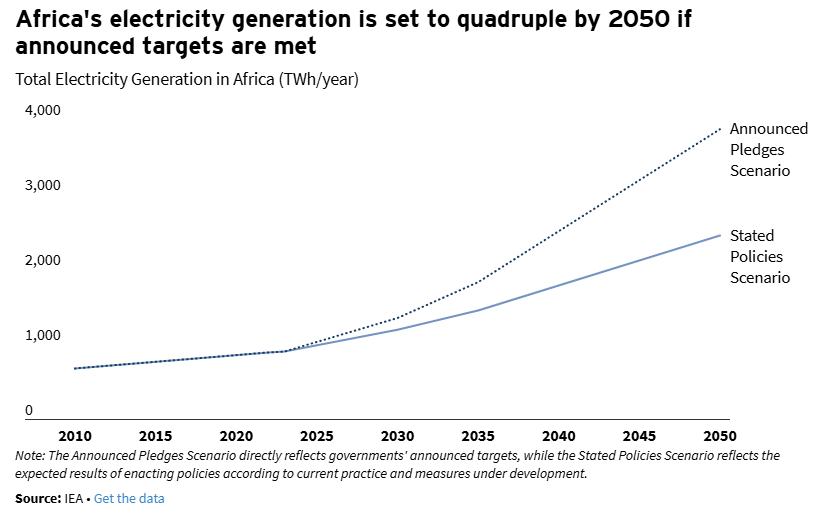
    Delivering power at least cost requires physical infrastructure, such as the solar panels and batteries in clean energy portfolios, as well as the information infrastructure that allows these components to work together. Emergent climate tech is part of both dimensions. On the physical infrastructure side, innovations in long-duration energy storage, for example, will be crucial to a stable grid with a high penetration of variable renewable resources. On the information infrastructure side, the distributed energy resources (DERs) on the grid need to coordinate with these energy storage resources to route excess power to storage, for example, to an iron-air battery or distributed EV batteries owned by customers participating in a vehicle-to-grid program. This piece focuses on the information infrastructure, with the view that emergent climate tech is key to building the intelligent, flexible, and interconnected grids that can wring the most value from the physical infrastructure of today — and of the future.

    Electricity grids across the continent are struggling to meet current customer demands. In 2025, most traditional utilities in Africa are manually operating analog electricity systems, with limited knowledge of who their customers are and where their assets are located.

    In Nigeria, only 25% of the 12 gigawatts (GW) of installed generation capacity is available due to constraints in generating, transmitting, and distributing power to customers.3 Further, only about half of the electricity there that is distributed to customers is ultimately billed and paid for: in a granular energy audit of the Port‑Harcourt distribution network, billing efficiency stood at only 68.6% and collection efficiency at 76.3%, resulting in an Aggregate Technical, Commercial, and Collection (ATC&C) loss of 49.5%.4 Data from the Nigerian Electricity Regulatory Commission routinely find ATC&C losses ranging from 40%–50% across utilities.5 Most of these distribution networks are operated with manual switches and interfaces. Under these conditions, the difference between overloading a transformer or shutting down safely can come down to whether someone looks at readings on site and makes a phone call to decide when to throw a switch.

    Para leer más ingrese a:

    The Opportunity for Grid Connectivity, Intelligence, and Flexibility in Africa

Busca los documentos, noticias y tendencias más relevantes del sector eléctrico

Buscador de documentos
Buscador de noticias y tendencias

Banco de Información

Descripción del semáforo tecnológico

Los documentos se clasifican en varios colores tipo semáforo tecnológico que indican el nivel de implementación de la tecnología en el país

Tecnología en investigación que no ha sido estudiado o reglamentado por entidades del sector.

La tecnología se aplica de manera focal y se encuentra en estudio por parte de las entidades del sector.

La tecnología se aplica de manera escalable y se encuentran políticas y regulaciones focales establecidas.

La tecnología se aplica a través de servicios  y se encuentran políticas y regulaciones transversales establecidas.

La tecnología se aplica de manera generalizada  y se tiene un despliegue masivo de esta.

Para acceder a todos los documentos publicados y descargarlos ingresa aquí