Autor: DIFUSIÓN COLOMBIA INTELIGENTE

  • El hongo «fotosintético» de Chernóbil que se alimenta de radiación y que podría ayudar a colonizar Marte

    El hongo «fotosintético» de Chernóbil que se alimenta de radiación y que podría ayudar a colonizar Marte

    ¿Qué conceptos se te vienen a la cabeza cuando piensas en Chernóbil? Quizás sea central nuclear, desastre, radiación, letalidad o lugar inhóspito. Y no estarían mal: se trata de un ambiente contaminado por radiación donde, incluso, es raro encontrar insectos. Pero es curioso ya que, a pesar de estar abandonado desde hace décadas… sigue habiendo vida en él. En las sombras de este entorno tan hostil, crece un hongo negro que no solo sobrevive a la radiación, sino que se alimenta de ella.


    Su nombre científico es Cladosporium sphaerospermum, pero algunos lo llaman “el hongo fotosintético de la oscuridad”. Aunque suene como si se tratase de una criatura sacada de una novela de ficción, es un organismo muy real y que crea una gran curiosidad entre el panorama científico. Y no solo porque desafiase lo que creíamos posible sobre la vida en la Tierra, sino porque también podría ser útil a la hora de salir de ella.


    Este curioso hongo fue descubierto en uno de los lugares donde, para ser sinceros, menos se esperaba descubrir algo: en las ruinas de la central nuclear de Chernóbil, en Ucrania. Tras el desastre nuclear de 1986, la zona se convirtió en un entorno tan contaminado por la radiación que se volvió inhabitable para la mayoría de las formas de vida. Pero, sorprendentemente, este hongo no solo resistió esas condiciones, sino que prosperó en ellas.

    Para leer más ingrese a:

    https://www.nationalgeographic.com.es/ciencia/hongo-fotosintetico-chernobil-que-se-alimenta-radiacion-y-que-podria-ayudar-a-colonizar-marte_25423

  • España, a la cabeza del proyecto europeo que sustituirá las baterías de iones de litio por una tecnología muy superior

    España, a la cabeza del proyecto europeo que sustituirá las baterías de iones de litio por una tecnología muy superior

    Un consorcio europeo, liderado por centros y empresas españolas, ha dado el primer paso en el inicio del proyecto TALISSMAN para desarrollar baterías de litio-azufre de quinta generación, que prometen convertirse en una revolución en el almacenamiento de energía para la movilidad sostenible.


    Con un presupuesto cercano a los 5 millones de euros procedentes del programa Horizonte Europa, la iniciativa tendrá una duración de 48 meses y está llamada a impulsar la electrificación en sectores tan exigentes como el transporte pesado, la aviación eléctrica y la automoción.


    Bajo la coordinación de CIDETEC Energy Storage, cuatro entidades españolas, CIDETEC, Airbus Operations, Tecnalia Research & Innovation y Sustainable Innovations, se han aliado con cinco socios de Francia, Alemania e Italia para diseñar, validar y escalar dos tecnologías de baterías: una híbrida semisólida, prevista para 2027, y otra completamente sólida, proyectada para 2030.

    Para leer más ingrese a:

    https://www.hibridosyelectricos.com/coches/espana-cabeza-proyecto-europeo-sustituira-baterias-iones-litio-por-tecnologia-muy-superior_80962_102.html

  • Startup estadounidense convierte mercurio común en oro y produce energía limpia al mismo tiempo

    Startup estadounidense convierte mercurio común en oro y produce energía limpia al mismo tiempo

    Una empresa de Silicon Valley, afirma haber desarrollado un método escalable para convertir mercurio en oro utilizando reactores de fusión nuclear.

    • Oro como subproducto de reactores de fusión nuclear.
    • Transformación de mercurio-198 en oro-197.
    • Hasta 5 toneladas de oro por gigavatio eléctrico.
    • Proceso basado en transmutación nuclear, no alquimia.
    • Oportunidad para abaratar la energía limpia.
    • En desarrollo, pero con implicaciones económicas y ambientales clave.


    La antigua obsesión alquímica de convertir metales comunes en oro podría estar más cerca de cumplirse, pero no por medio de magia ni fórmulas crípticas, sino gracias a los reactores de fusión nuclear. La empresa Marathon Fusion ha anunciado que su tecnología de reactor tipo tokamak podría transformar mercurio común en oro como subproducto de sus operaciones. Y lo más interesante: no se trataría de una rareza de laboratorio, sino de una reacción sostenible y económicamente significativa.

    Para leer más ingrese a:

    https://ecoinventos.com/marathon-fusion/
  • The World’s 20 Most Powerful AI Supercomputers

    The World’s 20 Most Powerful AI Supercomputers

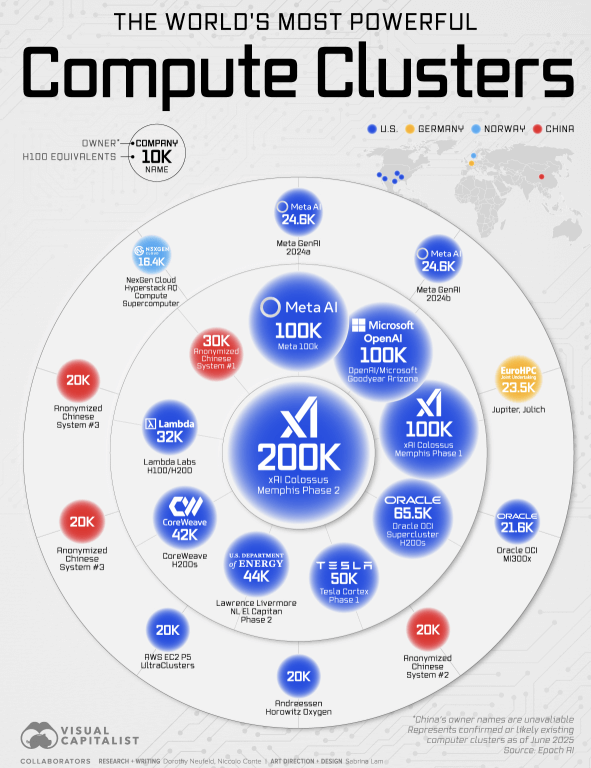
    Tech companies are rapidly building AI supercomputers, also known as GPU clusters or AI datacenters, by packing them with ever-growing numbers of chips for training advanced AI models. So far, the U.S. has taken the lead, as Big Tech firms pour billions into AI infrastructure to secure a competitive edge.


    xAI’s Colossus Memphis Phase 2 tops the chart with 200,000 H100 equivalents—twice the size of the next largest cluster.


    Colossus delivers 20.6 on the base-10 scale for non-sparse operations—over 400 quintillion per second. That would be enough compute power to train OpenAI’s 2020 GPT-3’s full two-week cycle in under two hours.


    Other major players are also scaling up. Meta’s 100K system, Microsoft/OpenAI’s Goodyear cluster, and Oracle’s H200-based machine follow, with GPU counts between 65,536 and 100,000.


    Notably absent from public rankings are Google and Amazon, which have not disclosed as much information on their AI hardware builds.

    Para leer más ingrese a:

    https://www.visualcapitalist.com/the-worlds-most-powerful-ai-supercomputers/

  • Solar and Storage Stability

    Solar and Storage Stability

    When extreme weather threatens lives and livelihoods, solar and battery storage are there to deliver energy security for the American people. Extreme weather events, from scorching heat waves to destructive hurricanes to frigid winter storms, are constantly challenging our aging infrastructure. When power lines fall or gas plants freeze, distributed solar and energy storage can be life savers, and over the past several years, these technologies are increasingly stepping up to deliver reliability and safety when it matters most.


    When the sun is at its hottest and demand peaks, solar power is a crucially important generation source. This June, large swaths of the country were scorched by a severe heat wave that stressed our aging grid. Demand for air conditioning soared, gas plants needed to reduce capacity, and the heat threatened rolling blackouts across the region. Thankfully, solar paired with battery storage stepped up to provide cool relief for American families. In New England, solar panels and a network of batteries supplied several gigawatts of power in key moments, saving households an estimated $20 million.


    This is no isolated incident. As heat waves have become more frequent and severe in recent years, solar and storage have been working overtime to make sure the AC stays on and people stay safe. Texas has led new solar additions for the last several years, and those investments have shored up resources in response to a heat wave in 2023 and have strengthened the grid in preparation for this summer. During Europe’s record heat wave this June, solar generation set records in 13 countries and was the largest source of electricity for the EU in June.

    Para leer más ingrese a:

    https://seia.org/blog/solar-and-storage-stability/

  • Geothermal Energy

    Geothermal Energy

    The Earth’s core contains radioactive metals that constantly give off heat. Where this heat reaches the surface, it can fuel roiling hot springs or erupt in explosive geysers.

    The first geothermal power plants were built on these natural sources of steam. Steam from hot springs turned a turbine to power a generator, just like in a coal-fired power plant.1

    Modern geothermal plants find or make steam deeper underground. A pair of wells is drilled into the Earth, up to around 3 kilometers (nearly 2 miles) deep, where the rock is boiling hot.2 Water is pumped into the first well to seep into pores and cracks in the rock below. As the water heats up, it emerges from the second well and becomes steam that turns a turbine. Water can be continuously recycled through this system, making electricity all the while.

    These power plants must be built on a very specific geology, with permeable rock and high heat near the Earth’s surface. This has mostly limited geothermal power to regions with lots of tectonic activity, like California, Indonesia, the Philippines, and Central America.

    In small countries with rich underground heat, geothermal can be an important part of the power mix. Kenya gets almost half its electricity from geothermal,3 and Iceland uses geothermal for 30% of its electricity and nearly all its home heating.4 But globally, only around 0.3% of electricity comes from geothermal.5

    Modern drilling technology is pushing these limits. As the cost of drilling falls, several countries have explored building geothermal power outside tectonically active areas, in places where the high heat needed lies deeper underground.

    Para leer más ingrese a:

    https://climate.mit.edu/explainers/geothermal-energy
  • Reality Check: Reinvesting at Coal Plant Sites with Clean Energy Upgrades Supports both Reliability and Affordability

    Reality Check: Reinvesting at Coal Plant Sites with Clean Energy Upgrades Supports both Reliability and Affordability

    Coal’s role in the power sector has been declining for years:  the aging coal fleet is increasingly unreliable and expensive to operate — creating billions of dollars in losses for ratepayers annually — and lower cost sources of power have grown exponentially to take its place.

    From an operations and planning perspective, transitioning away from coal requires proactive action to minimize the risk of disruptions that could stem from turning these legacy generators off overnight. Notably, utilities, states, and regional grid operators all do thorough analyses today to ensure that planned retirements will not negatively impact the grid and will provide cost benefits for customers. As such, forcing retiring coal to support grid reliability is incredibly costly and burdensome for customers, with minimal reliability benefit.

    For coal plants without imminent retirement dates, one way that utilities can make a smooth transition away from coal — in a way that benefits ratepayers and communities and avoids reliability cliffs — includes pairing economic dispatch and clean repowering. In other words, utilities can operate coal less often and more flexibly, and by doing so make room for low-cost replacement power to quickly support the grid.

    Para leer más ingrese a:

    https://rmi.org/reality-check-reinvesting-at-coal-plant-sites-with-clean-energy-upgrades-supports-both-reliability-and-affordability/
  • How Microgrids and DERs Pitch in During Heatwaves to Support the Grid–and Earn Income

    How Microgrids and DERs Pitch in During Heatwaves to Support the Grid–and Earn Income

    From June 23 to June 26, when the Northeast and Midwest experienced record high temperatures, Scale Microgrids kept all its microgrid customers in the region powered, offset customers’ demand by 86% and reduced demand by 9.1 MW, freeing up much-needed power for the grid.


    During that time period, the company’s microgrids responded to eastern U.S. grid operator PJM’s Emergency Load Response Program event, said Spencer Bernstein, senior director, client success at the company.


    For one customer, Scale Microgrids met its commitment to PJM to reduce capacity, cutting the customer’s demand by an average 4.3 MW, he said.


    Over the same time period, Bloom Energy’s microgrids–which can include fuel cells, solar, wind, energy storage and combined heat and power systems–supplied over 5 GWh of electricity across the region, said Bala Naidu, vice president of energy transition at Bloom Energy.

    Para leer más ingrese a:

    https://www.microgridknowledge.com/distributed-energy/article/55302960/how-microgrids-and-ders-pitch-in-during-heatwaves-to-support-the-gridand-earn-income

  • Wildfire Resilience as a Grid Imperative: Lessons from SDG&E’s Wildfire and Climate Resilience Center

    Wildfire Resilience as a Grid Imperative: Lessons from SDG&E’s Wildfire and Climate Resilience Center

    The 2007 Witch Fire was the catalyst event spurring SDG&E’s mitigation and resilience efforts. As presented by SDG&E, this was the event that changed the course of how SDG&E approached the wildfire space. From that moment forward, wildfire planning became a central function within their utility operations.


    As a result, SDG&E has established one of the country’s most advanced and data-driven wildfire mitigation strategies. While not all the learnings in California are replicable in other geographies, elements of SDG&E’s approach, such as risk quantification, predictive modeling, and cross-agency coordination, are transferable for utilities and regulators outside of the wildfire-prone West.


    In the past 18 years, SDG&E has built out five key elements of their strategy:


    1. Situational Awareness
    2. Predictive Modeling
    3. Grid Hardening and AI-Driven Inspection and Detection
    4. Quantifying Risk and Resilience
    5. Internal and External Coordination and Partnerships

    Para leer más ingrese a:

    https://sepapower.org/knowledge/wildfire-resilience-as-a-grid-imperative-lessons-from-sdges-wildfire-and-climate-resilience-center/

  • GRID INVESTMENTS: REGULATORY EVALUATION AND INCENTIVES

    GRID INVESTMENTS: REGULATORY EVALUATION AND INCENTIVES

    La comunicación energética en situaciones de emergencia requiere un enfoque estratégico que combine preparación institucional, claridad en los mensajes y capacidad de adaptación a escenarios altamente cambiantes. Para ello, es indispensable contar con marcos regulatorios claros, protocolos previamente establecidos y una coordinación eficaz entre entidades públicas, privadas y medios de comunicación. Una gestión comunicacional efectiva comienza con una planificación previa, que define responsabilidades, canales de comunicación y procedimientos para diferentes tipos de eventos, desde cortes de suministro hasta crisis por fenómenos naturales.

    El contexto actual, marcado por la transformación digital y el aumento en la frecuencia de eventos extremos, exige que los entes reguladores y operadores del sistema no solo informen, sino también construyan confianza en la ciudadanía. En ese sentido, resulta fundamental identificar los públicos objetivos, comprender sus necesidades de información y adaptar los mensajes a formatos comprensibles y culturalmente relevantes. La segmentación de audiencias facilita una respuesta más efectiva, dado que permite el uso de distintos medios y enfoques narrativos según la urgencia y naturaleza de la emergencia. Asimismo, la coordinación entre actores institucionales se vuelve imprescindible para evitar mensajes contradictorios. La existencia de una vocería técnica única, respaldada por evidencia y con capacidad de decisión, permite una comunicación más coherente, evitando especulaciones que podrían agravar la situación. En paralelo, la implementación de herramientas tecnológicas, como plataformas digitales de información en tiempo real, contribuye a mantener actualizada a la población y permite retroalimentación inmediata.

    Un aspecto determinante en este proceso es la preparación previa de los comunicadores. La capacitación continua de los equipos responsables y la realización de simulacros periódicos fortalecen la capacidad de respuesta, mientras que la incorporación de aprendizajes pasados permite refinar los protocolos. El análisis post-evento cobra especial relevancia, dado que brinda insumos para mejorar los mecanismos de comunicación ante futuras contingencias. Otro componente destacado es la necesidad de promover la transparencia informativa. Compartir con anticipación los riesgos, escenarios probables y medidas preventivas no solo disminuye el nivel de alarma, sino que fomenta una actitud proactiva por parte de la ciudadanía. La comunicación debe ser proactiva y no únicamente reactiva, anticipando escenarios y empoderando a la población con herramientas claras y realistas.

    El entorno regulatorio también desempeña un rol significativo. Establecer normativas que promuevan la obligación de comunicar con prontitud y precisión, así como mecanismos de supervisión, fortalece la rendición de cuentas institucional. La existencia de estándares comunes, incluso a nivel regional, permite una mayor coherencia y colaboración transfronteriza ante eventos que afectan a múltiples jurisdicciones. La inclusión de enfoques diferenciales garantiza que la comunicación sea efectiva en contextos diversos. Considerar aspectos como el acceso limitado a tecnologías digitales, la diversidad lingüística o las condiciones de vulnerabilidad socioeconómica evita que ciertos grupos queden excluidos de la información. Esto permite respuestas más equitativas y eficaces ante eventos que afectan la seguridad energética.

    En conjunto, la comunicación en emergencias energéticas requiere una estructura flexible, pero robusta, con roles definidos, mensajes claros, públicos bien identificados y mecanismos de aprendizaje constante. Más allá de la tecnología o las herramientas disponibles, lo que determina su efectividad es la capacidad de generar confianza, facilitar decisiones informadas y coordinar acciones entre múltiples actores.

    Para leer más ingrese a:

    https://erranet.org/erra-report-grid-investment/

    https://erranet.org/download/grid-investments-regulatory-evaluation-and-incentives/?wpdmdl=137131&refresh=6875cc4e450dc1752550478

Busca los documentos, noticias y tendencias más relevantes del sector eléctrico

Buscador de documentos
Buscador de noticias y tendencias

Banco de Información

Descripción del semáforo tecnológico

Los documentos se clasifican en varios colores tipo semáforo tecnológico que indican el nivel de implementación de la tecnología en el país

Tecnología en investigación que no ha sido estudiado o reglamentado por entidades del sector.

La tecnología se aplica de manera focal y se encuentra en estudio por parte de las entidades del sector.

La tecnología se aplica de manera escalable y se encuentran políticas y regulaciones focales establecidas.

La tecnología se aplica a través de servicios  y se encuentran políticas y regulaciones transversales establecidas.

La tecnología se aplica de manera generalizada  y se tiene un despliegue masivo de esta.

Para acceder a todos los documentos publicados y descargarlos ingresa aquí