Autor: DIFUSIÓN COLOMBIA INTELIGENTE

  • Anushree Chaudhuri: Involving local communities in renewable energy planning

    Anushree Chaudhuri: Involving local communities in renewable energy planning

    Anushree Chaudhuri has a history of making bold decisions. In fifth grade, she biked across her home state of California with little prior experience. In her first year at MIT, she advocated for student recommendations in the preparation of the Institute’s Climate Action Plan for the Decade. And recently, she led a field research project throughout California to document the perspectives of rural and Indigenous populations affected by climate change and clean energy projects.


    “It doesn’t matter who you are or how young you are, you can get involved with something and inspire others to do so,” the senior says.

    Initially a materials science and engineering major, Chaudhuri was quickly drawn to environmental policy issues and later decided to double-major in urban studies and planning and in economics. Chaudhuri will receive her bachelor’s degrees this month, followed by a master’s degree in city planning in the spring.

    Para leer más ingrese a:


  • Dutch developer Lion Storage planning 1.5GWh BESS for 2026 operation

    Dutch developer Lion Storage planning 1.5GWh BESS for 2026 operation

    Like the country’s two largest operational BESS projects, it will be located in the Vlissingen port area, one of the Netherlands’ new ‘energy hubs’, Lion Storage said. Energy-Storage.news interviewed the owner of both of those projects, SemperPower, recently for a Premium article.

    Lion said the location gives it direct access to the high-voltage network operated by the country’s transmission system operator TenneT.

    Energy-Storage.news has asked the company what progress has been made on the Mufasa project, considering it has been listed on its website for over a year with the same commercial operation date, and will update this article when a response is received.

    Para leer más ingrese a:


  • With Bushfires, Floods and Unreliable Electricity, Australia Could Benefit from Microgrids, But Challenges Stand in the Way

    With Bushfires, Floods and Unreliable Electricity, Australia Could Benefit from Microgrids, But Challenges Stand in the Way

    Many communities in Australia hit by bushfires, floods, unreliable electricity and extended power outages are looking into community microgrids, but a number of obstacles stand in the way, according to a report by two researchers from the Institute for Sustainable Futures at the University of Technology Sydney.

    The researchers interviewed community members who had proposed 25 of the 36 projects funded by a $50.4 million grant program from the Australian government’s Regional and Remote Communities Reliability Fund (RRCRF) for microgrid feasibility studies in over 110 communities across Australia.

    25 projects in 78 communities studied

    The 25 projects studied by the Institute for Sustainable Futures were located in 78 of the 110 communities, said Scott Dwyer, research director for the institute.

    Para leer más ingrese a:


  • Advanced solar panels still need to pass the test of time

    Advanced solar panels still need to pass the test of time

    But how can we tell that new solar technologies will stand the test of time? I’m fascinated by the challenge of predicting how new materials will hold up in decades of tough conditions. That’s been especially tricky for one emerging technology in particular: perovskites. They’re a class of materials that developers are increasingly interested in incorporating into solar panels because of their high efficiency and low cost. 

    The problem is, perovskites are notorious for degrading when exposed to high temperatures, moisture, and bright light … all the things they’ll need to withstand to make it in the real world. And it’s not as if we can sit around for decades, testing out different cells in the field for the expected lifetime of a solar panel—climate change is an urgent problem. The good news: researchers have made progress in both stretching out the lifetime of perovskite materials and working out how to predict which materials will be winners in the long run. 

    Para leer más ingrese a:


  • Private 5G networks provide secure foundation for Industry 4.0

    Private 5G networks provide secure foundation for Industry 4.0

    The Industry 4.0 revolution is spurring digital transformation and modernization initiatives across the manufacturing, logistics, and commercial sectors. Industrial organizations in pursuit of game-changing efficiency and productivity gains are making substantial investments in robotics, deploying IoT sensors throughout their facilities, and putting devices in the hands of every production-line and warehouse worker.

    A recent ABI Research survey of U.S. manufacturers revealed that data privacy and security are the biggest challenges and the top priority for digital transformation investments. The shift to Industry 4.0 is creating a perfect storm of cybersecurity risk fueled by three factors:

    • The expanding OT/IT footprint increases the attack surface and complexity.
    • The increasing rate and sophistication of cyberattacks on critical infrastructure.
    • The transition to wireless as the foundation of industrial networks.

    Para leer más ingrese a:


  • Weather the Disruption: Building Resilience Against Climate Change

    Weather the Disruption: Building Resilience Against Climate Change

    Climate change has increased the probability of wildfires in fire-prone areas. Implementing practices to increase resiliency, decrease damage, and lower costs from natural disasters can help businesses avoid potential financial impacts and remain operational.

    Recovering from Maui Fires
    Vulnerable power grids, including deteriorating components and aged infrastructure, increase the risk of wildfires. Due to the fires in early August, 2023, the island of Maui, Hawaii, is estimated to face more than $5.5 billion in rebuilding costs,1 impacting local businesses and the economy of the region.

    Building Energy Resilience 
    Climate change and global warming have increased natural disasters such as heatwaves, wildfires, and hurricanes, resulting in twice as many power outages from severe weather. The US Government Accountability Officer estimated weather-related power outages can cost companies and consumers billions of dollars annually. Investing in energy grid sustainability will assist businesses in being more resilient and, in turn, prevent the additional costs associated with business shutdowns and rebuilding that often come with power outages.

    Para leer más ingrese a:


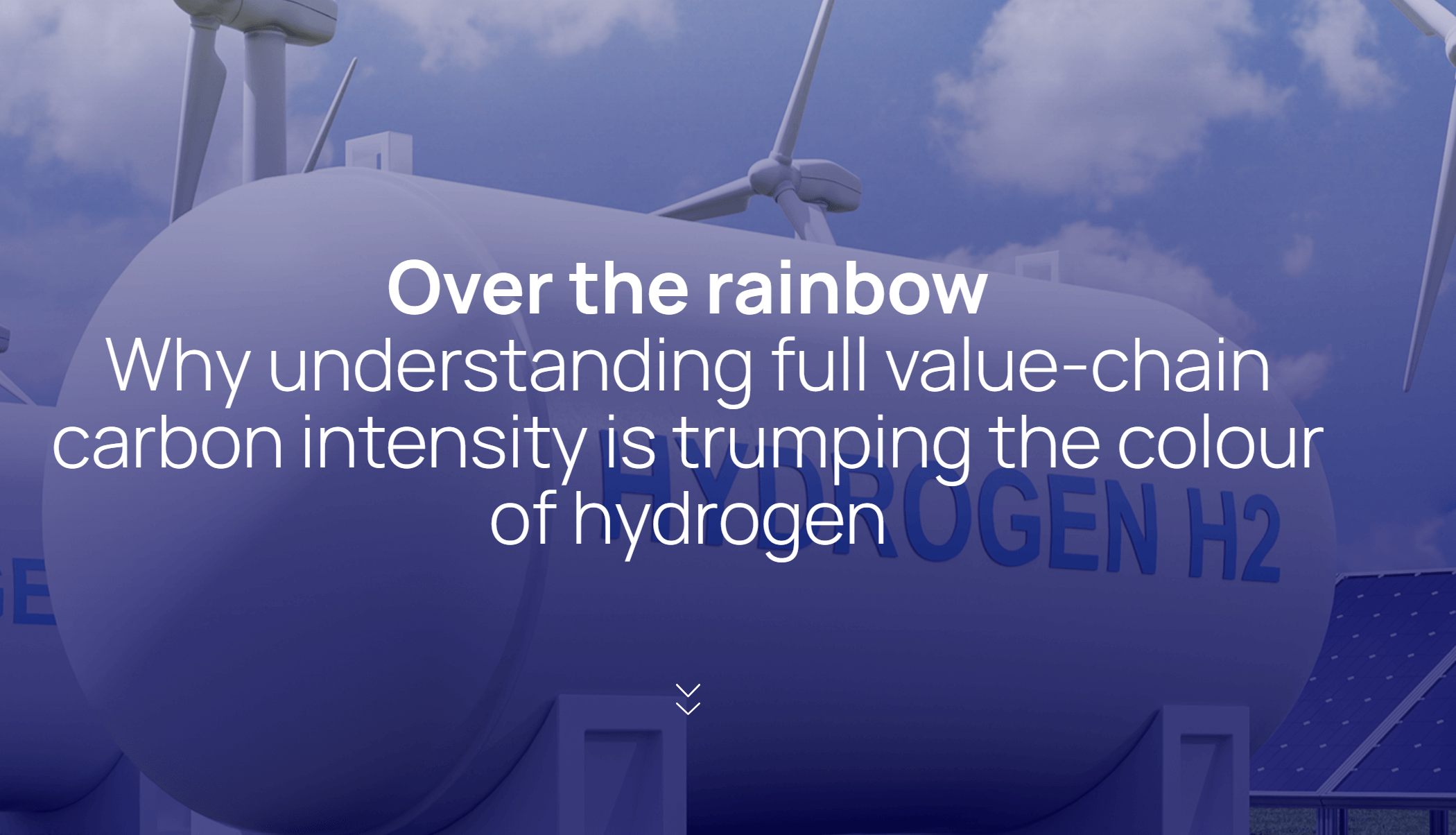
  • Why understanding full value-chain carbon intensity is trumping the colour of hydrogen

    Why understanding full value-chain carbon intensity is trumping the colour of hydrogen

    Labelling hydrogen by colour is a popular way of differentiating its production process. The hydrogen ‘rainbow’ includes brown hydrogen, made using coal, and grey hydrogen, produced from natural gas. Blue hydrogen is grey or brown hydrogen produced using carbon capture and storage (CCS) to cut carbon dioxide emissions, while green hydrogen, produced from water through electrolysis fuelled by renewable power, offers the potential for near zero emissions.

    As momentum builds around low-carbon hydrogen, the industry is having to look past colour labels. The future of low-carbon hydrogen hinges on governments putting in place regulations, subsidies and other incentives that are increasingly tied to the carbon intensity ‒ rather than the colour ‒ of the hydrogen produced.

    Calculating hydrogen’s carbon intensity is complex. For green (electrolytic) hydrogen, emissions can range from almost zero to levels beyond those of brown hydrogen. Green hydrogen is, in principle, made using 100% renewable energy. In practice, however, what is described as ‘green’ can also be produced using power from a grid that relies heavily on fossil fuels.

    Para leer más ingrese a:


  • Generative AI and the future of work in Australia

    Generative AI and the future of work in Australia

    In a 2019 report, Australia’s automation opportunity: Reigniting productivity and inclusive income growth, McKinsey examined the possible impact of automation on the future of work. Australia’s economy was at the tail end of a three-decade boom and losing momentum fast—yet the automation wave was on the horizon, bringing the possibility of inclusive economic growth and an uplift in productivity. The report found that, to realize this promise, Australia would need to embrace rapid automation adoption and facilitate social inclusion in the process.1

    Half a decade later, a lot has changed—not least because of the profound shifts that the COVID-19 pandemic brought to the Australian economy. In 2023, generative AI (gen AI) emerged as a significant new force with the potential to reshape the future of work.2 With its advanced natural language capabilities, gen AI could become ubiquitous, embedded into knowledge workers’ everyday tools (see sidebar, “What is generative AI?”). As gen AI continues to evolve through 2030, it could affect a more comprehensive set of work activities, transforming skills demand in Australia.

    Para leer más ingrese a:


  • NIST Establishes AI Safety Consortium

    NIST Establishes AI Safety Consortium

    The U.S. AI Safety Institute is a joint public and private sector research group and data-sharing space for “AI creators and users, academics, government and industry researchers, and civil society organizations,” according to NIST.

    Organizations could apply to become members between Nov. 2, 2023 and Jan. 15, 2024. Out of more than 600 interested organizations, NIST chose 200 companies and organizations to become members. Participating organizations include Apple, Anthropic, Cisco, Hewlett Packard Enterprise, Hugging Face, Microsoft, Meta, NVIDIA, OpenAI, Salesforce and other companies, academic institutions and research organizations.

    Those members will work on projects including:

    • Developing new guidelines, tools, methods, protocols and best practices to contribute to industry standards for developing and deploying safe, secure and trustworthy AI.
    • Developing guidance and benchmarks for identifying and evaluating AI capabilities, especially those capabilities that could cause harm.
    • Developing approaches to incorporate secure development practices for generative AI.
    • Developing methods and practices for successfully red-teaming machine learning.
    • Developing ways to authenticate AI-generated digital content.
    • Specifying and encouraging AI workforce skills.

    Para leer más ingrese a:


  • Navigating Industry 4.0: A guide for the rest of us

    Navigating Industry 4.0: A guide for the rest of us

    Back in 2011, a term popped up at a big tech fair in Hannover, Germany, that was set to change the game for factories and businesses everywhere. This term was “Industry 4.0,” (or “Industrie 4.0” in its original context) and it was part of Germany’s high-tech strategy to make their manufacturing smarter.

    What started as a fancy way to say “let’s make our factories more digital” has gained traction all across the world and grown into something much bigger. Now, Industry 4.0 is about shaking up how every part of an industrial business runs, from the front desk all the way to the delivery truck.

    Para leer más ingrese a:

     
    https://www.smartindustry.com/benefits-of-transformation/digital-transformation/article/33036599/navigating-industry-40-a-guide-for-the-rest-of-us


Busca los documentos, noticias y tendencias más relevantes del sector eléctrico

Buscador de documentos
Buscador de noticias y tendencias

Banco de Información

Descripción del semáforo tecnológico

Los documentos se clasifican en varios colores tipo semáforo tecnológico que indican el nivel de implementación de la tecnología en el país

Tecnología en investigación que no ha sido estudiado o reglamentado por entidades del sector.

La tecnología se aplica de manera focal y se encuentra en estudio por parte de las entidades del sector.

La tecnología se aplica de manera escalable y se encuentran políticas y regulaciones focales establecidas.

La tecnología se aplica a través de servicios  y se encuentran políticas y regulaciones transversales establecidas.

La tecnología se aplica de manera generalizada  y se tiene un despliegue masivo de esta.

Para acceder a todos los documentos publicados y descargarlos ingresa aquí