Autor: Luisa Buitrago

  • Smart Electrification with Renewables: Driving the Transformation of Energy Services

    Smart Electrification with Renewables: Driving the Transformation of Energy Services

    Los países de todo el mundo necesitan gran expansión de las energías renovables, redes eléctricas más inteligentes y un gran aumento del número de vehículos, Estos tres elementos -combinados en una estrategia de «electrificación inteligente»- serán cruciales para dar forma al nuevo sistema energético dominado por las renovables. 

    The world has made the transition from one dominant form of energy to another several times. The replacement of fossil fuels with renewables marks the next historic shift. Yet, to ensure sustainability and global climate stability, this latest energy transformation needs to happen much faster. electricity’s growth begin as soon as possible, as every year the increase in electrification with renewables is delayed means an even greater acceleration is needed. If the world would like to hold the line at a 1.5°C temperature increase, then the pace of electrification with renewables must accelerate further still to meet additional clean electricity uses required by 2050.


    Para mayor información ingrese a los siguientes enlaces:  

    https://www.irena.org/publications/2022/Feb/Smart-Electrification-with-Renewables  
    https://www.irena.org/-/media/Files/IRENA/Agency/Publication/2022/Feb/IRENA_Smart_Electrification_Renewables_2022.pdf  


  • Developing digital Ecosystems that drive industry alignment and new business opportunities

    Developing digital Ecosystems that drive industry alignment and new business opportunities

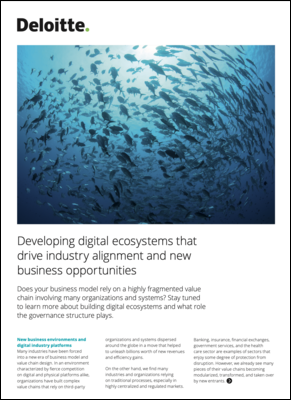
    Muchas industrias se han visto obligadas a entrar en una nueva era de diseño de modelos de negocio y cadenas de valor. En un entorno caracterizado por una competencia feroz tanto en las plataformas digitales como en las físicas. presentamos un marco sencillo que incluye todas las dimensiones que impulsan el éxito de los ecosistemas digitales. 

     Does your business model rely on a highly fragmented value chain involving many organizations and systems? Stay tuned to learn more about building digital ecosystems and what role the governance structure plays. organizations have built complex value chains that rely on third-party organizations and systems dispersed around the globe. 


    Para mayor información ingrese a los siguientes enlaces:  

     https://www2.deloitte.com/dl/en/pages/legal/articles/digitale-oekosysteme-governance.html  

    https://www2.deloitte.com/content/dam/Deloitte/de/Documents/legal/Deloitte-Digital-Ecosystems.pdf  

  • Security and Privacy for public DNS Resolvers

    Security and Privacy for public DNS Resolvers

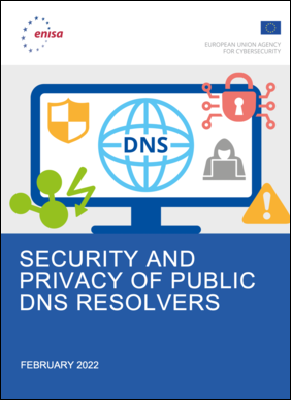
    En este articulo, presentamos y analizamos los principales factores que impulsan el cambio de los resolutorios de DNS públicos y la evolución de los protocolos de resolución de DNS. Examinamos los aspectos de seguridad y residencia de estos cambios.

     In the DNS resolution market there is a shift towards large-scale public DNS resolvers, such as Google, Cloudflare and Quad9, using new DNS resolution protocols like DoH and DoT. These encryption protocols mean that there is an inflection point where changes are being made in DNS settings, consciously by the user or by the service provider within the applications or operating system during upgrades. This brings an opportunity to change not only the protocol itself, but the server from which answers are obtained. This means that DNS queries, which are critical and sensitive, are starting to be handled with different protocols and by different entities that are often based in a different country or even continent than the user.


    Para mayor información ingrese a los siguientes enlaces:  

    https://www.enisa.europa.eu/publications/security-and-privacy-for-public-dns-resolvers  

    https://www.enisa.europa.eu/publications/security-and-privacy-for-public-dns-resolvers/@@download/fullReport

  • European Economic Forecast. Winter 2022 

    European Economic Forecast. Winter 2022 

     La economía de la UE entró en el nuevo año con una nota más débil de lo previsto; El resurgimiento de la pandemia el pasado otoño y la propagación exponencial de la nueva variante Omicron han provocado nuevas tensiones en los sistemas sanitarios y un aumento sin precedentes de las bajas laborales en muchos países de la UE. 

     Having regained the pre pandemic output level in summer last year, a moderate slowdown was already expected in the Autumn Forecast. However, since   then headwinds to growth have intensified. After a soft patch, the economic expansion is set to regain pace in the second quarter of this year and remain  robust over the forecast horizon. Following a strong recovery by 5.3% in 2021, the EU economy is now forecast to grow by 4.0% in 2022, as in the euro  area, and by 2.8% in 2023 (2.7% in the euro area). 


    Para mayor información ingrese a los siguientes enlaces:  

    https://ec.europa.eu/info/publications/european-economic-forecast-winter-2022_es  

    https://ec.europa.eu/info/sites/default/files/economy-finance/ip169_en.pdf  

  • Foresighting Skills for Net Zero Homes

    Foresighting Skills for Net Zero Homes

    El Reino Unido cuenta con uno de los parques de viviendas más antiguos e ineficientes de Europa y se prevé que alrededor del 90% del parque de viviendas existente siga en uso en 2050. Las viviendas representan alrededor del 15% de las emisiones anuales de CO2 del Reino Unido. Para cumplir el compromiso del Gobierno de alcanzar el nivel cero, el parque de viviendas y los sistemas de calefacción del Reino Unido requerirán una revisión radical. 

    No other sector of the economy has the potential to accelerate the Net Zero ambition and create the same volume of high-quality jobs as the decarbonisation of our homes. However, the educational system and the wider sector is underprepared for this retrofit revolution. Higher Education and Further Education curricula focus almost entirely on new build and fossil-fuel burning technologies, to the detriment of retrofit and low carbon technologies. This challenge must be addressed collaboratively, building on existing best practice, identifying gaps and bringing together different elements of the supply chain to create joined up solutions that will work for customers and businesses alike.


    Para mayor información ingrese a los siguientes enlaces:  

    https://es.catapult.org.uk/report/foresighting-skills-for-net-zero-homes/  

    https://esc-production-2021.s3.eu-west–2.amazonaws.com/2022/01/MW4dbmRW-ESC-Gatsby-Skills-Report-2021-Web-Version.pdf  

  • New Nature Economy Report III: Seizing Business Opportunities in China’s Transition Towards a Nature-positive Economy 

    New Nature Economy Report III: Seizing Business Opportunities in China’s Transition Towards a Nature-positive Economy 

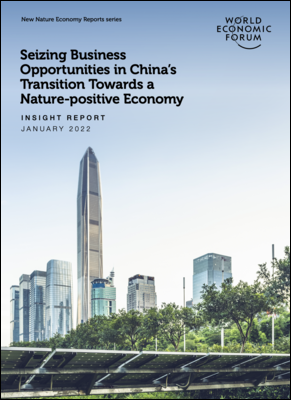
    Desde las reformas y la apertura de la economía a finales de la década de 1970, china ha logrado un notable éxito económico. Ha mejorado notablemente la vida de sus ciudadanos y ha logrado construir una sociedad moderadamente próspera; siendo uno de los países mas biodiversos del planeta, china alberga ecosistemas, especies y variedad genética únicos, con el 10% de las especies vegetales del mundo y el 14% de las especies animales.

    In 2010, China became the world’s second-largest economy, It has markedly improved its citizens’ lives and succeeded in building a moderately prosperous society. The past four decades have seen 700 million people lifted out of poverty, with the urbanization rate increasing from 18% in 1978 to 63.9% today. Average annual income per capita increased from $120 in 1978 to $9,000 in 2019. As one of the most biodiverse countries on earth. 


    Para mayor información ingrese a los siguientes enlaces: 
     

    https://www.weforum.org/reports?year=2022#filter  

    https://www3.weforum.org/docs/WEF_New_Nature_Economy_Report_China_2022.pdf 

  • African Renewable Electricity Profiles for Energy Modelling Database: Hydropower

    African Renewable Electricity Profiles for Energy Modelling Database: Hydropower

    Esta base de datos ofrece perfiles de disponibilidad estacional de la energía hidroeléctrica en años normales, secos y húmedos, tanto en el clima actual como en escenarios climáticos futuros. 

    Hydropower is typically subject to strong seasonality’s, driven by rainfall patterns, snowmelt and other hydrological phenomena. comprehensive databases of the seasonal availability of hydropower are currently unavailable to the modeling community, which hampers research efforts to asses the spatiotemporal synergies between variable renewable energy and hydropower.


    Para mayor información ingrese a los siguientes enlaces:  

    https://www.irena.org/publications/2021/Dec/African-Renewable-Electricity-Profiles-Hydropower  

    https://www.irena.org/-/media/Files/IRENA/Agency/Publication/2021/Dec/IRENA_Africa_Hydropower_Database_2021.pdf  

  • The Need for Advanced Chemistry Energy Storage Cells in India

    The Need for Advanced Chemistry Energy Storage Cells in India

    Este informe traza la necesidad de almacenamiento de energía en los sectores clave y proyecta la demanda de baterías en la India hasta 2030. El informe prevé una demanda acumulada de baterías de entre 106 GWh y 260 GWh en función del ritmo de adopción de los vehículos eléctricos y de la descarbonización de la red. 

    India has outlined an ambitious target of 500 GW of non fossil fuel based energy generation in India by 2030 and to reduce the total projected carbon  emissions by 1 billion tons by same period. To attain these targets, India needs a significant amount of grid storage and a large increase in the number of electric vehicles (EVs). While mobility is the primary driver of  demand growth, energy storage is expected to see  significant uptake for grid support applications to enable a resilient power sector and facilitate the integration of increasingly higher shares of variable renewable energy. 


    Para mayor información ingrese a los siguientes enlaces:  

    https://rmi.org/insight/the-need-for-advanced-chemistry-energy-storage-cells-in-india/  

    https://rmi.org/insight/the-need-for-advanced-chemistry-energy-storage-cells-in-india/#download-form  

  • E-Privacy Regulation impacts on DSOs

    E-Privacy Regulation impacts on DSOs

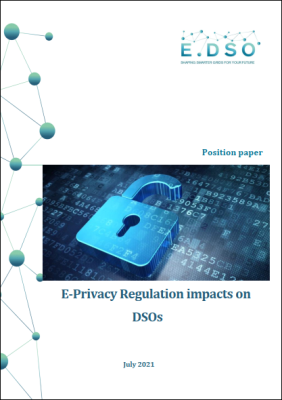
    En los cuatro años transcurridos desde que la Comisión Europea presentó por primera vez la propuesta de Reglamento sobre la privacidad electrónica, la importancia de los datos y las comunicaciones electrónicas se ha visto muy reforzada, especialmente durante la pandemia.   Los avances en el expediente han sido considerables. Sin embargo, aunque el Consejo ha estudiado formas de mejorar el texto, quedan demasiadas preocupaciones sin resolver, y las sucesivas enmiendas siguen creando más incertidumbre que claridad.  

    In this light, E.DSO tailored a position paper in which observations are made available to move forward with a much mature text for trilogue negotiations. With this input, we touch upon aspects of the draft Regulation that negotiating parties should consider ahead of trilogue compromise amendments. 

    Our evaluation of the proposed e-Privacy Regulation relies on the following considerations: 

    • Energy services are different from other services targeted by the Regulation: they use digital tools and telecom networks to provide essential services to electricity customers, based on legal obligations. 
    • Smart meters should be recognised as a specific tool to provide these energy services. This should be endorsed in the provisions of the proposal. 
    • DSOs’ missions and responsibilities should not be hindered, which would be the case if the e-Privacy Regulation does not consider the specificity of smart meters and their role in the energy services. 
    • Considering a smart meter is made of a terminal equipment using electronical communications, the provisions applying to these two components should be consistent. Articles 6 and 8 should encompass compliance with legal obligations to fully allow DSOs to fulfil their missions. 

    Para mayor información ingrese a los siguientes enlaces: 

     https://www.edsoforsmartgrids.eu/e-privacy-regulation-impacts-on-dsos/ 

     https://www.edsoforsmartgrids.eu/wp-content/uploads/E.DSO-position-paper-on-E-Privacy-Regulation_FINAL-7.pdf 


  • CEER Analysis of the COVID-19 Pandemic’s Effects on the Energy Sector – Second Report

    CEER Analysis of the COVID-19 Pandemic’s Effects on the Energy Sector – Second Report

    Con este documento, (C21-COV-09-03) el CEER continúa su análisis de los efectos de la pandemia del COVID-19 en el sector energético. El informe se basa en las respuestas de 24 autoridades reguladoras y abarca un periodo que va de enero de 2020 a junio de 2021. En él se examinan las medidas adoptadas por las autoridades públicas de los países del CEER para limitar la propagación del COVID-19 (especialmente los cierres), así como los efectos sobre el consumo y los precios de la electricidad y el gas natural (que registraron mínimos históricos en varios países, especialmente debido a los cierres de la primavera de 2020).  

    The report also addresses the specific impact of the pandemic on consumers, energy suppliers, network operators, as well as the measures taken to support them. It presents the measures taken by NRAs with regard to their internal organisation, notably telework. It concludes that the energy system has proved resilient and that measures such as disconnection moratoria have shielded consumers from the worst impact. The pandemic-related restrictions have also fostered teleworking, remote operations and  digital solutions across the energy sector.  


    Para mayor información ingrese al siguiente enlace:
     

     https://www.ceer.eu/documents/104400/-/-/4c242433-bbba-cb27-ca23-74e6d60be22a  

Busca los documentos, noticias y tendencias más relevantes del sector eléctrico

Buscador de documentos
Buscador de noticias y tendencias

Banco de Información

Descripción del semáforo tecnológico

Los documentos se clasifican en varios colores tipo semáforo tecnológico que indican el nivel de implementación de la tecnología en el país

Tecnología en investigación que no ha sido estudiado o reglamentado por entidades del sector.

La tecnología se aplica de manera focal y se encuentra en estudio por parte de las entidades del sector.

La tecnología se aplica de manera escalable y se encuentran políticas y regulaciones focales establecidas.

La tecnología se aplica a través de servicios  y se encuentran políticas y regulaciones transversales establecidas.

La tecnología se aplica de manera generalizada  y se tiene un despliegue masivo de esta.

Para acceder a todos los documentos publicados y descargarlos ingresa aquí