Autor: Luisa Buitrago

  • Resource Analysis of NP Kunta Solar Park Site-A White Paper

    Resource Analysis of NP Kunta Solar Park Site-A White Paper

    India has set a target of 175 GW of renewable energy (RE) capacity by 2022 and 450 GW by 2030. Flexibility is key for efficient integration of renewables. The modern-day RE plants are grid-friendly and can also provide this flexibility. A pilot to demonstrate this flexibility by implementing automatic generation control (AGC) at a solar plant is being conducted by the U.S. Agency for International Development (USAID) under USAID’s Greening the Grid (GTG) Program and Renewable Integration & Sustainable Energy (RISE) initiative.

    This paper presents the resource variability analysis of the 250-MW NP Kunta solar plant site where the AGC pilot project is being implemented. This paper also demonstrates the use of publicly available resource quality data, which can be utilized by various stakeholders to better understand the variability of any existing or potential RE site in India and possibly increase confidence in decisions or help to understand the impacts that can be expected.

    Para leer más ingrese a:

    https://www.nrel.gov/docs/fy20osti/77784.pdf

  • Distributed Solar Utility Tariff and Revenue Impact Analysis: A Guidebook for International Practitioners

    Distributed Solar Utility Tariff and Revenue Impact Analysis: A Guidebook for International Practitioners

    Around the world, there has been increasing interest in understanding the impacts of prospective and emerging distributed photovoltaic (DPV) programs on utilities and ratepayers. This guidebook has been assembled to provide clear direction to policymakers, regulators, utilities, and researchers in designing and executing a DPV utility tariff and revenue impact analysis (TRIA), with some special considerations offered for doing so in developing and emerging economy environments with lower availability of utility sector data.

    This guidebook provides a methodological approach for quantifying the net financial impact of DPV on utilities (in the form of “net revenue losses”) and ratepayers (in the form of “net tariff impacts”). The approach for calculating net revenue losses can be applied in nearly any utility jurisdiction, regardless of institutional arrangements, business models, or regulatory paradigms. The approach for calculating net tariff impacts works best in settings where some form of cost-based economic utility regulation is present (i.e., settings where there is an established policy or regulatory mechanism to pass through changes in utility costs to ratepayers).

    Para leer más ingrese a:

    https://emp.lbl.gov/publications/distributed-solar-utility-tariff-and

  • Technical Evaluation of Battery Electric Bus Potential in Mexico City and Leon, Mexico

    Technical Evaluation of Battery Electric Bus Potential in Mexico City and Leon, Mexico

    Clean, advanced vehicle technologies, such as battery electric buses (BEBs), can contribute to fewer traffic emissions, improved air quality and public health, economic development opportunities, and a better quality of life for city inhabitants. Globally, the BEB is the fastest growing form of electrified transportation, as public transit in dense cities is key to traffic congestion reduction and air quality improvements, with significant BEB deployment in China (IEA 2020).

    Projected technology cost declines are expected to drive BEB sales to 84% of all transit bus sales by 2030 (BNEF 2018). Several factors contribute to BEB market growth. For one, BEBs are 3-4 times more efficient on an energy basis (i.e., joule of energy) than their conventional counterparts (Eudy et al. 2016). Moreover, they typically have lower fuel and maintenance costs than conventional vehicles. In fact, the total cost of ownership of BEBs can be competitive with conventional buses when purchase
    subsidies are included to offset high capital costs (BNEF 2020). Third, BEBs produce fewer (or displace) emissions that contribute to local air pollution harmful to human health and greenhouse gas emissions that contribute to climate change. Despite these advantages, barriers such as high upfront costs, reduced range and charging convenience, less vehicle variety, and general unfamiliarity in the field can hinder BEB deployment. The exact benefits and barriers to BEB deployment depend on their application
    and implementation; it is not as simple as buying BEBs to replace conventional municipal buses.

    Para leer más ingrese a:

    https://www.nrel.gov/docs/fy20osti/76815.pdf

  • Battery Electric Bus Deployment Considerations in Developing Countries

    Battery Electric Bus Deployment Considerations in Developing Countries

    Low-cost solar and wind are increasingly powering the electricity sector of developing countries worldwide. But for countries to fulfill their greenhouse gas emissions, air quality, and other environmental goals, they must also consider changes to the transportation sector. Transportation emissions contribute to about 23% of carbon dioxide (CO2) gas emissions globally. Black carbon, produced by diesel buses, is the second-highest contributor to transport emissions.

    Electrifying the transportation sector may help countries achieve their sustainability goals. There are numerous approaches to electrification of the transportation sector, including deployment of battery electric buses (BEBs). BEBs can improve air quality (particularly in urban areas), may help curb greenhouse gas emission, encourage public transit ridership (i.e., reducing traffic congestion) and can have positive impacts on public health and the quality of life for city inhabitants. Energy production is shifted to stationary electrical power plants, often located outside cities. Moving the source to a few stationary power plants (as opposed to many tailpipes) may make emissions easier to control. Electric buses may have other benefits, such as lower noise pollution and potential for improved grid services.

    Para leer más ingrese a:

    https://www.nrel.gov/docs/fy21osti/76816.pdf

  • Microgrids in Emerging Markets – Private Sector Perspectives

    Microgrids in Emerging Markets – Private Sector Perspectives

    This quick read assesses the barriers and opportunities for private sector entry into microgrid development.

    Information presented in this paper is based on qualitative and quantitative data collection and analysis methods to provide an empirical understanding of barriers to private sector clean energy investment in emerging markets.

    Para leer más ingrese a:

    https://www.osti.gov/biblio/1665847

    https://www.osti.gov/servlets/purl/1665847

  • IEEE Electrification Maga- zine December 2020

    IEEE Electrification Maga- zine December 2020

    IEEE Electrification Magazine is dedicated to disseminating information on all matters related to microgrids onboard electric vehicles, ships, trains, planes, and off-grid applica-
    tions, including electrification of remote communities and decarbonization strategies. Microgrids refer to electric networks in a car, a ship, a plane, or an electric train, which have a limited number of sources and multiple types of loads as well as off-grid applications that include small scale multi-carrier energy systems supplying electricity and heat
    in areas away from high voltage power networks.

    Feature articles focus on advanced concepts, technologies, and practices associated with all aspects of electrification in the transportation and off-grid sectors from a technical perspective in synergy with nontechnical areas such as business, environmental, social and policy topics.

    Para leer más ingrese a:

    https://www.nxtbook.com/nxtbooks/pes/electrification_december2020%20/index.php?mkt_tok=eyJpIjoiWWprNU56YzBNV0V3T0dGaSIsInQiOiJDak12TCtvd3hLV1pndTJzOHFRNEdydjE0WTRHa0lIcnZuWGNLb2plRkptc0cyN0p5SXF1K1wvbVdUQUlQb3du#/p/Cover1

  • Smart Grids in Emerging Markets – Private Sector Perspectives

    Smart Grids in Emerging Markets – Private Sector Perspectives

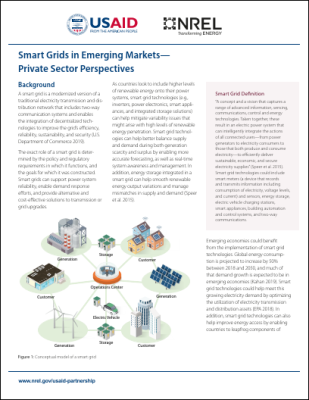
    Information presented in this report is based on qualitative and quantitative data collection and analysis methods to provide an empirical understanding of barriers to private sector clean energy investment in emerging markets as it relates to smart grids.

    Through literature review, a survey, and a series of webinar dialogues, the U.S. Agency for International Development (USAID) and the U.S. Department of Energy’s National Renewable Energy Laboratory (NREL) solicited input from private sector actors, including developers, project financiers, manufacturers, and technical assistance service providers on the challenges they face to market entry in developing and emerging markets, and their suggestions for improving market competitiveness.

    Para leer más ingrese a:

    https://www.osti.gov/biblio/1677465

    https://www.osti.gov/servlets/purl/1677465

  • Facilitating customers energy data management and interoperability -DSOs’ perspective-

    Facilitating customers energy data management and interoperability -DSOs’ perspective-

    There is a seemingly endless torrent of research, white papers, and analyst reports on data management. That entails a lot of readings and keeping up with the deluge of content. However not much, or almost inexistent is the information on the data management from DSOs viewpoint.

    With that in mind, the E.DSO data management working group has compiled a very attractive position paper “Facilitating customers energy data management and interoperability -DSOs’ perspective”. The paper emphasizes that management of data remains crucial to operate the distribution system flexibly while responding to customer needs and managing critical situations appropriately. It further sheds lights into the role and responsibilities of DSOs as provided by the Electricity Directive, the data exchange process between the DSOs and third parties, as well as DSOs’ willingness to improve cooperation with TSOs at European level for the benefit of customers.

    Para leer más ingrese a:

    https://www.edsoforsmartgrids.eu/facilitating-customers-energy-data-management-and-interoperability-dsos-perspective/

    https://www.edsoforsmartgrids.eu/wp-content/uploads/EDSO-Data-management-position-paper.pdf

  • E-quality: Shaping an inclusive energy transition

    E-quality: Shaping an inclusive energy transition

    We are living in times of unprecedented global challenges being caught between a rock and a hard place: climate change requires our urgent action while rising inequality is affecting more and more communities.

    As the EU and national governments set out to implement a range of climate policies, Eurelectric, with the scientific contribution of the Enel Foundation, has decided to answer the following questions:

        How do these policies affect households with different incomes?
        What can and should be done to address any disproportionate effects?
        What is the impact of COVID-19 crisis in this process?

    Para leer más ingrese a:

    https://www.eurelectric.org/e-quality/

    https://cdn.eurelectric.org/media/4543/e-quality-shaping-an-inclusive-energy-transition-2020-030-0436-01-e-h-0CE97758.pdf

  • Informe Nacional de Competitividad 2020-2021

    Informe Nacional de Competitividad 2020-2021

    El Consejo Privado de Competitividad (CPC) presenta el Informe Nacional de Competitividad 2020-2021. El informe se publica anualmente desde 2007, con el propósito de analizar en detalle el estado de la competitividad de Colombia y plantear recomendaciones para avanzar. Este trabajo es posible gracias a un grupo de empresas líderes y comprometidas, que han apoyado la labor del CPC de manera generosa y decidida, con el propósito de contribuir, con independencia y rigor, al desarrollo equitativo y sostenible de Colombia a nivel nacional y local, promoviendo buenas políticas públicas que impacten la productividad.

    El CPC articula sector privado, Gobierno y academia para que cada uno, desde su rol, genere mayor competitividad en beneficio del interés general. El CPC recomienda con este informe priorizar la agenda de cierre de brechas para avanzar hacia una sociedad más justa, con mayor equidad de oportunidades y movilidad social.

    Para leer más ingrese a:

    https://compite.com.co/informe/informe-nacional-de-competitividad-2020-2021/

Busca los documentos, noticias y tendencias más relevantes del sector eléctrico

Buscador de documentos
Buscador de noticias y tendencias

Banco de Información

Descripción del semáforo tecnológico

Los documentos se clasifican en varios colores tipo semáforo tecnológico que indican el nivel de implementación de la tecnología en el país

Tecnología en investigación que no ha sido estudiado o reglamentado por entidades del sector.

La tecnología se aplica de manera focal y se encuentra en estudio por parte de las entidades del sector.

La tecnología se aplica de manera escalable y se encuentran políticas y regulaciones focales establecidas.

La tecnología se aplica a través de servicios  y se encuentran políticas y regulaciones transversales establecidas.

La tecnología se aplica de manera generalizada  y se tiene un despliegue masivo de esta.

Para acceder a todos los documentos publicados y descargarlos ingresa aquí