Autor: Luisa Buitrago

  • How to learn fast? A case study of challenges in evaluating a programme designed to bring about systems

    How to learn fast? A case study of challenges in evaluating a programme designed to bring about systems

    Through the Smart Systems and Heat (SSH) Programme, the Energy Systems Catapult (ESC) delivered a large consumer-focused project aimed at identifying how to overcome the barriers to the decarbonisation of residential heat.  SSH was designed as an opportunity for learning about what and how to innovate in the delivery of residential heat.

     Evaluation was built into the programme, with a role in helping to deliver this learning aim.  This paper will use the evaluation of SSH as a case study of challenges in evaluating what has and will work with regards to systems innovation and the methods and approaches that do, don’t and might be used to address this.

    Para leer más ingrese a:

    https://t.co/srvfkjcx0V?amp=1&s=09

  • Trabajar desde casa: posibilidades y desafíos

    Trabajar desde casa: posibilidades y desafíos

    Con la pandemia, ha quedado claro que el trabajo desde casa llegó para quedarse. Desde el Congreso de la República y el Ministerio de Trabajo, ya se discute la regulación de esta modalidad de trabajo.

    Para intentar aportar a esta discusión, desde el CESLA elaboramos esta investigación que, en líneas generales, trata de responder las siguientes preguntas:
        ¿Qué porcentaje de los trabajadores pueden trabajar desde sus casas?
        ¿Quiénes son los que pueden hacerlo y qué características socioeconómicas tienen?
        Y, finalmente, desde lo jurídico: ¿Cómo el marco regulatorio vigente podría desincentivar el trabajo en casa a futuro? Y, ¿Qué consideraciones debería tener la reglamentación sobre el trabajo desde casa, para proteger al trabajador y, al mismo tiempo, incentivar la modalidad y la productividad empresarial?

    Para leer más ingrese a:

    http://www.andi.com.co/Home/Pagina/20-cesla-centro-de-estudios-sociales-y-labora?s=09

  • Global Photovoltaic Power Potential by Country

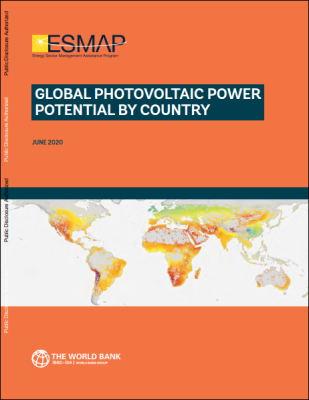
    Global Photovoltaic Power Potential by Country

    Solar radiation is essentially a free resource available anywhere on Earth, to a greater or lesser extent. Solar PV power plants convert solar radiation into electricity. In the current era of global climate change, PV technology becomes an opportunity for countries and communities to transform or develop their energy infrastructure and step up their low-carbon energy transition.

    Until now, a global and harmonized assessment of country-level PV potential has not existed. This report aims to provide an aggregated and harmonized view on solar resource and PV power potential from the perspective of countries and regions, assuming a utility-scale installation of monofacial modules fixed mounted at an optimum angle, which has been the prevailing setup of a PV power plant.

    Para leer más ingrese a:

    https://documents.worldbank.org/en/publication/documents-reports/documentdetail/466331592817725242/global-photovoltaic-power-potential-by-country

  • The new age of mobility

    The new age of mobility

    We are moving into a different era: while the 20th century was the age of the fuel-powered car, the 21st will most probably be characterized by new and less polluting forms of transport.

    Various types of electric vehicles (EVs), from electric cars and buses to e-scooters or e-bikes are becoming ubiquitous in our cities. Hybrid solutions involving batteries and combustion engines have already been widely adopted.

    Para leer más ingrese a:

    https://basecamp.iec.ch/download/briefing-paper-the-new-age-of-mobilty-en/

    https://basecamp.iec.ch/download/briefing-paper-the-new-age-of-mobilty-en/?wpdmdl=2151&ind=1591884668072

  • Electric Vehicles at Scale – Phase I Analysis: High EV Adoption Impacts on the Western U.S. Power Grid

    Electric Vehicles at Scale – Phase I Analysis: High EV Adoption Impacts on the Western U.S. Power Grid

    EVs are coming en masse. How can local utilities, grid planners and cities prepare? That’s the key question addressed with a new PNNL study, which integrates multiple factors not evaluated before, such as electric trucks for delivery and long haul, as well as smart EV charging strategies.

    The good news is that through 2028, the overall U.S. power system looks healthy up to 24 million EVs. However, at about 30 million EVs, things get dicey

    Para leer más ingrese a:

    https://www.electrive.com/study-guide/electric-vehicles-at-scale-phase-i-analysis-high-ev-adoption-impacts-on-the-western-u-s-power-grid/

    https://www.pnnl.gov/sites/default/files/media/file/EV-AT-SCALE_1_IMPACTS_final.pdf

  • Reporte Ciberseguridad 2020: riesgos, avances y el camino a seguir en América Latina y el Caribe

    Reporte Ciberseguridad 2020: riesgos, avances y el camino a seguir en América Latina y el Caribe

    Este reporte brinda un panorama detallado y actualizado de las políticas y prácticas de ciberseguridad en los países de América Latina y el Caribe, ofreciendo una perspectiva sobre el progreso alcanzado desde su primera edición en 2016. Incluye ensayos sobre las tendencias de la seguridad cibernética en la región, aportados por reconocidos expertos internacionales.

    También examina la madurez cibernética de cada país mediante la aplicación del Modelo de Madurez de Capacidad de Seguridad Cibernética (CMM). Identifica brechas serias en las cinco dimensiones que definen la capacidad de seguridad cibernética, teniendo en cuenta la importancia de la seguridad cibernética en el crecimiento económico y la sostenibilidad, al tiempo que enfatiza el respeto por los derechos humanos. Esta visión objetiva de las fortalezas y del espacio de crecimiento de la región apunta a sustentar el diseño de políticas e iniciativas que aborden la urgente tarea de incrementar la resiliencia cibernética.

    Para leer más ingrese a:

    https://publications.iadb.org/es/reporte-ciberseguridad-2020-riesgos-avances-y-el-camino-seguir-en-america-latina-y-el-caribe?s=09

    https://publications.iadb.org/publications/spanish/document/Reporte-Ciberseguridad-2020-riesgos-avances-y-el-camino-a-seguir-en-America-Latina-y-el-Caribe.pdf

  • Connected Communities: A Better Way of Building

    Connected Communities: A Better Way of Building

    Looking out your window you might see another building. But close as that may be, you likely share very little with it, even though both your building and the ones near you are dependent on much of the same infrastructure. What if we change this relationship and create functional connections between buildings to enhance their operations and economics? That change is happening now, in connected communities throughout the United States.

    To better understand what connected communities are and if they are effective, Rocky Mountain Institute and the National Renewable Energy Laboratory conducted a nationwide inventory of connected communities. These communities vary widely in their strategies and size, and they provide real and scalable solutions to mitigate energy costs, enable more flexibility in grid operations, and offer choices in meeting greenhouse gas emissions goals.

    Para leer más ingrese a:

    https://rmi.org/connected-communities-a-better-way-of-building/

    https://www.nrel.gov/docs/fy20osti/75528.pdf

  • Street Smart

    Street Smart

    People around the world are unhappy with the city life and the many social, environmental, and infrastructure challenges it brings. Smart cities offer solutions to many of these challenges. But what, exactly, do citizens hope for and want from a smart city? And what stands in the way? Finally, what can cities do to accelerate implementation and keep their citizens from leaving? We wanted to find out.

    In the latest report from the Capgemini Research Institute – Street smart: Putting the citizen at the center of smart city initiatives – we surveyed 10,000 citizens across 10 countries in April 2020, looking at the challenges they face and their willingness to use smart city initiatives. We also spoke with 300 city officials about their views on smart city initiatives and the challenges of implementation, interviewing a number of senior city officials to get their perspectives on smart city implementation.

    Para leer más ingrese a:

    https://www.capgemini.com/research/street-smart/

    https://www.capgemini.com/wp-content/uploads/2020/07/Street_Smart_28-07-2020_SS.pdf

  • Implementing Effective Emissions Trading Systems

    Implementing Effective Emissions Trading Systems

    Emissions trading systems are well suited to accelerate the clean energy transition in the power sector. Electricity and heat generation account for over 40% of global energy-related CO2 emissions, with 30% of energy-related CO2 emissions coming from coal-fired power plants. The power sector is already decarbonising worldwide, due to falling low-carbon technology costs and low competitiveness risks, but not quickly enough to meet the Paris Agreement goals.

    The power sector is particularly well-suited to be covered by an emissions trading system. First, it is a large emitting sector with proven, low-GHG technologies that are commercially available. Second, data availability for electricity generation is on average strong across jurisdictions, which is needed to determine allocation benchmarks. Moreover, several jurisdictions already have experience in implementing power sector mitigation activities with the support of carbon pricing, for instance through crediting mechanisms such as the Clean Development Mechanism. 

    Para leer más ingrese a:

    https://www.iea.org/reports/implementing-effective-emissions-trading-systems/tailoring?utm_content=buffer8ddfe&utm_medium=social&utm_source=twitter.com&utm_campaign=buffer

  • Hydrogen technology : workshop summary

    Hydrogen technology : workshop summary

    It is widely accepted that renewable and decarbonised hydrogen will need to play a major role in the EU’s future decarbonised energy market. The technological solutions to produce it exist. However, the costs are high and the production capacity is small. How to drive down costs and catalyse sufficient capacity in time for the 2050 decarbonisation deadline? How to ensure that the principles of the internal gas market are retained? How to link the electricity and gas markets? How could ETS accelerate the process? These are some of the questions to answer to design the policy framework.

    This report is a summary of two online workshops organised by The Florence School of Regulation on the 15th and 22nd of April that shed valuable light on the state of technological development regarding renewable and decarbonised/low-carbon hydrogen. One focused on decarbonised hydrogen produced from natural gas; the other examined the potential of renewable hydrogen. They were both organised in the context of the European Commission’s preparations for its ‘Energy System Integration’ initiative and they aimed to examine and discuss technological development, as well as current and future policy/regulation landscape for hydrogen.

    Para leer más ingrese a:

    https://fsr.eui.eu/publications/?handle=1814/67676

    https://cadmus.eui.eu/bitstream/handle/1814/67676/Hydrogen_technology_report.pdf?sequence=4

Busca los documentos, noticias y tendencias más relevantes del sector eléctrico

Buscador de documentos
Buscador de noticias y tendencias

Banco de Información

Descripción del semáforo tecnológico

Los documentos se clasifican en varios colores tipo semáforo tecnológico que indican el nivel de implementación de la tecnología en el país

Tecnología en investigación que no ha sido estudiado o reglamentado por entidades del sector.

La tecnología se aplica de manera focal y se encuentra en estudio por parte de las entidades del sector.

La tecnología se aplica de manera escalable y se encuentran políticas y regulaciones focales establecidas.

La tecnología se aplica a través de servicios  y se encuentran políticas y regulaciones transversales establecidas.

La tecnología se aplica de manera generalizada  y se tiene un despliegue masivo de esta.

Para acceder a todos los documentos publicados y descargarlos ingresa aquí