Autor: DIFUSIÓN COLOMBIA INTELIGENTE

  • Enabling energy innovation at scale

    Enabling energy innovation at scale

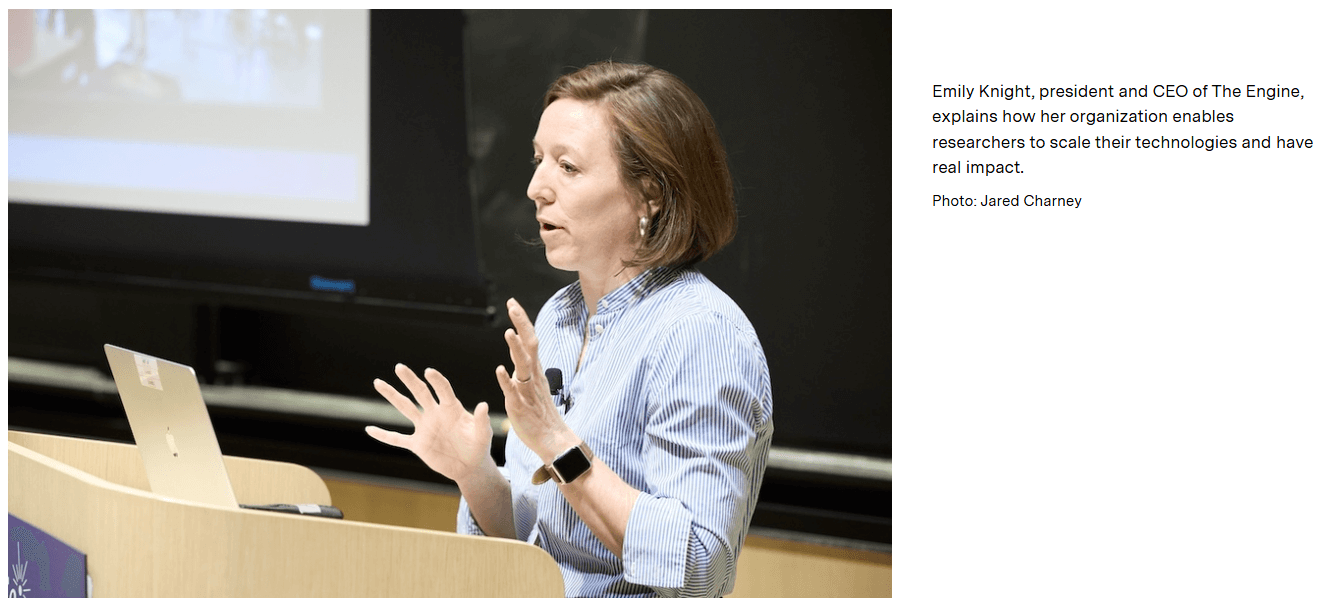
    Enabling and sustaining a clean energy transition depends not only on groundbreaking technology to redefine the world’s energy systems, but also on that innovation happening at scale. As a part of an ongoing speaker series, the MIT Energy Initiative (MITEI) hosted Emily Knight, the president and CEO of The Engine, a nonprofit incubator and accelerator dedicated to nurturing technology solutions to the world’s most urgent challenges. She explained how her organization is bridging the gap between research breakthroughs and scalable commercial impact.


    “Our mission from the very beginning was to support and accelerate what we call ‘tough tech’ companies — [companies] who had this vision to solve some of the world’s biggest problems,” Knight said.


    The Engine, a spinout of MIT, coined the term “tough tech” to represent not only the durability of the technology, but also the complexity and scale of the problems it will solve. “We are an incubator and accelerator focused on building a platform and creating what I believe is an open community for people who want to build tough tech, who want to fund tough tech, who want to work in a tough tech company, and ultimately be a part of this community,” said Knight.

    Para leer más ingrese a:

    https://news.mit.edu/2025/enabling-energy-innovation-at-scale-emily-knight-0408

  • Conagra’s Slim Jim and Manwich Facilities to be Powered by Fuel Cell Technology

    Conagra’s Slim Jim and Manwich Facilities to be Powered by Fuel Cell Technology

    Two of Conagra Brand’s food production facilities will soon be largely powered by fuel cells.


    The consumer packaged goods (CPG) food company announced this week that Bloom Energy will install approximately 6 MW of fuel cell capacity at Conagra’s Troy and Archbold, Ohio production facilities.


    Bloom Energy manufactures combustion-free solid oxide fuel cells for the distributed generation of low-carbon electricity and hydrogen. The fuel cells avoid the release of pollutants and particulates associated with fossil fuel-based power generation emissions.


    The fuel cell systems will be installed under a 15-year power purchase agreement. It is expected that they will supply between 70% and 75% of the plants’ electricity needs and reduce greenhouse gas emissions by 19%, according to a statement from Conagra.


    The energy from the fuel cells will directly power the two Conagra facilities. They will not be used to provide grid services.


    «Implementing this technology is a significant step towards achieving our science-based targets, supporting our pursuit of renewable energy solutions and reducing our environmental footprint,” Christine Daugherty, vice president of sustainability at Conagra Brands, said in a statement.

    Para leer más ingrese a:

    https://www.microgridknowledge.com/generation-fuels/news/55279559/conagras-slim-jim-and-manwich-facilities-to-be-powered-by-fuel-cell-technology

  • Tough at the top – The threats to US energy dominance

    Tough at the top – The threats to US energy dominance

    But one objective remains constant in the Trump administration’s America First strategy: the pursuit of US “energy dominance”. The aim is to continue increasing domestic oil and gas supply, to generate employment and investment, cut costs for consumers, reinforce national security and strengthen US global influence.


    On more than one measure, the US is already dominant. US oil production – including crude, condensate and natural gas liquids – has risen nearly three-fold over the past 15 years and now accounts for 20% of all global supply. US natural gas production has doubled since 2005 and now makes up a quarter of global output. In fact, the US now produces more hydrocarbons than its two largest competitors combined, and its dominance of world production is set to increase over the next decade. 


    This huge growth in production of energy is also increasing US influence over world markets. Last year, the US became the world’s largest exporter of liquefied natural gas (LNG). It was also the third-largest exporter of crude and condensate.


    In this month’s Horizons, we explore the implications of the spectacular success of US oil and gas in the 21st century. We examine its global impact and assess whether this period of dominance can continue.

    Para leer más ingrese a:

    https://www.woodmac.com/horizons/us-energy-dominance/
  • Enershare – Cross-value Chain Services for Energy-data-driven Green Financing

    Enershare – Cross-value Chain Services for Energy-data-driven Green Financing

    The initiative builds on 11 user scenarios that integrate intra-energy and cross-sector interactions. Furthermore, it includes validation through seven large-scale pilot projects. In this series of blog posts, we invite you to discover more about these pilot projects.


    How can AI drive better energy efficiency and investment decisions? A collaboration between the Latvian Environmental Investment Fund (LEIF) and the National Technical University of Athens (NTUA) within the Enershare Horizon Europe project is answering this question.


    LEIF funds energy projects that help municipalities and businesses transition to cleaner energy sources. To enhance its impact, LEIF partnered with NTUA to develop AI4EF, an AI-powered tool providing data-driven insights for energy efficiency and green financing. AI4EF supports homeowners, policymakers, and businesses in making informed, cost-effective energy investment decisions.

    Para leer más ingrese a:

    https://enershare.eu/enershare-cross-value-chain-services-for-energy-data-driven-green-financing/

  • Using liquid air for grid-scale energy storage

    Using liquid air for grid-scale energy storage

    As the world moves to reduce carbon emissions, solar and wind power will play an increasing role on electricity grids. But those renewable sources only generate electricity when it’s sunny or windy. So to ensure a reliable power grid — one that can deliver electricity 24/7 — it’s crucial to have a means of storing electricity when supplies are abundant and delivering it later, when they’re not. And sometimes large amounts of electricity will need to be stored not just for hours, but for days, or even longer.


    Some methods of achieving “long-duration energy storage” are promising. For example, with pumped hydro energy storage, water is pumped from a lake to another, higher lake when there’s extra electricity and released back down through power-generating turbines when more electricity is needed. But that approach is limited by geography, and most potential sites in the United States have already been used. Lithium-ion batteries could provide grid-scale storage, but only for about four hours. Longer than that and battery systems get prohibitively expensive.


    A team of researchers from MIT and the Norwegian University of Science and Technology (NTNU) has been investigating a less-familiar option based on an unlikely-sounding concept: liquid air, or air that is drawn in from the surroundings, cleaned and dried, and then cooled to the point that it liquefies.

    Para leer más ingrese a:

    https://news.mit.edu/2025/using-liquid-air-grid-scale-energy-storage-0410

  • Chick-fil-A Launches Third Solar Plus Storage Microgrid in California

    Chick-fil-A Launches Third Solar Plus Storage Microgrid in California

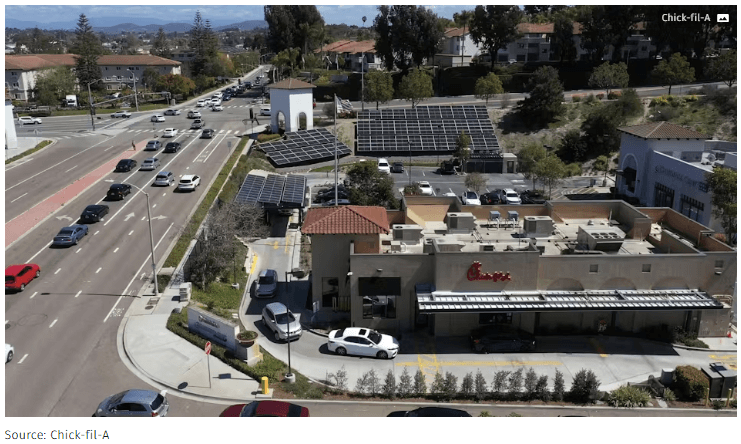
    Restaurant chain Chick-fil-A celebrated the launch of its third microgrid in California on Wednesday.


    The solar plus storage microgrid will provide one-third of the annual energy demand of the locally owned and operated Quarry Creek location in Oceanside.


    Built by microgrid developer SolMicroGrid, the system includes an 81-kWh battery energy storage system, a 112-kW canopy and ground-mounted solar array and an energy management system that leverages predictive analytics and artificial intelligence to control and optimize the performance of the energy technologies.


    To accommodate the location’s pitched terrain, ground screws were used to install the system’s ground-mounted solar modules, rather than traditional concrete footings.


    Designed for rocky slopes, ground screws, also known as earth screws, are typically made of galvanized steel and penetrate deep into the soil, providing a stable base for the solar array. They are ideally suited for hilly sites or those with difficult soil conditions.

    Para leer más ingrese a:

    https://www.microgridknowledge.com/commercial-microgrids/news/55276019/chick-fil-a-launches-third-solar-plus-storage-microgrid-in-california

  • Trump directs FERC, other agencies to add 5-year sunsets to energy-related regulations

    Trump directs FERC, other agencies to add 5-year sunsets to energy-related regulations

    President Donald Trump on Wednesday directed the Federal Energy Regulatory Commission, the Environmental Protection Agency and other agencies to add provisions to their energy-related regulations so they would expire within five years.


    “By rescinding outdated regulations that serve as a drag on progress, we can stimulate innovation and deliver prosperity to everyday Americans,” Trump said in an executive order.


    Trump ordered the sunset provisions to be in place by Sept. 30. For FERC, the directive covers all regulations under the Federal Power Act, the Natural Gas Act and the Power Plant and Industrial Fuel Use Act.


    The U.S. Department of Energy must add sunset provisions to its regulations under the Atomic Energy Act; the National Appliance Energy Conservation Act; the Energy Policy Act of 1992; the Energy Policy Act of 2005; and the Energy Independence and Security Act, according to the executive order.


    Other departments and agencies affected by Trump’s order are: the Nuclear Regulatory Commission; the Office of Surface Mining Reclamation and Enforcement; the Bureau of Land Management; the Bureau of Ocean Energy Management; the Bureau of Safety and Environmental Enforcement; the U.S. Fish and Wildlife Service; and the U.S. Army Corps of Engineers.


    Trump directed agency heads to coordinate with their so-called Department of Government Efficiency team leads and the Office of Management and Budget to implement the sunset order.

    Para leer más ingrese a:

    https://www.utilitydive.com/news/trump-executive-order-eo-ferc-doe-epa-sunset-energy-regulation/745003/

  • Falling Short: African Minigrid Market Growing, But Not Fast Enough to Meet 2030 Goals

    Falling Short: African Minigrid Market Growing, But Not Fast Enough to Meet 2030 Goals

    Unless the African minigrid sector can accelerate deployments, the goal of universal access to electricity by 2030 will likely fall short, according to the latest edition of the African Minigrid Developers Association’s (AMDA) “Benchmarking Africa’s Minigrids Report.”


    The African minigrid market is expanding, driving up electrification rates and spurring job creation, according to the report. However, AMDA found that regulatory bottlenecks, funding issues and supply chain problems are hindering the pace of development and driving up costs.


    “The third edition of the Benchmarking Africa’s Minigrid Report arrives at a critical moment, as governments, investors, and industry stakeholders must intensify efforts to scale minigrids for Africa’s energy future,” Olamide Niyi-Afuye, CEO of AMDA, said during the launch event. “With data-driven insights and actionable recommendations, we aim to accelerate progress toward universal electrification.”


    AMDA is an industry association established in 2018 by 11 minigrid developers. The organization now has 52 members in 24 countries across Africa, including private, decentralized utilities, minigrid developers and operators, and companies that provide minigrid products and services.


    AMDA says its members represent 70% of the region’s minigrid developers and that they have commissioned nearly 600 minigrids with a total installed capacity of more than 16.5 MW.

    The organization launched its new report last week during the 8th Minigrid Action Learning Event in Lusaka, Zambia.

    Para leer más ingrese a:

    https://www.microgridknowledge.com/remote-microgrids/article/55281198/falling-short-african-minigrid-market-growing-but-not-fast-enough

  • The benefits of battery swapping for electric vehicles

    The benefits of battery swapping for electric vehicles

    The wide adoption of electric vehicles around the world is one of the ways of reaching 2030 and 2050 emission targets. The International Renewable Energy Agency (IRENA) has been pushing that message consistently, as Jaidev Dhavle, Associate Programme Officer at IRENA made clear in a recent e-tech interview. One of our approaches, he says, “ is to focus on crucial “end-use” sectors that can benefit from a greener model. At the Innovation and Technology Centre in Bonn that I’m a part of, there are five end-use areas that are of key interest which include promoting the adoption of electric vehicles and energy storage solutions.”

    While the adoption of EVs has surged over the last ten years, many doubt that the market will be able to grow enough to help reach net zero emission targets by 2050. According to the International Energy Agency (IEA), road transport contributes to one sixth of global emissions. It warns that to attain the net zero scenario, “electric car sales must reach around 65% of total car sales in 2030.”

    While growth was on track in 2023, sustained efforts need to be made to stay on course, including the greater deployment of a charging infrastructure, which is not meeting requirements for the time being. “The number of public charging points is increasing but deployment must accelerate,” the organization advises.

    Para leer más ingrese a:

    https://etech.iec.ch/issue/2025-02/the-benefits-of-battery-swapping-for-electric-vehicles
  • Massachusetts home-electrification pilot could offer a national model

    Massachusetts home-electrification pilot could offer a national model

    Solar panels are installed on a New England home. (Chris Wingard/U.S. Department of Energy)

    A first-of-its-kind pilot to electrify homes on Cape Cod and Martha’s Vineyard is set to finish construction in the coming weeks — and it could offer a blueprint for decarbonizing low- and moderate-income households in Massachusetts and beyond.


    The Cape and Vineyard Electrification Offering is designed to be a turnkey program that makes it financially feasible and logistically approachable for households of all income levels to adopt solar panels, heat pumps, and batteries, and to realize the amplified benefits of using the resources together. These technologies slash emissions, reduce utility bills, and increase a home’s resilience during power outages, but are often only adopted by wealthier households due to their upfront cost.


    “We are going to be advancing this as a model that should be emulated by other states across the country that are trying to achieve decarbonization goals,” said Todd Olinsky-Paul, senior project director for the Clean Energy Group, a nonprofit that produced a new report about the program.

    In total, the program is providing free or heavily subsidized solar panels and heat pumps to 55 participating households, 12 of which also received batteries at no cost. Work should be completed on the final participating home this month.

    Para leer más ingrese a:

    https://www.canarymedia.com/articles/electrification/massachusetts-solar-heat-pump-battery-pilot

Busca los documentos, noticias y tendencias más relevantes del sector eléctrico

Buscador de documentos
Buscador de noticias y tendencias

Banco de Información

Descripción del semáforo tecnológico

Los documentos se clasifican en varios colores tipo semáforo tecnológico que indican el nivel de implementación de la tecnología en el país

Tecnología en investigación que no ha sido estudiado o reglamentado por entidades del sector.

La tecnología se aplica de manera focal y se encuentra en estudio por parte de las entidades del sector.

La tecnología se aplica de manera escalable y se encuentran políticas y regulaciones focales establecidas.

La tecnología se aplica a través de servicios  y se encuentran políticas y regulaciones transversales establecidas.

La tecnología se aplica de manera generalizada  y se tiene un despliegue masivo de esta.

Para acceder a todos los documentos publicados y descargarlos ingresa aquí