
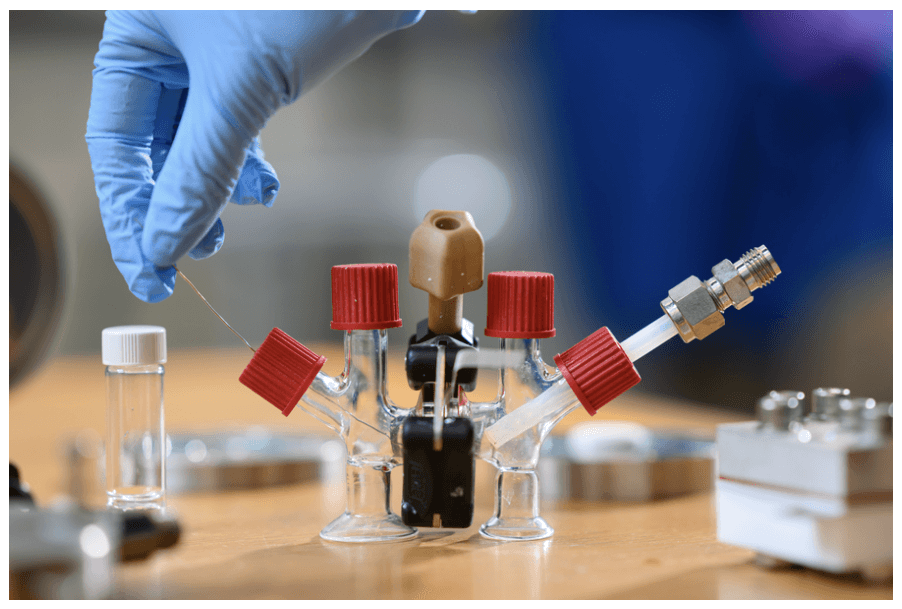
Batteries are nearing their limits in terms of how much power they can store for a given weight. That’s a serious obstacle for energy innovation and the search for new ways to power airplanes, trains, and ships. Now, researchers at MIT and elsewhere have come up with a solution that could help electrify these transportation systems.
Instead of a battery, the new concept is a kind of fuel cell — which is similar to a battery but can be quickly refueled rather than recharged. In this case, the fuel is liquid sodium metal, an inexpensive and widely available commodity. The other side of the cell is just ordinary air, which serves as a source of oxygen atoms. In between, a layer of solid ceramic material serves as the electrolyte, allowing sodium ions to pass freely through, and a porous air-facing electrode helps the sodium to chemically react with oxygen and produce electricity.
In a series of experiments with a prototype device, the researchers demonstrated that this cell could carry more than three times as much energy per unit of weight as the lithium-ion batteries used in virtually all electric vehicles today.
Para leer más ingrese a:
https://news.mit.edu/2025/new-fuel-cell-could-enable-electric-aviation-0527
Compartir artículo
Para información general sobre la organización: difusion@colombiainteligente.org | Dirección: Edf. TecnoParque Cr 46#56-11 Piso 13 | Medellín – Colombia
Teléfono: +57-4-4441211 Ext. 171 | FAX: +57-4-4440460

Los documentos se clasifican en varios colores tipo semáforo tecnológico que indican el nivel de implementación de la tecnología en el país
Tecnología en investigación que no ha sido estudiado o reglamentado por entidades del sector.
La tecnología se aplica de manera focal y se encuentra en estudio por parte de las entidades del sector.
La tecnología se aplica de manera escalable y se encuentran políticas y regulaciones focales establecidas.
La tecnología se aplica a través de servicios y se encuentran políticas y regulaciones transversales establecidas.
La tecnología se aplica de manera generalizada y se tiene un despliegue masivo de esta.
Para acceder a todos los documentos publicados y descargarlos ingresa aquí