
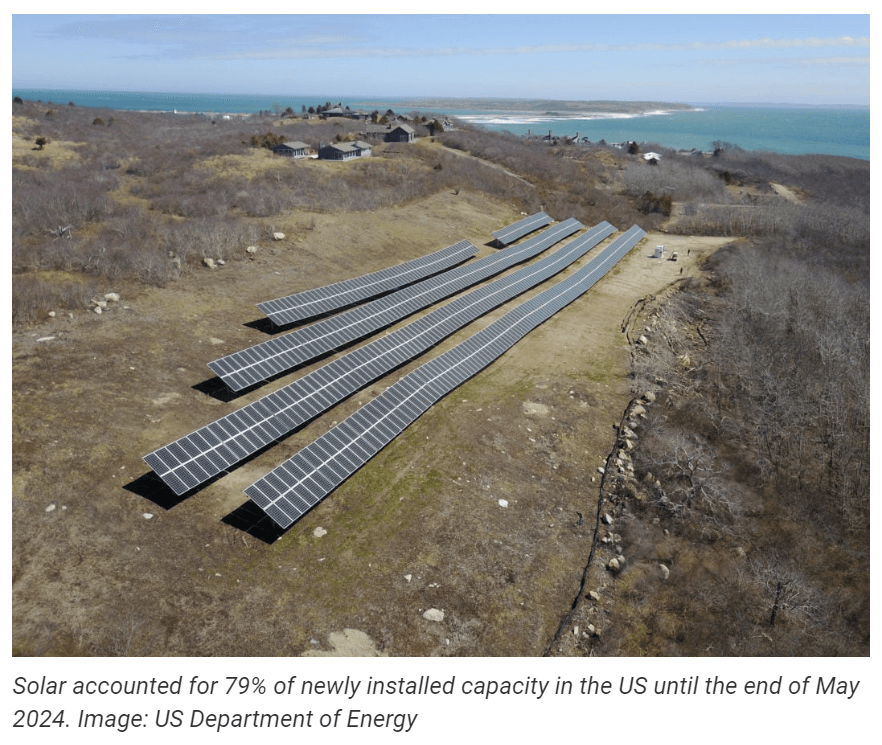
Solar has become the largest energy source of new capacity in the first five months in the US, while almost 90GW of new solar projects will have a “high probability” of being added to the generation capacity in the next three years.
According to the Federal Energy Regulatory Commission’s (FERC) Energy Infrastructure Update for May 2024, the US had 251 new solar “units” that became operational from January to May this year, with a combined capacity of 10,669MW. The additions were way ahead of wind, which came second with 13 new “units” and had a total installed capacity of 2,095MW, followed by natural gas (23 units and 348MW of newly installed capacity).
In the first five months of 2024, the US installed capacity increased by 14,435MW, meaning newly installed solar capacity accounted for about 74% of the total additions.
In May, 50 new solar projects were placed in service with a combined capacity of 2,517MW, ahead of wind (277MW, two units), hydropower (211MW, two units) and natural gas (184MW, nine units). Solar accounted for 79% of the newly installed capacity in the US that month.
Year-on-year, installed solar capacity in the US increased by 118% from 4,885MW in the first five months in 2023 to 10,669MW in the same period in 2024.
PV Tech reported that the US added 4,557MW of solar capacity in the first quarter of 2024, bringing the total installed capacity to over 100GW, according to trade body American Clean Power Association (ACP).
Compartir artículo
Para información general sobre la organización: difusion@colombiainteligente.org | Dirección: Edf. TecnoParque Cr 46#56-11 Piso 13 | Medellín – Colombia
Teléfono: +57-4-4441211 Ext. 171 | FAX: +57-4-4440460

Los documentos se clasifican en varios colores tipo semáforo tecnológico que indican el nivel de implementación de la tecnología en el país
Tecnología en investigación que no ha sido estudiado o reglamentado por entidades del sector.
La tecnología se aplica de manera focal y se encuentra en estudio por parte de las entidades del sector.
La tecnología se aplica de manera escalable y se encuentran políticas y regulaciones focales establecidas.
La tecnología se aplica a través de servicios y se encuentran políticas y regulaciones transversales establecidas.
La tecnología se aplica de manera generalizada y se tiene un despliegue masivo de esta.
Para acceder a todos los documentos publicados y descargarlos ingresa aquí