
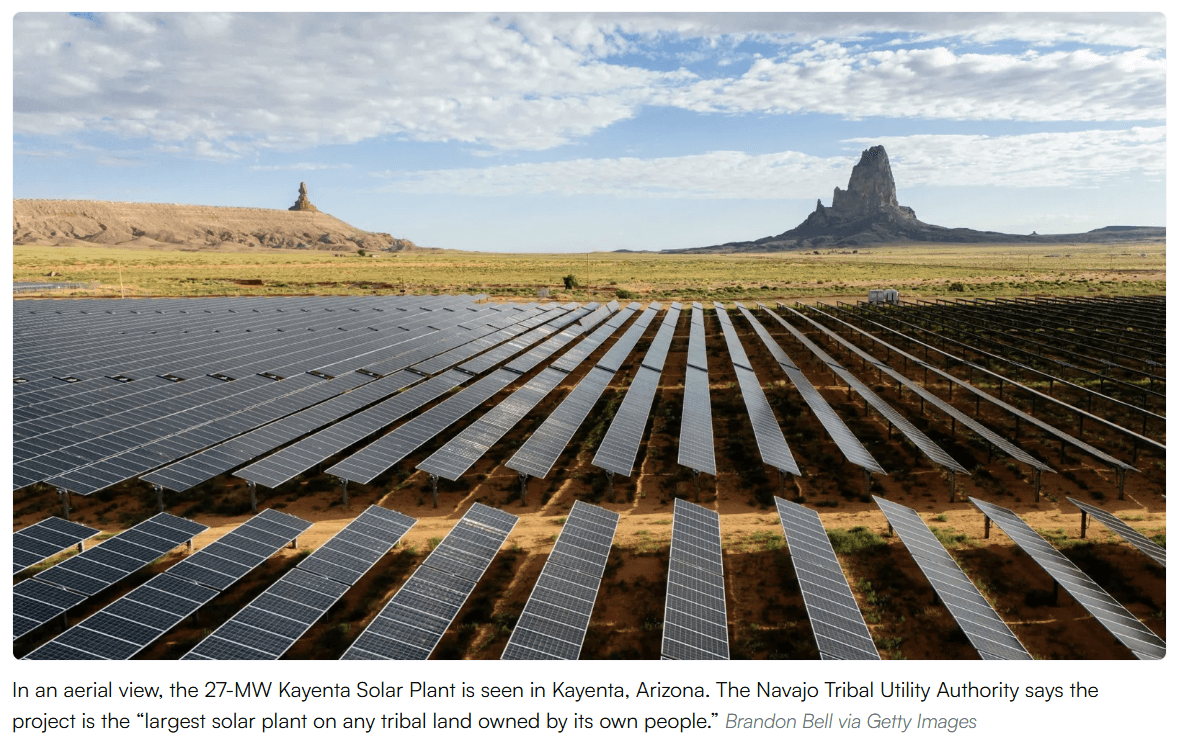
The Inflation Reduction Act authorized hundreds of billions in federal support to bolster clean energy projects nationwide – but interconnection queues remain backlogged, and the Federal Energy Regulatory Commission’s commercial readiness requirements can require project developers to pay $5 million to remain in the queue.
These delays and costs are felt acutely by tribal nations in the U.S., said Chéri Smith, CEO of the Alliance for Tribal Clean Energy. Utility-scale renewables projects are “big economic engines” that could replace the jobs lost by fossil fuel closures and provide reliable energy to remote and impoverished tribal communities, Smith said.
Many tribes see energy as “the last hope to regain true sovereignty,” she said, and the opportunity to sell power and participate in energy markets as a way to recover from the economic disruptions of deforestation, the damming of rivers, the near-extinction of the buffalo, and fossil fuel closures like the 2019 shutdown of the Kayenta coal mine.
That shutdown reduced the Hopi budget by around 80%. The Hopi Utility Corporation, with support from Inflation Reduction Act funding, is now looking to bring online 400 MW of solar and energy storage generation that would create jobs and provide first-time access power to around 900 homes on the reservation, but had to come up with millions to keep their place in the Arizona Public Service interconnection queue, said Smith.
Para leer más ingrese a:
Compartir artículo
Para información general sobre la organización: difusion@colombiainteligente.org | Dirección: Edf. TecnoParque Cr 46#56-11 Piso 13 | Medellín – Colombia
Teléfono: +57-4-4441211 Ext. 171 | FAX: +57-4-4440460

Los documentos se clasifican en varios colores tipo semáforo tecnológico que indican el nivel de implementación de la tecnología en el país
Tecnología en investigación que no ha sido estudiado o reglamentado por entidades del sector.
La tecnología se aplica de manera focal y se encuentra en estudio por parte de las entidades del sector.
La tecnología se aplica de manera escalable y se encuentran políticas y regulaciones focales establecidas.
La tecnología se aplica a través de servicios y se encuentran políticas y regulaciones transversales establecidas.
La tecnología se aplica de manera generalizada y se tiene un despliegue masivo de esta.
Para acceder a todos los documentos publicados y descargarlos ingresa aquí