
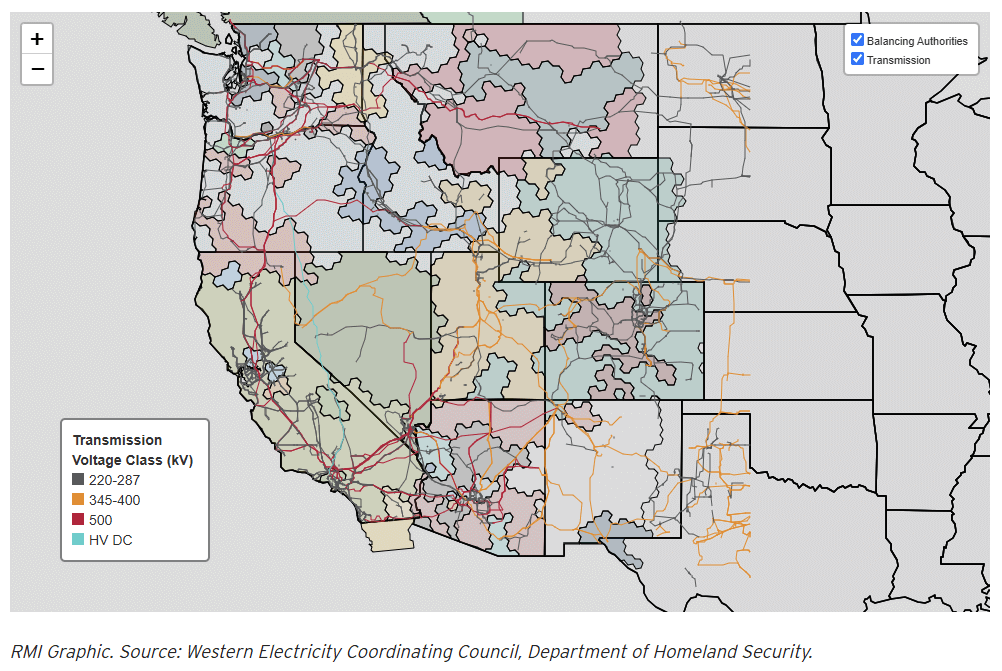
Many people think their electricity begins and ends with the utility at the top of their monthly bill. However, when you flip a switch, your light is not powered by the nearest plant. It draws from a regional pool supplied by hundreds of generators spanning thousands of miles across the West. The western grid is a vast, interconnected web of transmission wires linking utilities, states, and the entire region into one shared system.
Electrons take the path of least resistance, guided by the laws of physics — not state or utility boundaries. Utilities continuously adjust supply and demand, routing power to where it can serve customers most reliably and affordably. This constant, invisible balancing act is what makes the western grid so powerful: no state stands alone. In moments of crisis, states support each other to keep the lights on across the West. As our demand for electricity grows from increased manufacturing, new data centers, and more, we will need more generation — and more regional transmission.
Every western state shares power with its neighbors. As illustrated in Exhibit 2 below, most major utilities in each state acted as both electricity importers and exporters in 2024 (data for all 38 western balancing authorities). When one utility has more supply than it needs, that surplus automatically helps meet demand in neighboring areas. And, when a utility’s electricity demand spikes or generation dips, the grid taps into regional supply to avoid outages. In this shared system, everyone relies on and supports one another.
Power flows between states are dynamic, shifting with seasons, weather patterns, and market conditions. As an example, Exhibit 3 showcases the seasonal dance of electricity interchange between the largest utilities in Arizona and New Mexico. In the summer, Arizona’s electricity demand increases as residents combat the sweltering heat with air conditioning. Next door, New Mexico produces more electricity than it consumes, sending excess power to Arizona. As the temperatures cool in the winter, demand patterns shift, and flows reverse or become bi-directional, depending on where supply is cheapest and most available.
Para leer más ingrese a:
Why No State Stands Alone: The Shared Power of Regional Transmission
Compartir artículo
Para información general sobre la organización: difusion@colombiainteligente.org | Dirección: Edf. TecnoParque Cr 46#56-11 Piso 13 | Medellín – Colombia
Teléfono: +57-4-4441211 Ext. 171 | FAX: +57-4-4440460

Los documentos se clasifican en varios colores tipo semáforo tecnológico que indican el nivel de implementación de la tecnología en el país
Tecnología en investigación que no ha sido estudiado o reglamentado por entidades del sector.
La tecnología se aplica de manera focal y se encuentra en estudio por parte de las entidades del sector.
La tecnología se aplica de manera escalable y se encuentran políticas y regulaciones focales establecidas.
La tecnología se aplica a través de servicios y se encuentran políticas y regulaciones transversales establecidas.
La tecnología se aplica de manera generalizada y se tiene un despliegue masivo de esta.
Para acceder a todos los documentos publicados y descargarlos ingresa aquí