Autor: DIFUSIÓN COLOMBIA INTELIGENTE

  • Cuál es el mejor internet fijo de los operadores que hay en el país

    Cuál es el mejor internet fijo de los operadores que hay en el país

    La firma francesa nPerf, especializada en medir y evaluar la conectividad a internet alrededor del mundo, presentó su más reciente balance sobre las conexiones fijas en Colombia, qué mostro quién es quien en este frente de las telecomunicaciones.

    De acuerdo con la compañía, para este análisis, que se desarrolló entre el primero de julio del 2023 y el 30 de junio del 2024, se tuvieron en cuenta 778.393 pruebas realizadas con el medidor de velocidad de nPerf y los tests efectuados en la app de nPerf (Android y iOS) Además, se contó con la participación de clientes de los principales operadores de Colombia.

    Entre los hallazgos,  se destacó que la compañía ETB ha ofrecido «el mejor rendimiento en internet fijo” en Colombia durante el 2024, según la puntuación obtenida en la medición. Además, este operador consiguió los mejores resultados en los indicadores de latencia, streaming y navegación web.

    Es de destacar que la puntuación de nPerf evalúa las mediciones de velocidad y latencia, así como el rendimiento de navegación web y streaming, con el fin de “representar la calidad de la experiencia del usuario para un uso normal de internet”.

    Para leer más ingrese a:

    https://www.portafolio.co/amp/tecnologia/como-es-el-rendimiento-del-internet-fijo-de-los-operadores-en-colombia-608820
  • Electric vehicles fed power into Australian grid during blackout

    Electric vehicles fed power into Australian grid during blackout

    During a major storm event that eventually cut power to tens of thousands of homes, a fleet of electric vehicles (EVs) were able to feed power back into Australia’s electricity grid, according to a new report from The Australian National University (ANU).

    According to lead author of the study, Senior Research Fellow Dr Bjorn Sturmberg, it’s the first time in the world this type of vehicle-to-grid response to an emergency has been demonstrated. 

    “It shows electric vehicles can provide the backup we need in an emergency like this,” he said. 

    “We have a fleet of 51 EVs across Canberra that monitor the grid whenever they’re plugged in and can quickly inject short bursts of power to rebalance the system if the national grid rapidly loses power. They’re essentially big batteries on wheels. 

    “The event in February — caused by storms in Victoria — was the first real-world test of our vehicles and chargers. We now know a vehicle-to-grid system can work.”  

    At the time, 16 EVs were plugged in at properties across Canberra. Four were charging, while 12 were idle. 

    “These vehicles quickly stopped charging and within seconds started discharging power into the grid, as they’ve been programmed to do,” Dr Sturmberg said. 

    “In total, they provided 107 kilowatts of support to the national grid. To put that in perspective, 105,000 vehicles responding in this way would fully cover the backup required for the whole of the ACT and NSW.  

    “For context, there were just under 100,000 EVs sold in Australia last year.” 

    Dr Sturmberg said there is still work to be done to balance the growing demand for vehicle charging with grid security. 

    Para leer más ingrese a:

    https://bsgip.com/news-events/news/electric-vehicles-fed-power-into-australian-grid-during-blackout/
  • Islands need resilient power systems more than ever. Clean energy can deliver

    Islands need resilient power systems more than ever. Clean energy can deliver

    Small and remote islands are subject to an array of energy challenges. As they are often isolated from mainland power grids, many face difficulties balancing supply and demand. They tend to be heavily dependent on imported fossil fuels, which can lead to high costs and energy security risks. And, despite their limited contributions to global emissions, they are disproportionately affected by the impacts of climate change, including extreme weather events. 

    These dynamics create major inequities. Electricity generation on islands can cost 10 times more than on mainland territories and countries. In 2021, island nations had the most expensive average cost of electricity in the world; in the Solomon Islands, for example, electricity cost almost seven times more than in the United States, while electricity tariffs in Caribbean countries are more than double the US average. This can negatively impact socio-economic development. In Pacific island countries, fuel imports accounted for up to 13% of GDP in 2019.

    Islands – including those that make up the group known as Small Island Developing States (SIDS) – also need to upgrade their energy infrastructure so that it is resilient to higher temperatures, more frequent natural disasters and flooding related to rising sea levels. At the same time, aging power systems are often inadequate to accommodate growing electricity demand due to economic growth and increased air-conditioning usage. Consequently, many systems are prone to load shedding events and recurrent outages, such as in Sint MaartenGuam and Dominica, the latter of which was left without electricity for months in 2017 after Hurricane Maria damaged its long-distance grid.

    With more than 730 million people living on 11 000 permanently inhabited islands across the world, and with the number of natural disasters rising sharply in recent decades, it is crucial to find solutions to these issues and meet the energy needs of island residents in a secure, sustainable and affordable manner. Expanding the deployment of clean energy technologies, including renewables, therefore presents a major opportunity, while increasing the efficiency and digitalisation of energy systems could also deliver major benefits if harnessed. 

    Para leer más ingrese a:

    https://www.iea.org/commentaries/islands-need-resilient-power-systems-more-than-ever-clean-energy-can-deliver
  • Projecting the effect of climate change on the future risk of hurricane-induced power outages

    Projecting the effect of climate change on the future risk of hurricane-induced power outages

    Each year, extreme weather events such as hurricanes cause billions of dollars of damage to infrastructure systems, residences and businesses. Utility repair and recovery costs often total millions for any event. Just this year, Hurricane Beryl became the earliest Category 5 hurricane on record in the Atlantic. 

    EPRI and a team of researchers at the Pacific Northwest National Laboratory (PNNL) collaborated to predict how the risks of hurricane-induced power outages are expected to evolve based on climate-driven changes to hurricane behavior.

    The results show dramatically increasing power outage risk along the U.S. coastline–particularly in the Gulf Coast and Florida, as well as Puerto Rico—driven by an increase in the number of major hurricanes expected under a future climate change scenario. The data studied suggests storms may travel further and make landfall more often, power outage frequency may significantly increase, and outage events will likely be more severe.

    The assessment relied on PNNL’s Risk Analysis Framework for Tropical Cyclones, or RAFT.

    Para leer más ingrese a:

    https://www.utilitydive.com/spons/projecting-the-effect-of-climate-change-on-the-future-risk-of-hurricane-ind/720654/
  • FERC: solar dominates new generation capacity in US

    FERC: solar dominates new generation capacity in US

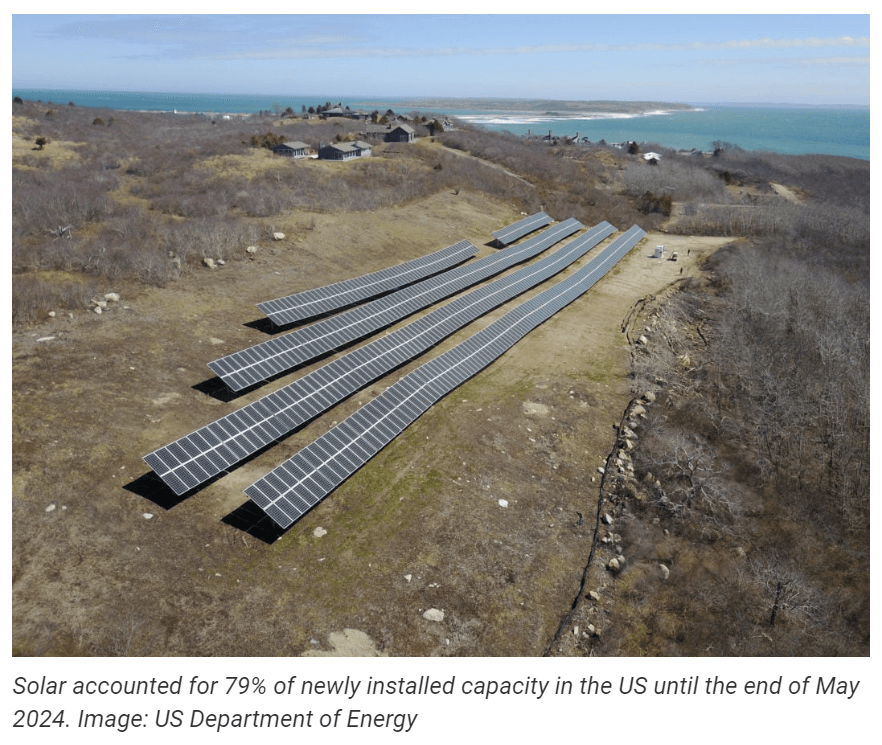
    Solar has become the largest energy source of new capacity in the first five months in the US, while almost 90GW of new solar projects will have a “high probability” of being added to the generation capacity in the next three years.

    According to the Federal Energy Regulatory Commission’s (FERC) Energy Infrastructure Update for May 2024, the US had 251 new solar “units” that became operational from January to May this year, with a combined capacity of 10,669MW. The additions were way ahead of wind, which came second with 13 new “units” and had a total installed capacity of 2,095MW, followed by natural gas (23 units and 348MW of newly installed capacity).

    In the first five months of 2024, the US installed capacity increased by 14,435MW, meaning newly installed solar capacity accounted for about 74% of the total additions.

    In May, 50 new solar projects were placed in service with a combined capacity of 2,517MW, ahead of wind (277MW, two units), hydropower (211MW, two units) and natural gas (184MW, nine units). Solar accounted for 79% of the newly installed capacity in the US that month.

    Year-on-year, installed solar capacity in the US increased by 118% from 4,885MW in the first five months in 2023 to 10,669MW in the same period in 2024.

    PV Tech reported that the US added 4,557MW of solar capacity in the first quarter of 2024, bringing the total installed capacity to over 100GW, according to trade body American Clean Power Association (ACP).

    Para leer más ingrese a:

    https://www.pv-tech.org/ferc-solar-dominates-new-generation-capacity-in-us/
  • Problems Plague BEVs Despite Traditional OEMs Leveling Playing Field with Tesla, J.D. Power Finds

    Problems Plague BEVs Despite Traditional OEMs Leveling Playing Field with Tesla, J.D. Power Finds

     In its inaugural year incorporating franchise dealership repair visits with the Voice of the Customer (VOC) data to create a more expansive metric for problems per 100 vehicles (PP100), the J.D. Power 2024 U.S. Initial Quality StudySM (IQS), released today, the industry average is 195 PP100. Mass market brands, with a combined average of 181 PP100, outperform the industry average. Meanwhile, premium brands—often including more complicated systems and thus more reliance on connectivity—average 232 PP100. A lower score reflects higher vehicle quality.

    “It is not surprising that the introduction of new technology has challenged manufacturers to maintain vehicle quality,” said Frank Hanley, senior director of auto benchmarking at J.D. Power. “However, the industry can take solace in the fact that some problem areas such as voice recognition and parking cameras are seen as less problematic now than they were a year ago.”

    Proponents of battery electric vehicles (BEVs) often state these vehicles should be less problematic and require fewer repairs than gas-powered vehicles since they have fewer parts and systems. However, newly incorporated repair data shows BEVs, as well as plug-in hybrid electric vehicles (PHEVs), require more repairs than gas-powered vehicles in all repair categories. “Owners of cutting edge, tech-filled BEVs and PHEVs are experiencing problems that are of a severity level high enough for them to take their new vehicle into the dealership at a rate three times higher than that of gas-powered vehicle owners,” Hanley said.

    Gas- and diesel-powered vehicles average 180 PP100 this year, while BEVs are 86 points higher at 266 PP100. While there are no notable improvements in BEV quality this year, the gap between Tesla’s BEV quality and that of traditional OEMs’ BEV quality has closed, with both at 266 PP100. In the past, Tesla has performed better, but that is not the case this year and the removal of traditional feature controls, such as turn signals and wiper stalks, has not been well received by Tesla customers.

    Para leer más ingrese a:

    https://www.jdpower.com/business/press-releases/2024-us-initial-quality-study-iqs
  • Data center, crypto operations in 10 states drive all US commercial power sales growth since 2019: EIA

    Data center, crypto operations in 10 states drive all US commercial power sales growth since 2019: EIA

    U.S. commercial sector electricity use grew 1% last year from 2019 levels, but the growth was driven by data center development in 10 states, according to the Energy Information Administration.

    The agency expects electricity sales to the U.S. commercial sector will grow 3% this year and by 1% in 2025, largely driven by the development of large-scale computing facilities such as data centers and cryptocurrency operations, the EIA said in a June 28 report.

    Commercial sector electricity demand in the 10 states with the most demand growth jumped 10%, or by a total of 42 billion kWh, between 2019 and 2023, according to the EIA. Demand in the 40 other states fell 3%, or by 28 billion kWh, in the same period.

    Virginia, Texas, South Carolina and Arizona led the way with the highest commercial sector demand growth while Pennsylvania, New York, Illinois and New Jersey had the largest losses in commercial sales, the EIA said.

    Sales in North Dakota jumped 37% in the four-year period, the most of any state, according to the agency.

    The EIA said it revised its outlook upwards for commercial sales after reviewing information from utilities and grid operators.

    Para leer más ingrese a:

    https://www.utilitydive.com/news/commercial-sector-power-sales-data-center-crypto-eia/721467/
  • Costs down, resilience up. First vehicle-to-grid tariff to save drivers $1,640 per year

    Costs down, resilience up. First vehicle-to-grid tariff to save drivers $1,640 per year

    Octopus Energy, partly owned by Australia’s Origin Energy, has launched the UK’s first vehicle-to-grid tariff, offering free charging for EVs if the customer allows the energy provider to utilise their vehicle’s battery to export electricity back to the grid during peak demand hours.

    The company says the new smart tariff will save EV owners more than £850 ($A1640) a year in charging costs.

    To qualify for the tariff, customers must have their EV plugged into the grid for 170+ hours each month (about 6 hours per day) and stay below the annual usage limit of 333kWh per month, which Octopus says represents about 12,000 miles (19,000 km) of annual driving.

    For reference the average Australian passenger vehicle drives just 11,100km per year.

    Octopus says its smart tariff platform, Kraken uses advanced data and machine learning to enable the new vehicle-to-grid tariff. The company says the platform has been licensed to support over 50 million accounts worldwide, including Origin Energy, which recently increased its holding in Octopus to 23%.

    The new V2G tariff marks a milestone in the transition to clean technology and could be the key to unlocking massive amounts of battery storage, enabling a further acceleration away from fossil fuels.

    Para leer más ingrese a:

    https://thedriven.io/2024/02/16/costs-down-resilience-up-first-vehicle-to-grid-tariff-to-save-drivers-1640-per-year/
  • After Hurricane Beryl, Microgrid-Equipped Grocery Stores and Homes Weathered Outages for More Than a Week in Houston

    After Hurricane Beryl, Microgrid-Equipped Grocery Stores and Homes Weathered Outages for More Than a Week in Houston

    When Hurricane Beryl slammed into Houston on July 8, knocking out power to 2.2 million customers, many grocery stores lacked the power to provide food to customers or keep their products cool. 

    Long lines formed at gas stations – consisting in part of residents who wanted to fuel their generators with gasoline to power their homes. Tree limbs toppled onto  roads and a field hospital was created at a football stadium to meet the needs of people with medical challenges, said Allen Schurr, chief commercial officer of Enchanted Rock, which provides microgrids.

    As of July 15, as many as 200,000 were still without power.

    Texas Gov. Greg Abbott gave the utility company CenterPoint Energy until the end of the month to create a plan for minimizing future outages or be subject to executive orders – which he didn’t detail – to address the outages.

    What is a microgrid?

    Para leer más ingrese a:

    https://www.microgridknowledge.com/microgrids/critical-services/article/55127168/after-hurricane-beryl-microgrid-equipped-grocery-stores-and-homes-weathered-outages-for-more-than-a-week-in-houston
  • Exploring microgrids in the Australian context

    Exploring microgrids in the Australian context

    Intuitively it makes sense that microgrids are a good idea. There are many of us that want that to be the case and for good reason. They have the potential to bolster local resilience, increase utilisation of renewable energy sources and give a sense of autonomy back to communities.

    One of BSGIP’s most substantial pieces of research is drawing to a close. The Southcoast microgrid Reliability Feasibility (SµRF) project is a $3.1 m transdisciplinary project that explores the challenges and benefits of microgrids within an Australian context. Set within the New South Wales south coast shire of Eurobodalla, a region devastated by the 2019-2020 Black Summer, the project took a deep dive into this technology and how it could be integrated into today’s complex and multifaceted energy system.

    This article focuses on two recently published reports; a technical report that lays out a number of scenarios using real-world data applied to selected sites, and a social science report examining governance, social and regulatory issues under the current system.

    But firstly,

    What is a microgrid?

    Para leer más ingrese a:

    https://bsgip.com/news-events/news/exploring-microgirds-in-the-australian-context/

Busca los documentos, noticias y tendencias más relevantes del sector eléctrico

Buscador de documentos
Buscador de noticias y tendencias

Banco de Información

Descripción del semáforo tecnológico

Los documentos se clasifican en varios colores tipo semáforo tecnológico que indican el nivel de implementación de la tecnología en el país

Tecnología en investigación que no ha sido estudiado o reglamentado por entidades del sector.

La tecnología se aplica de manera focal y se encuentra en estudio por parte de las entidades del sector.

La tecnología se aplica de manera escalable y se encuentran políticas y regulaciones focales establecidas.

La tecnología se aplica a través de servicios  y se encuentran políticas y regulaciones transversales establecidas.

La tecnología se aplica de manera generalizada  y se tiene un despliegue masivo de esta.

Para acceder a todos los documentos publicados y descargarlos ingresa aquí