Autor: Luisa Buitrago

  • Solar Marketplace Intel Report

    Solar Marketplace Intel Report

    EnergySage’s eleventh semi-annual Solar Marketplace Intel Report uses data from the EnergySage Solar Marketplace to provide further visibility into the residential solar markets in the United States.

    Additionally, and for the first time, the report also features transaction-level battery storage data including information about consumer preferences, market share, and pricing.

    Para leer más ingrese a:
    https://www.energysage.com/data/

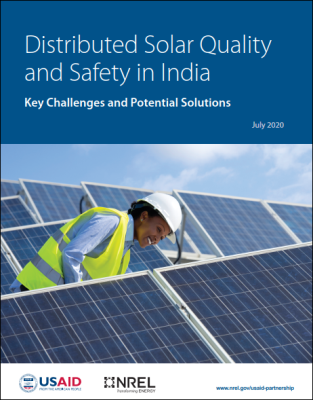
  • Distributed Solar Quality and Safety in India – Key Challenges and Potential Solutions

    Distributed Solar Quality and Safety in India – Key Challenges and Potential Solutions

    In India, the quality and safety of solar photovoltaic (PV)  systems—and their installation—have become a concern for  investors, regulators, consumers, and distribution companies (discoms).

    This report provides solar quality and safety information and best practices that can help increase confidence in RTPV in India, particularly for small-capacity systems, and thus accelerate the growth of that sector. New data stemming from expert interviews and a stakeholder workshop shed light on common quality and safety technical issues at various stages of an RTPV system’s life and potential solutions for addressing them. To achieve the goal of a low-cost system with high energy yield, best practices must be followed at each stage of system life.

    Para leer más ingrese a:

    https://www.nrel.gov/docs/fy20osti/74833.pdf

  • The Automated Mobility District Implementation Catalog: Insights from Ten Early-Stage Deployments

    The Automated Mobility District Implementation Catalog: Insights from Ten Early-Stage Deployments

    Major disruptive technologies are set to redefine the way in which people view travel, particularly in dense urban areas. Already, ride-hailing services have redefined mobility
    expectations of a new generation of urban dwellers in some places around the country. Over the next few decades, the proliferation of automated vehicles1 (AVs), will be enhanced by the next generation of shared mobility.

    This combination of AV operations with on-demand service will provide convenience of mobility similar to that being exhibited in today’s transportation networking companies (TNCs). Shared, automated, public mobility resulting from the cross-hybridization of AVs with on-demand mobility service will bring economic and system efficiencies. Economic efficiencies may be realized by less vehicle ownership and more vehicle “usership.” Many companies are already exploring avenues for shared automated mobility through fleet operations as the wave of the future. 

    Para leer más ingrese a:

    https://search4.nrel.gov/texis/search/redir.html?query=76551&pr=metanrel&prox=page&rorder=750&rprox=1000&rdfreq=0&rwfreq=250&rlead=1000&rdepth=62&sufs=1&order=r&u=https%3A//www.nrel.gov/docs/fy20osti/76551.pdf&m=2&p=0

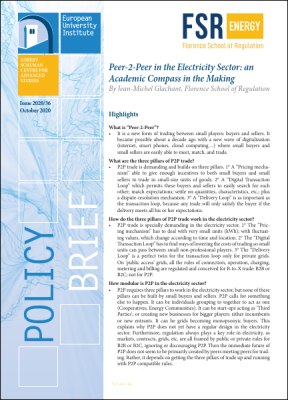
  • Peer-2-peer in the electricity sector : an academic compass in the making

    Peer-2-peer in the electricity sector : an academic compass in the making

    What is “Peer-2-Peer”? It is a new form of trading between small players: buyers and sellers. It became possible about a decade ago with a new wave of digitalization (internet, smart phones, cloud computing…) where small buyers and small sellers are easily able to meet, match, and trade. What are the three pillars of P2P trade? P2P trade is demanding and builds on three pillars. 1° A “Pricing mechanism” able to give enough incentives to both small buyers and small sellers to trade in small-size units of goods. 2° A “Digital Transaction Loop” which permits these buyers and sellers to easily search for each other; match expectations; settle on quantities, characteristics, etc.; plus a dispute-resolution mechanism. 3° A “Delivery Loop” is as important as the transaction loop, because any trade will only satisfy the buyer if the delivery meets all his or her expectations.

    How do the three pillars of P2P trade work in the electricity sector? P2P trade is specially demanding in the electricity sector. 1° The “Pricing mechanism” has to deal with very small units (kWh); with fluctuating values, which change according to time and location. 2° The “Digital Transaction Loop” has to find ways of lowering the costs of trading so small units can pass between small non-professional players. 3° The “Delivery Loop” is a perfect twin for the transaction loop only for private grids. On ‘public access’ grids, all the rules of connection, operation, charging, metering and billing are regulated and conceived for B-to-X trade: B2B or B2C; not for P2P. How modular is P2P in the electricity sector? P2P requires three pillars to work in the electricity sector, but none of these pillars can be built by small buyers and sellers. P2P calls for something else to happen. It can be individuals grouping to together to act as one (Cooperatives, Energy Communities). It can be start-ups acting as ‘Third Parties’; or creating new businesses for bigger players: either incumbents or new entrants. It can be grids becoming monopsonyic buyers. This explains why P2P does not yet have a regular design in the electricity sector. Furthermore, regulation always plays a key role in electricity, as markets, contracts, grids, etc. are all framed by public or private rules for B2B or B2C, ignoring or discouraging P2P. Then the immediate future of P2P does not seem to be primarily created by peers meeting peers for trading. Rather, it depends on getting the three pillars of trade up and running with P2P compatible rules.

    Para leer más ingrese a:

    https://fsr.eui.eu/publications/?handle=1814%2F68542

    https://cadmus.eui.eu/bitstream/handle/1814/68542/PB_2020_36_FSR.pdf?sequence=1

  • The pathway to net zero heating in the UK

    The pathway to net zero heating in the UK

    The UK must make far faster progress on rolling out low-carbon heating across its homes if it is to hit its target of net zero carbon emissions by 2050, energy experts have warned. At current rates, it will take 700 years for the UK to move to low-carbon heating, as over 19,000 of the UK’s 29 million homes need to be upgraded per week to reach the 2050 target, the UK Energy Research Centre (UKERC) has said in a new report.

    However, the government’s current proposals will see only 12,500 homes a year switched to low carbon heating solutions, while the proportion of homes heated by gas in the UK is in fact increasing due to most new build homes being connected to the gas grid, the centre found.

    Para leer más ingrese a:

    https://ukerc.ac.uk/publications/net-zero-heating/

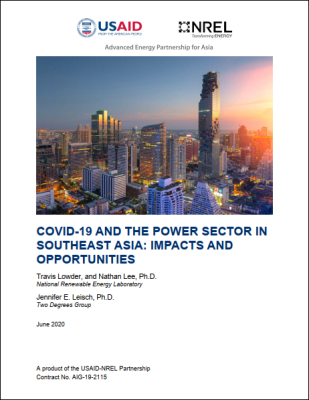
  • COVID-19 and the Power Sector in Southeast Asia: Impacts and Opportunities

    COVID-19 and the Power Sector in Southeast Asia: Impacts and Opportunities

    In just a few months, the coronavirus disease (COVID-19) pandemic has taken a significant toll on populations and economies across the globe. The International Monetary Fund projected that global gross domestic product (GDP) could contract by up to 3% in 2020 as a result of the “Great Lockdown,” or government-mandated closure of businesses, border closures, and stay-at-home orders across the world aimed at preventing greater infection and deaths from COVID-19 (IMF 2020). The World Bank estimate is even higher, at 5.2%. (World Bank 2020a). These lockdowns have helped to reduce the spread of disease; however, the protracted economic inactivity has also resulted in a number of supply demand shocks across the world (World Bank 2020b). 

    In the power sector, these lockdown measures depressed commercial and industrial sector electricity consumption and increased electricity demand in the residential sector, effectively mimicking a Sunday load curve through every day of the week. Overall electricity demand has decreased with some countries reporting up to a 20% drop in consumption during periods of full lockdown. This is demand destruction on a scale not seen over the last 70 years, and it has come with a corresponding dive in  electricity commodity prices (IEA 2020a). Reliable, low-cost energy is essential to the pandemic response and economic recovery.

    Para leer más ingrese a:

    https://www.nrel.gov/docs/fy20osti/76963.pdf

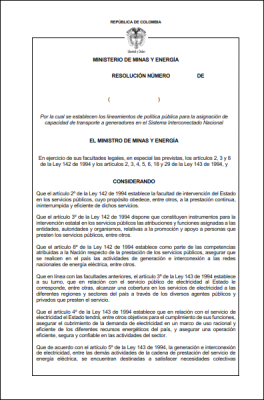
  • Lineamientos política pública asignación capacidad transporte – SIN

    Lineamientos política pública asignación capacidad transporte – SIN

    En cumplimiento de lo señalado en el numeral 8 del artículo 8 de la Ley 1437 de 2011, en concordancia con lo previsto en el inciso 2 del artículo 2.1.2.1.14 del Decreto 1081 de 2015, sustituido por el artículo 1 del Decreto 270 de 2017 y las resoluciones 4 0310 y 4 1304 de 2017, se pública para participación ciudadana el Proyecto de Resolución “Por la cual se establecen los lineamientos de política pública para la asignación de capacidad de transporte a generadores en el Sistema Interconectado Nacional”, con el objeto de recibir observaciones y comentarios.

    Las observaciones, comentarios y propuestas al referido proyecto de resolución deberán realizarse por medio de este foro o  al correo electrónico pciudadana@minenergia.gov.co, hasta el próximo  miércoles 7 de octubre de 2020.

    Para leer más ingrese a:

    https://www.minenergia.gov.co/en/foros?idForo=24239467&idLbl=Listado+de+Foros+de+Octubre+De+2020

    https://www.minenergia.gov.co/documents/10192/24239441/021020_071020_Resoluci%C3%B3n_Lineamientos+pol%C3%ADtica+p%C3%BAblica+asignaci%C3%B3n+de+capacidad+de+transporte+a+generadores+-+SIN.pdf/13c2a0b2-6dc4-458d-863d-a612cd1265a4

  • Reduce: Nuclear

    Reduce: Nuclear

    Today, with 400 GW of installed capacity and about 10% of the world’s electricity mix, nuclear is the first source of low carbon electricity in advanced countries and the second in the world after hydropower. NEA states that by 2040, nuclear capacity is expected to increase by 35% from today’s levels. This translates to a doubling of the current annual rate of capacity additions. Reaching this deployment of nuclear power would require the long-term operation of existing nuclear power plants, new nuclear builds of large Gen-III reactors, and emerging technologies such as SMRs.

    By 2050, the NEA states that nuclear electricity generation can avoid over 2 gigatonnes (Gt) of CO2 per year. In addition, nuclear energy offers unique opportunities to deliver valuable non-electric applications, ranging from district and industrial heat applications, desalination, and large scale hydrogen production that can play a significant role in the circular carbon economy.

    Para leer más ingrese a:

    https://www.cceguide.org/guide/

    https://www.cceguide.org/wp-content/uploads/2020/08/03-NEA-Reduce.pdf

  • Reduce: Energy efficiency

    Reduce: Energy efficiency

    IEA finds that energy efficiency measures alone are projected to contribute 40% of the carbon reductions needed to be in line with the Paris Agreement. The wide range of solutions available provides opportunities for savings in every country’s context. In addition to reducing carbon emissions, energy efficiency is shown to generate multiple benefits across society, the economy, and the environment, including new jobs, improved energy access, improved public health, and more.

    Despite a slowing in global efficiency progress in recent years, decisive, forward-thinking action can help to capture these benefits and create a more resilient, efficient energy system and economy for decades to come. Governments are in the driver’s seat in accelerating this transition, as the primary barrier to progress is not technology, but rather policy design and ambition.

    Para leer más ingrese a:

    https://www.cceguide.org/guide/

    https://www.cceguide.org/wp-content/uploads/2020/08/01-IEA-Reduce.pdf

  • Programs to Promote Zero-Energy New Homes and Buildings

    Programs to Promote Zero-Energy New Homes and Buildings

    As baseline building energy codes become more stringent, and as interest in decarbonizing buildings increases, a growing number of efficiency program administrators are focusing all or a portion of their new-construction programs on zero-energy buildings and zero-energy-ready buildings.

    This paper discusses 20 such programs that together have an annual budget of about $65 million. These programs have collectively completed nearly 200 single-family homes, about 900 multifamily apartments, and 74 commercial buildings (with the commercial space totaling more than two million square feet of floor area). The brief provides information on the structure of these programs and lessons learned to date.

    Para leer más ingrese a:

    https://www.aceee.org/topic-brief/2020/09/programs-promote-zero-energy-new-homes-and-buildings

    https://www.aceee.org/sites/default/files/pdfs/zeb_topic_brief_final_9-29-20.pdf

Busca los documentos, noticias y tendencias más relevantes del sector eléctrico

Buscador de documentos
Buscador de noticias y tendencias

Banco de Información

Descripción del semáforo tecnológico

Los documentos se clasifican en varios colores tipo semáforo tecnológico que indican el nivel de implementación de la tecnología en el país

Tecnología en investigación que no ha sido estudiado o reglamentado por entidades del sector.

La tecnología se aplica de manera focal y se encuentra en estudio por parte de las entidades del sector.

La tecnología se aplica de manera escalable y se encuentran políticas y regulaciones focales establecidas.

La tecnología se aplica a través de servicios  y se encuentran políticas y regulaciones transversales establecidas.

La tecnología se aplica de manera generalizada  y se tiene un despliegue masivo de esta.

Para acceder a todos los documentos publicados y descargarlos ingresa aquí