
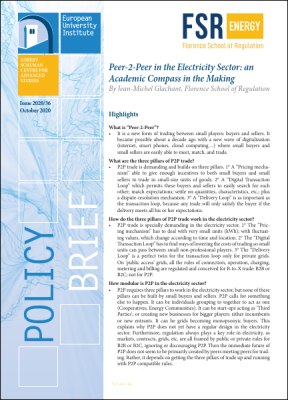
What is “Peer-2-Peer”? It is a new form of trading between small players: buyers and sellers. It became possible about a decade ago with a new wave of digitalization (internet, smart phones, cloud computing…) where small buyers and small sellers are easily able to meet, match, and trade. What are the three pillars of P2P trade? P2P trade is demanding and builds on three pillars. 1° A “Pricing mechanism” able to give enough incentives to both small buyers and small sellers to trade in small-size units of goods. 2° A “Digital Transaction Loop” which permits these buyers and sellers to easily search for each other; match expectations; settle on quantities, characteristics, etc.; plus a dispute-resolution mechanism. 3° A “Delivery Loop” is as important as the transaction loop, because any trade will only satisfy the buyer if the delivery meets all his or her expectations.
How do the three pillars of P2P trade work in the electricity sector? P2P trade is specially demanding in the electricity sector. 1° The “Pricing mechanism” has to deal with very small units (kWh); with fluctuating values, which change according to time and location. 2° The “Digital Transaction Loop” has to find ways of lowering the costs of trading so small units can pass between small non-professional players. 3° The “Delivery Loop” is a perfect twin for the transaction loop only for private grids. On ‘public access’ grids, all the rules of connection, operation, charging, metering and billing are regulated and conceived for B-to-X trade: B2B or B2C; not for P2P. How modular is P2P in the electricity sector? P2P requires three pillars to work in the electricity sector, but none of these pillars can be built by small buyers and sellers. P2P calls for something else to happen. It can be individuals grouping to together to act as one (Cooperatives, Energy Communities). It can be start-ups acting as ‘Third Parties’; or creating new businesses for bigger players: either incumbents or new entrants. It can be grids becoming monopsonyic buyers. This explains why P2P does not yet have a regular design in the electricity sector. Furthermore, regulation always plays a key role in electricity, as markets, contracts, grids, etc. are all framed by public or private rules for B2B or B2C, ignoring or discouraging P2P. Then the immediate future of P2P does not seem to be primarily created by peers meeting peers for trading. Rather, it depends on getting the three pillars of trade up and running with P2P compatible rules.
Para leer más ingrese a:
https://fsr.eui.eu/publications/?handle=1814%2F68542
https://cadmus.eui.eu/bitstream/handle/1814/68542/PB_2020_36_FSR.pdf?sequence=1
Compartir artículo
Para información general sobre la organización: difusion@colombiainteligente.org | Dirección: Edf. TecnoParque Cr 46#56-11 Piso 13 | Medellín – Colombia
Teléfono: +57-4-4441211 Ext. 171 | FAX: +57-4-4440460

Los documentos se clasifican en varios colores tipo semáforo tecnológico que indican el nivel de implementación de la tecnología en el país
Tecnología en investigación que no ha sido estudiado o reglamentado por entidades del sector.
La tecnología se aplica de manera focal y se encuentra en estudio por parte de las entidades del sector.
La tecnología se aplica de manera escalable y se encuentran políticas y regulaciones focales establecidas.
La tecnología se aplica a través de servicios y se encuentran políticas y regulaciones transversales establecidas.
La tecnología se aplica de manera generalizada y se tiene un despliegue masivo de esta.
Para acceder a todos los documentos publicados y descargarlos ingresa aquí