Autor: DIFUSIÓN COLOMBIA INTELIGENTE

  • OECD Economic Surveys: Greece 2023

    OECD Economic Surveys: Greece 2023

    recia se ha recuperado bien de la crisis de COVID-19, generando un fuerte crecimiento del empleo. El aumento de la inversión y las exportaciones, las medidas de apoyo del gobierno, la implementación del Paquete de Recuperación y Resiliencia de Grecia 2.0 y las reformas de la última década han estado apoyando la economía. Sin embargo, los vientos en contra de los aumento de los precios de la energía y la incertidumbre tras la guerra de agresión de Rusia contra Ucrania han ralentizado la recuperación. Lograr y mantener modestos superávits presupuestarios primarios, orientar mejor las medidas de apoyo energético y mantener los ingresos públicos, al tiempo que se amplía aún más la base impositiva y mejora su eficiencia mejorará aún más las perspectivas de Grecia de lograr una calificación de deuda soberana de inversión. 

    Mantener el impulso de la reforma, completar la restauración de la salud de los bancos y continuar los esfuerzos para mejorar el clima empresarial, puede garantizar que la recuperación sostenible continúe a largo plazo. Ayudaría a Grecia a elevar aún más los niveles de vida a medida que se ajusta a un clima cambiante y logra cero emisiones netas. Como en otros lugares, el cambio climático ya está alterando los medios de vida y el bienestar en Grecia. Una combinación bien elegida de precios de carbono, inversiones en infraestructura pública, aumento de la eficiencia energética de los edificios y el traslado del transporte a modos de bajas emisiones puede lograr recortes de emisiones de manera rentable, al tiempo que mejora a las personas con una mejor calidad de la vivienda y la movilidad. Involucrar a todas las partes interesadas, mantener un consenso y apoyar a los hogares vulnerables afectados por la transición de la economía verde ayudará a garantizar que el progreso continúe a largo plazo. 


    El informe consta de 2 secciones en las cuales se habla de los objetivos que tiene Grecia por alcanzar, la hoja de ruta trazada para llegar a ellos, los obstáculos que permiten agilizar el proceso y especifica los contribuyentes importantes que necesita que se unan a la causa para lograr alcanzar todos los objetivos propuestos. 

    Para leer más ingrese a:

    https://www.oecd-ilibrary.org/economics/oecd-economic-surveys-greece-2023_c5f11cd5-en  

    https://www.oecd-ilibrary.org/deliver?redirecturl=http%3A%2F%2Fwww.keepeek.com%2FDigital-Asset-Management%2Foecd%2Feconomics%2Foecd-economic-surveys-greece-2023_c5f11cd5-en&isPreview=true&itemId=%2Fcontent%2Fpublication%2Fc5f11cd5-en  

  • Global Risks Report 2023

    Global Risks Report 2023

    A principios de 2023, el mundo se enfrenta a una serie de riesgos que parecen a la vez totalmente nuevos e inquietantemente familiares. Hemos asistido al retorno de riesgos «antiguos» -inflación, crisis del coste de la vida, guerras comerciales, salidas de capitales de los mercados emergentes, malestar social generalizado, confrontación geopolítica y el espectro de la guerra nuclear- que pocos de los líderes empresariales y responsables de las políticas públicas de esta generación han experimentado. Todo ello se ve amplificado por la evolución relativamente reciente del panorama mundial de los riesgos, que incluye niveles insostenibles de deuda, una nueva era de bajo crecimiento, escasa inversión mundial y desglobalización, un declive de la productividad humana y un aumento del desempleo. 


    Se utilizan tres marcos temporales para comprender los riesgos mundiales. El Capítulo 1 considera el creciente impacto de las crisis actuales (es decir, los riesgos globales que ya se están desarrollando) sobre los riesgos globales más graves que muchos esperan que se desarrollen a corto plazo (dos años). El Capítulo 2 examina una selección de riesgos que probablemente serán más graves a largo plazo (10 años), explorando los riesgos económicos, medioambientales, sociales, geopolíticos y tecnológicos de reciente aparición o en rápida aceleración que podrían convertirse en los riesgos del mañana. 

    El Capítulo 3 imagina futuros a medio plazo, explorando cómo las conexiones entre los riesgos emergentes esbozados en las secciones anteriores pueden evolucionar colectivamente hacia una «policrisis» centrada en la escasez de recursos naturales para 2030. El informe concluye examinando las percepciones sobre el estado comparativo de preparación ante estos riesgos y destacando los elementos facilitadores para trazar el rumbo hacia un mundo más resiliente 

    Para leer más ingrese a:

    https://www.weforum.org/reports/global-risks-report-2023/  

    https://www3.weforum.org/docs/WEF_Global_Risks_Report_2023.pdf  

  • 23 intriguing microgrid projects to watch in 2023

    23 intriguing microgrid projects to watch in 2023

    This is more than a microgrid project. You might say Sunnova is offering up a new microgrid ecosystem – one with fewer obstructions to microgrid development. It’s not always easy to develop community microgrids because they clash with the conventional utility model. So Sunnova has proposed a new approach — microutilities that would operate microgrids in newly built California neighborhoods of fewer than 2,000 customers. The plan requires state regulatory approval. Whether or not that happens, Sunnova has put forward an innovative model that could spur new ways of thinking about the utility/microgrid relationship.

    Like Sunnova, Cuyahoga County, Ohio, sees outdated utility rules getting in the way of microgrid development, so it is bypassing its local utility and creating its own microgrid-friendly utility. The county utility will oversee multiple microgrids built to encourage economic activity and improve energy resilience. Cuyahoga County made last year’s list of microgrid projects to watch too. At the time, we said it would take some time for this project to be realized because of its complexity. County officials, however, are moving forward diligently with a plan to make the county a national microgrid industry hub.

    Para leer más ingrese a:

    https://www.microgridknowledge.com/microgrids/article/21452302/23-intriguing-microgrid-projects-to-watch-in-2023

  • Emerging risks for the planet and its people: What leaders must know now

    Emerging risks for the planet and its people: What leaders must know now

    Soon, leaders from around the globe will gather in Davos to address the state of our planet and the long list of pressing challenges it faces. The theme of this year’s World Economic Forum annual meeting, «Cooperation in a Fragmented World,» is a clarion call for government, business, and civil society leaders at this critical time.

    With the whole world now teetering on edge, bold action is needed more than ever. In the past year, the pandemic persisted, the climate crisis deepened, war erupted in Europe, and high inflation returned, creating storm clouds over the global economy.

    https://www.weforum.org/agenda/2023/01/axa-future-risks-report-davos23/

  • What will it take to scale Sustainable Aviation Fuel in the next decade?

    What will it take to scale Sustainable Aviation Fuel in the next decade?

    Air travel connects the world, linking people, culture, and ultimately enabling global economies to prosper. The aviation industry recognises that it must continue to deliver these benefits while reducing environmental impacts, and the sector has committed to net zero carbon emissions by 2050 or earlier. How can we achieve these ambitious, but crucial, goals? The good news is that if aviation sustainability follows the same trajectory as wind and solar, the industry can achieve these goals—however, much work and investment remains.

    Sustainable Aviation Fuel (SAF) is an immediate and scalable solution to decarbonising the industry. As a quick primer, SAF is a mix of hydrocarbons that is chemically similar to conventional jet fuel but not derived from fossil fuels. SAF instead relies on carbon atoms from organic and waste materials known as feedstocks. These include waste oils, algae, forest residues, municipal solid waste, and industrial gasses, as well as atmospheric CO2. By utilising carbon that exists in or would have otherwise been emitted into the atmosphere, SAF can lower CO2 emissions from aviation by up to 100% compared to conventional jet fuel.

    https://www.weforum.org/agenda/2023/01/scale-sustainable-aviation-fuel-in-the-next-decade-davos23/

  • Here are 4 ways transition finance can pave the road to decarbonization

    Here are 4 ways transition finance can pave the road to decarbonization

    Can we break new ground accelerating the energy transition? Can the public and private sectors help depoliticize the issue, move beyond talk, and coalesce around concrete action? I would argue that the answers are a resounding “yes”. A critical path forward to achieve these goals is through transition finance.

    Transition finance – new solutions to fund the energy transition to help remediate climate change – is something that all stakeholders can get behind. Done correctly, transition finance can potentially: a) enable a true shift toward decarbonization; b) enable the private sector to generate sufficient returns; c) support the public sector, which cannot fund this effort alone; and d) embrace, rather than ostracize, carbon-heavy industries and economies. In the case of the latter, this allows current high-emitters to participate and share much-needed institutional knowledge while decarbonizing their businesses and promoting economic growth and employment during the period of the transition. Let us examine each of those points in turn.

    https://www.weforum.org/agenda/2023/01/davos23-transition-finance-decarbonization/

  • Schneider Electric and BitSight announce partnership to improve detection of OT-cybersecurity exposure

    Schneider Electric and BitSight announce partnership to improve detection of OT-cybersecurity exposure

    Schneider Electric and BitSight announced a strategic partnership to develop an OT risk-identification and threat-intelligence capability. The partners note how this move furthers their commitment to improve the security and resilience of their communities by detecting OT protocols exposed over the internet and contextualizing them with improved attribution.  

    Through a joint effort, Schneider Electric will fuse its knowledge of OT protocols and systems with BitSight’s exposure-detection and management capabilities in order to generate the critical insights necessary for proactive security monitoring of externally observable risks to the OT community. The goal of this collaboration is to strengthen industrial security and provide more visibility into Industrial infrastructure and industrial control system (ICS) devices that may be at risk from a cyber-breach, they note. 

    https://www.smartindustry.com/benefits-of-transformation/cybersecurity/news/21529158/schneider-electric-and-bitsight-announce-partnership-to-improve-detection-of-ot-cybersecurity-exposure

  • Product News: Software component Locator from Bosch Rexroth

    Product News: Software component Locator from Bosch Rexroth

    With Bosch Rexroth’s ROKIT Locator software, mobile robots can independently determine their position, notes its maker, heralding the launch of this new offering. Locator enables mobile robots to determine their position and orientation in any environment, simplifying the automation of intralogistics tasks in industry and trade, they add, noting that Locator is compatible with various industrial controllers and laser sensors on the market and is suitable for mobile units of all sizes and drive types.

    With Locator, the process of introducing autonomous guided vehicles can be replaced with quick and easy commissioning, without requiring additional expert knowledge, claims Bosch. Locator enables the robots to evaluate the signals from a laser sensor in the vehicle and convert them into coordinates in space. No permanently installed aids, such as markers or reflectors, are required for orientation and position determination. Users only need one click to start up the system and familiarize the unit with its surroundings in a one-time orientation trip.

    https://www.smartindustry.com/tools-of-transformation/robotics/news/21527779/product-news-software-component-locator-from-bosch-rexroth

  • Hydrogen patents indicate shift towards clean technologies such as electrolysis, according to new joint study by IEA and EPO

    Hydrogen patents indicate shift towards clean technologies such as electrolysis, according to new joint study by IEA and EPO

    Technologies motivated by climate change concerns accounted for nearly 80% of all patents related to hydrogen production in 2020, new analysis shows

    Hydrogen technology development is shifting towards low-emissions solutions such as electrolysis, according to a joint study of patents by the European Patent Office (EPO) and the International Energy Agency (IEA). The report is the first of its kind and uses global patent data to provide comprehensive up-to-date analysis of innovation in all hydrogen technologies. It covers the full range of technologies, from hydrogen supply to storage, distribution and transformation, as well as end-use applications.

    https://www.iea.org/news/hydrogen-patents-indicate-shift-towards-clean-technologies-such-as-electrolysis-according-to-new-joint-study-by-iea-and-epo

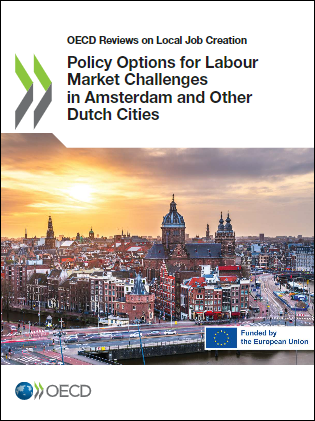
  • Policy Options for Labour Market Challenges in Amsterdam and Other Dutch Cities

    Policy Options for Labour Market Challenges in Amsterdam and Other Dutch Cities

    Los mercados laborales de los Países Bajos se recuperaron rápidamente de la conmoción de COVID-19 y las ciudades holandesas se enfrentan ahora a un nivel sin precedentes de estanqueidad del mercado laboral. La alta demanda de trabajadores presenta una oportunidad única para que los municipios holandeses encuentren vías de empleo para aquellos con el menor apego al mercado laboral y aliviar la presión a la que se enfrentan los empleadores locales que luchan por encontrar trabajadores adecuados. 

    Apoyar a la población diversa de las ciudades holandesas para que se adhieran al mercado laboral requiere el uso eficiente de los instrumentos existentes del mercado laboral, el avance de métodos innovadores de adecuación de empleo basada en habilidades y la mejora de la cooperación entre las instituciones nacionales, regionales y locales del mercado laboral. Este informe de la OCDE analiza los cuellos de botella actuales y futuros que podrían obstaculizar la prestación efectiva de servicios del mercado laboral local. Destaca las opciones políticas para fortalecer la capacidad de los municipios para apoyar a los diferentes grupos de población en la transición de los beneficiarios del bienestar social a los trabajadores. 

    https://www.oecd-ilibrary.org/employment/policy-options-for-labour-market-challenges-in-amsterdam-and-other-dutch-cities_181c0fff-en  

    https://www.oecd-ilibrary.org/docserver/181c0fff-en.pdf?expires=1673301855&id=id&accname=guest&checksum=86B3E3EDDF3F7B251EADCC9F14BEBDCB  


Busca los documentos, noticias y tendencias más relevantes del sector eléctrico

Buscador de documentos
Buscador de noticias y tendencias

Banco de Información

Descripción del semáforo tecnológico

Los documentos se clasifican en varios colores tipo semáforo tecnológico que indican el nivel de implementación de la tecnología en el país

Tecnología en investigación que no ha sido estudiado o reglamentado por entidades del sector.

La tecnología se aplica de manera focal y se encuentra en estudio por parte de las entidades del sector.

La tecnología se aplica de manera escalable y se encuentran políticas y regulaciones focales establecidas.

La tecnología se aplica a través de servicios  y se encuentran políticas y regulaciones transversales establecidas.

La tecnología se aplica de manera generalizada  y se tiene un despliegue masivo de esta.

Para acceder a todos los documentos publicados y descargarlos ingresa aquí