
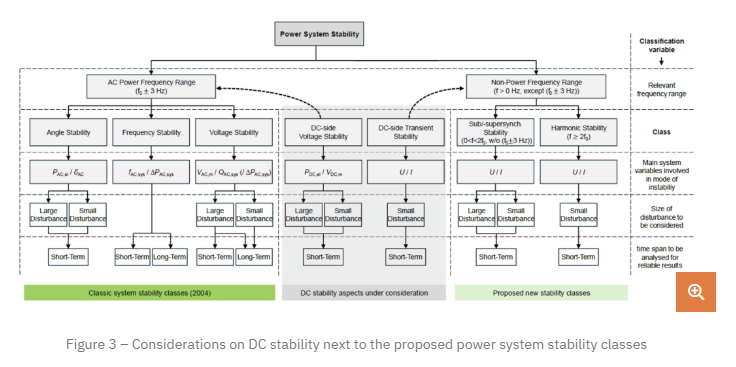
The well-established system stability classes “Rotor Angle Stability”, “Voltage Stability” and “Frequency Stability” stand in contrast to the recently proposed classes “Resonance Stability” and “Converter-driven Stability”. The proposed classes are highly ambiguous, do not contribute to a common understanding of the phenomena in industry and academia and more importantly, they do not provide a solid basis for model simplification and stability phenomena reproduction and mitigation. This paper revisits the classification of power system stability categories and proposes an appropriate classification scheme to account for actual and future converter dominated power grids. To achieve this, the original considerations for classification are retained and two new classes “Sub-/Supersynchronous Stability” and “Harmonic stability” are established based on additional categorisation variables considering the range of possible frequency components and appropriate assumptions for model simplifications. The result is a suitable Classification of Power System Stability Phenomena offering a broad overview of power system stability and allowing suitable model simplifications for detailed studies.
For this purpose and to promote common understanding, a clear and unambiguous definition of important technical terms is introduced, including (non)-oscillatory (in)stability, damping, resonances, attenuation, amplification, passivity, harmonics, transient interactions, sub- and supersynchronous oscillations and power oscillations.
Para leer más ingrese a:
https://cse.cigre.org/cse-n037/suitable-classification-of-power-system-stability-phenomena.htmlCompartir artículo
Para información general sobre la organización: difusion@colombiainteligente.org | Dirección: Edf. TecnoParque Cr 46#56-11 Piso 13 | Medellín – Colombia
Teléfono: +57-4-4441211 Ext. 171 | FAX: +57-4-4440460
Los documentos se clasifican en varios colores tipo semáforo tecnológico que indican el nivel de implementación de la tecnología en el país
Tecnología en investigación que no ha sido estudiado o reglamentado por entidades del sector.
La tecnología se aplica de manera focal y se encuentra en estudio por parte de las entidades del sector.
La tecnología se aplica de manera escalable y se encuentran políticas y regulaciones focales establecidas.
La tecnología se aplica a través de servicios y se encuentran políticas y regulaciones transversales establecidas.
La tecnología se aplica de manera generalizada y se tiene un despliegue masivo de esta.
Para acceder a todos los documentos publicados y descargarlos ingresa aquí