
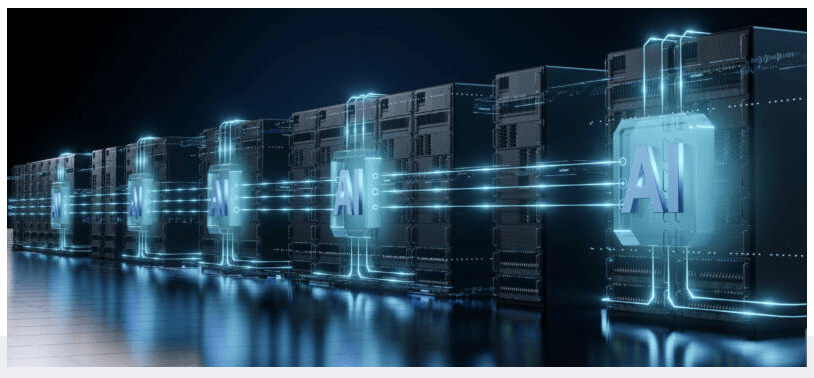
In leading the MCSC’s work on Data & Computing, Noman Bashir has been exploring effective decarbonization strategies in this space, with an emphasis on generative artificial intelligence (Gen-AI) – a large-scale technology-induced shift that is rapidly expanding. While the perceived advantages of Gen-AI are vast, neglecting to consider the negative effects alongside these potential benefits can lead to uncontrolled growth with lasting consequences on the environment. When exploring some of the key drivers of this growth, why sustainability considerations for Gen-AI are lacking, and how ignoring the potential costs could lead to negative social and environmental impacts, data centers are central to the conversation.
With the rapid growth of Gen-AI, data centers’ energy demands are increasing. The quality of Gen-AI algorithms correlates with the size of required computing systems, necessitating a larger number or more powerful sets of computers for more sophisticated data sets and models. Because of this pressure, there are both rising power demands on existing data centers and the need to build new ones. Some organizations, AI giants in particular, are deploying more data centers and computing infrastructure than ever before.
“Our capacity to build sustainably cannot keep pace with the data center construction necessary to support Gen-AI, and the global electricity consumption of data centers is expected to continue to rise,” explained Noman, whose research focuses on designing, prototyping, and analyzing experimental computer systems that enable decarbonizing societal-scale systems, such as computing systems, electric grids, buildings, and transportation.
Para leer más ingrese a:
https://impactclimate.mit.edu/2025/03/20/investigating-the-ecological-impacts-of-data-centers/
Compartir artículo
Para información general sobre la organización: difusion@colombiainteligente.org | Dirección: Edf. TecnoParque Cr 46#56-11 Piso 13 | Medellín – Colombia
Teléfono: +57-4-4441211 Ext. 171 | FAX: +57-4-4440460

Los documentos se clasifican en varios colores tipo semáforo tecnológico que indican el nivel de implementación de la tecnología en el país
Tecnología en investigación que no ha sido estudiado o reglamentado por entidades del sector.
La tecnología se aplica de manera focal y se encuentra en estudio por parte de las entidades del sector.
La tecnología se aplica de manera escalable y se encuentran políticas y regulaciones focales establecidas.
La tecnología se aplica a través de servicios y se encuentran políticas y regulaciones transversales establecidas.
La tecnología se aplica de manera generalizada y se tiene un despliegue masivo de esta.
Para acceder a todos los documentos publicados y descargarlos ingresa aquí