
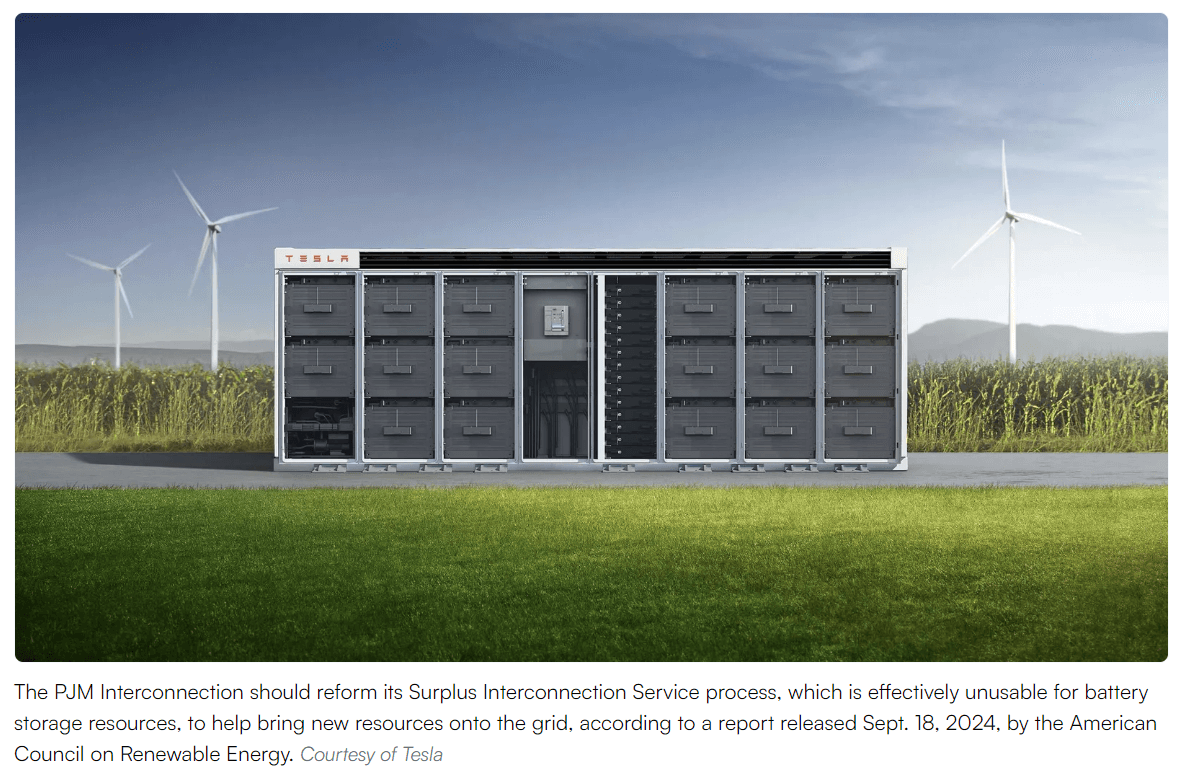
The PJM Interconnection should reform its rarely used Surplus Interconnection Service process — a fast-track pathway for adding capacity to its system — which is effectively unusable for battery storage resources, according to a report from the American Council on Renewable Energy.
SIS allows a new resource to use any unused portion of an existing generating facility’s interconnection service as long as the total amount of interconnection service at the point of interconnection remains the same.
Under the SIS process, projects that don’t trigger transmission system upgrades qualify for expedited review outside the interconnection queue, Michael Borgatti, the report’s co-author, said Wednesday during a webinar. Borgatti is senior vice president of RTO services and regulatory affairs at Gabel Associates.
The SIS review process takes about 270 days to complete. If the rules were changed, it could unlock significant capacity in PJM, which faces capacity shortfalls later this decade, Borgatti said. Battery storage projects can be built in roughly two years, making them an attractive option for meeting PJM’s near-term capacity needs, he said.
PJM’s forecast resource mix for the 2026/27 delivery year includes about 9.7 GW of nameplate capacity from fixed and tracking solar resources, according to the report. Given those resources’ low “effective load carrying capability” values — 8% for fixed solar and 13% for tracking solar — their accredited capacity is 1.9 GW, leaving about 7.8 GW potential available capacity at their interconnection points, Gabel estimated.
Para leer más ingrese a:
Compartir artículo
Para información general sobre la organización: difusion@colombiainteligente.org | Dirección: Edf. TecnoParque Cr 46#56-11 Piso 13 | Medellín – Colombia
Teléfono: +57-4-4441211 Ext. 171 | FAX: +57-4-4440460

Los documentos se clasifican en varios colores tipo semáforo tecnológico que indican el nivel de implementación de la tecnología en el país
Tecnología en investigación que no ha sido estudiado o reglamentado por entidades del sector.
La tecnología se aplica de manera focal y se encuentra en estudio por parte de las entidades del sector.
La tecnología se aplica de manera escalable y se encuentran políticas y regulaciones focales establecidas.
La tecnología se aplica a través de servicios y se encuentran políticas y regulaciones transversales establecidas.
La tecnología se aplica de manera generalizada y se tiene un despliegue masivo de esta.
Para acceder a todos los documentos publicados y descargarlos ingresa aquí