
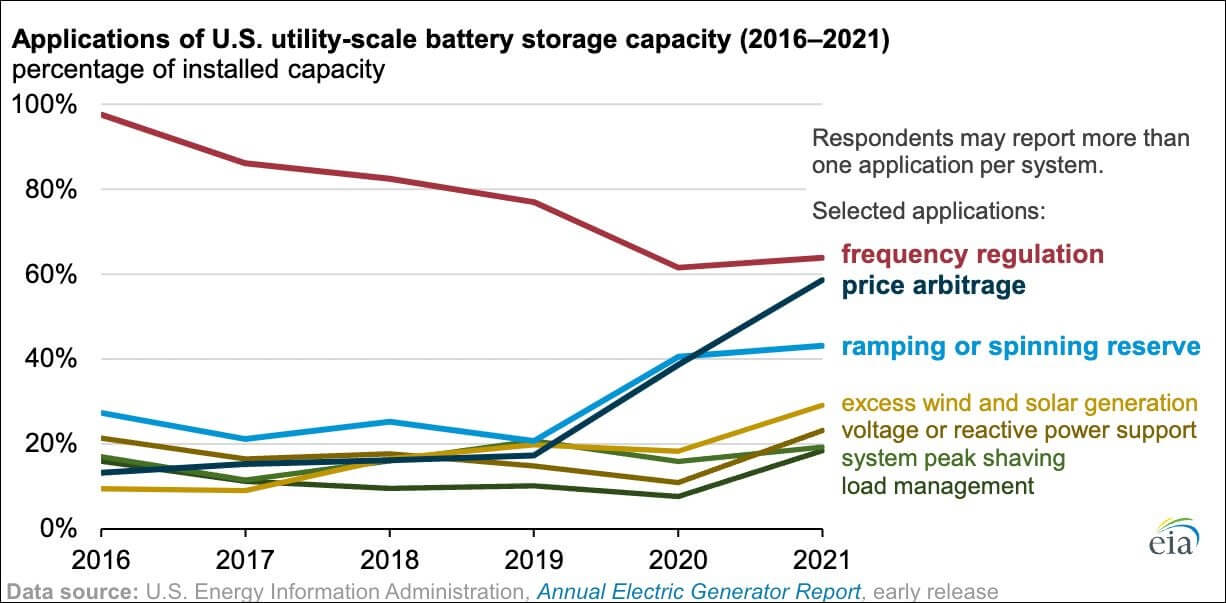
Among the many uses for battery storage systems is price arbitrage. Basically, this means storing electricity when prices are low and discharging it when prices are high. Data from the US Energy Information Administration indicates that the proportion of US utility scale battery storage being used for price arbitrage has increased dramatically in recent years. Back in 2019, only 17 per cent of US utility scale battery capacity was used for price arbitrage, but this had soared to 59 per cent in 2021. In California alone, more than 80 per cent of the state’s total capacity of 2,339 MW of battery storage in 2021 was used for arbitrage.
As S&P has highlighted, battery storage arbitrage maximises its potential “when it can charge from $0/MWh prices set by renewable resources on the margin and discharge when expensive gas, coal or oil are setting the price”. Unsurprisingly, 93 per cent of new battery storage in 2021 in the US was co-located with a renewable energy resources in order for it to be charged directly from a zero-cost resource. “Areas with high solar penetration like California will increasingly see a ‘duck curve’ in day-ahead hourly prices where daytime prices drop and evening prices increase, creating the belly and head of the duck, respectively,” S&P has said. “Battery storage can lessen this impact by generating in those peak net demand hours.”
Para leer más ingrese a:
Compartir artículo
Para información general sobre la organización: difusion@colombiainteligente.org | Dirección: Edf. TecnoParque Cr 46#56-11 Piso 13 | Medellín – Colombia
Teléfono: +57-4-4441211 Ext. 171 | FAX: +57-4-4440460

Los documentos se clasifican en varios colores tipo semáforo tecnológico que indican el nivel de implementación de la tecnología en el país
Tecnología en investigación que no ha sido estudiado o reglamentado por entidades del sector.
La tecnología se aplica de manera focal y se encuentra en estudio por parte de las entidades del sector.
La tecnología se aplica de manera escalable y se encuentran políticas y regulaciones focales establecidas.
La tecnología se aplica a través de servicios y se encuentran políticas y regulaciones transversales establecidas.
La tecnología se aplica de manera generalizada y se tiene un despliegue masivo de esta.
Para acceder a todos los documentos publicados y descargarlos ingresa aquí