
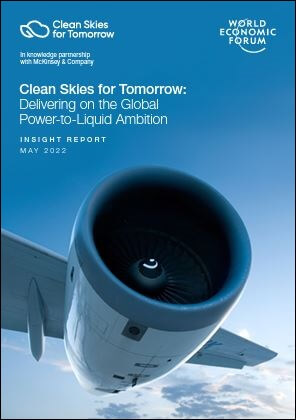
La reducción de las emisiones de carbono proporcionará enormes beneficios económicos y sanitarios en todas las industrias y sociedades, mejorará la sostenibilidad y ayudará a mantener el planeta habitable para las generaciones futuras. La industria de la aviación debe desempeñar un papel importante en este esfuerzo, por lo que el Foro Económico Mundial lanzó la iniciativa Cielos Limpios para el Mañana (CST) en 2019. La asociación público-privada CST está trabajando estrechamente con las partes interesadas de la industria, el gobierno y la sociedad civil para ayudar a la industria de la aviación a hacer la transición a las emisiones netas cero para 2050 utilizando combustibles de aviación sostenibles (SAF) y otras tecnologías de propulsión limpias.
fuels are already in use and progress is under way. Europe has released its Fit for 55 and ReFuelEU package to mandate the use of SAF, and the US launched the Sustainable Aviation Fuel Grand Challenge, which aims to fully decarbonize aviation by 2050. The Clean Skies for Tomorrow initiative, with support from the Mission Possible Partnership, has brought together almost 100 organizations – including leading airlines, airports, fuel suppliers, aircraft manufacturers, frequent Robin Riedel Partner, McKinsey & Company corporate flyers and freight forwarders – which have committed to accelerating the use of SAF to meet 10% of global aviation fuel demand by 2030 and reach the net-zero goal by 2050.
Para leer más ingrese a:
https://www3.weforum.org/docs/WEF_Clean_Skies_for_Tomorrow_Power_to_Liquid_Deep_Dive_2022.pdf
Compartir artículo
Para información general sobre la organización: difusion@colombiainteligente.org | Dirección: Edf. TecnoParque Cr 46#56-11 Piso 13 | Medellín – Colombia
Teléfono: +57-4-4441211 Ext. 171 | FAX: +57-4-4440460

Los documentos se clasifican en varios colores tipo semáforo tecnológico que indican el nivel de implementación de la tecnología en el país
Tecnología en investigación que no ha sido estudiado o reglamentado por entidades del sector.
La tecnología se aplica de manera focal y se encuentra en estudio por parte de las entidades del sector.
La tecnología se aplica de manera escalable y se encuentran políticas y regulaciones focales establecidas.
La tecnología se aplica a través de servicios y se encuentran políticas y regulaciones transversales establecidas.
La tecnología se aplica de manera generalizada y se tiene un despliegue masivo de esta.
Para acceder a todos los documentos publicados y descargarlos ingresa aquí