
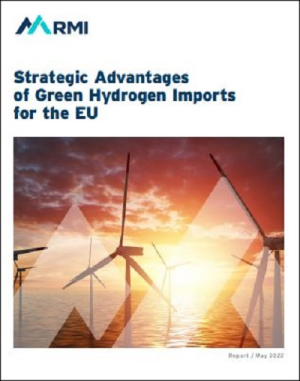
El hidrógeno verde importado producido a partir de energías renovables -y el amoníaco verde fabricado con él- son cruciales para que la industria europea elimine su dependencia del gas natural ruso. Las importaciones de estos combustibles de energía limpia ya son competitivas en cuanto a costes y pueden sustituir a la mayoría de los combustibles fósiles utilizados por la industria pesada y el transporte en la UE en un plazo de ocho años.
Costs and time lines for green hydrogen projects are now more competitive than for blue hydrogen projects, and considering natural gas futures and EU carbon allowance futures, importing green hydrogen will be cheaper than producing gray or blue hydrogen in the EU by the time capacity comes on line in 2024. A green fuel pathway can be created quickly if policymakers coordinate across Europe, offering straightforward incentives for infrastructure development and the adoption of a hydrogen certification system to incentivize investment in low-carbon energy. Developing ammonia made from renewablesbased hydrogen (“green ammonia”) would allow Europe to build upon a well-established supply chain of shipping ammonia. Industrial demand centers in Northern Europe are preparing to receive green ammonia and distribute it directly to the fertilizer sector and use it as green bunker fuel for ships. Additional green ammonia supply can be cracked back into hydrogen to meet demand at petrochemical facilities, steel manufacturers, and other use cases.
Para mayor información ingrese a:
https://rmi.org/insight/strategic-advantages-of-green-hydrogen-imports-for-the-eu/#download-form
https://rmi.org/insight/strategic-advantages-of-green-hydrogen-imports-for-the-eu/
Compartir artículo
Para información general sobre la organización: difusion@colombiainteligente.org | Dirección: Edf. TecnoParque Cr 46#56-11 Piso 13 | Medellín – Colombia
Teléfono: +57-4-4441211 Ext. 171 | FAX: +57-4-4440460

Los documentos se clasifican en varios colores tipo semáforo tecnológico que indican el nivel de implementación de la tecnología en el país
Tecnología en investigación que no ha sido estudiado o reglamentado por entidades del sector.
La tecnología se aplica de manera focal y se encuentra en estudio por parte de las entidades del sector.
La tecnología se aplica de manera escalable y se encuentran políticas y regulaciones focales establecidas.
La tecnología se aplica a través de servicios y se encuentran políticas y regulaciones transversales establecidas.
La tecnología se aplica de manera generalizada y se tiene un despliegue masivo de esta.
Para acceder a todos los documentos publicados y descargarlos ingresa aquí