
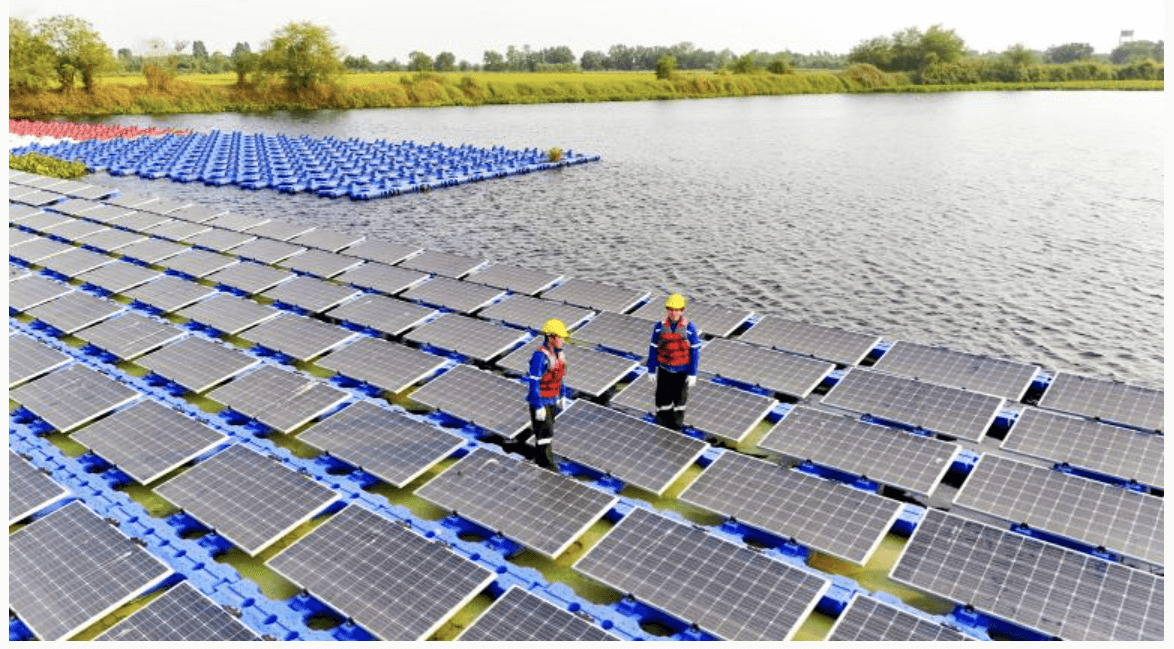
Floating solar photovoltaic (FPV) panels – sometimes called floatovoltaics – is a relatively new renewable energy option, but one with huge potential. According to the IEA, in 2023, solar PV alone accounted for three-quarters of renewable capacity additions worldwide. Yet most of the solar panels installed so far lie on land, which pose crucial issues for land use particularly in countries where land is at a premium. This includes island states, for instance, but also countries with high population density where land is a constraint.
It’s one of the reasons why the deployment of solar technologies which float on water are predicted to increase rapidly over the next few years. “With 70% of the world covered with water, research and development of FPV on ocean platforms opens a new era of solar energy with the advancement of robust floating structures,” an international research team states in a review of the field published in April.
The scientists conclude that FPV systems outperform land-based solar PV systems under similar conditions but warn that offshore weather and harsh ocean currents may pose serious challenges to FPV structures. “Therefore, research and development efforts addressing this issue are crucial,” they say.
Para leer más ingrese a:
https://etech.iec.ch/issue/2024-05/the-bright-future-for-floating-solar-tech
Compartir artículo
Para información general sobre la organización: difusion@colombiainteligente.org | Dirección: Edf. TecnoParque Cr 46#56-11 Piso 13 | Medellín – Colombia
Teléfono: +57-4-4441211 Ext. 171 | FAX: +57-4-4440460

Los documentos se clasifican en varios colores tipo semáforo tecnológico que indican el nivel de implementación de la tecnología en el país
Tecnología en investigación que no ha sido estudiado o reglamentado por entidades del sector.
La tecnología se aplica de manera focal y se encuentra en estudio por parte de las entidades del sector.
La tecnología se aplica de manera escalable y se encuentran políticas y regulaciones focales establecidas.
La tecnología se aplica a través de servicios y se encuentran políticas y regulaciones transversales establecidas.
La tecnología se aplica de manera generalizada y se tiene un despliegue masivo de esta.
Para acceder a todos los documentos publicados y descargarlos ingresa aquí